
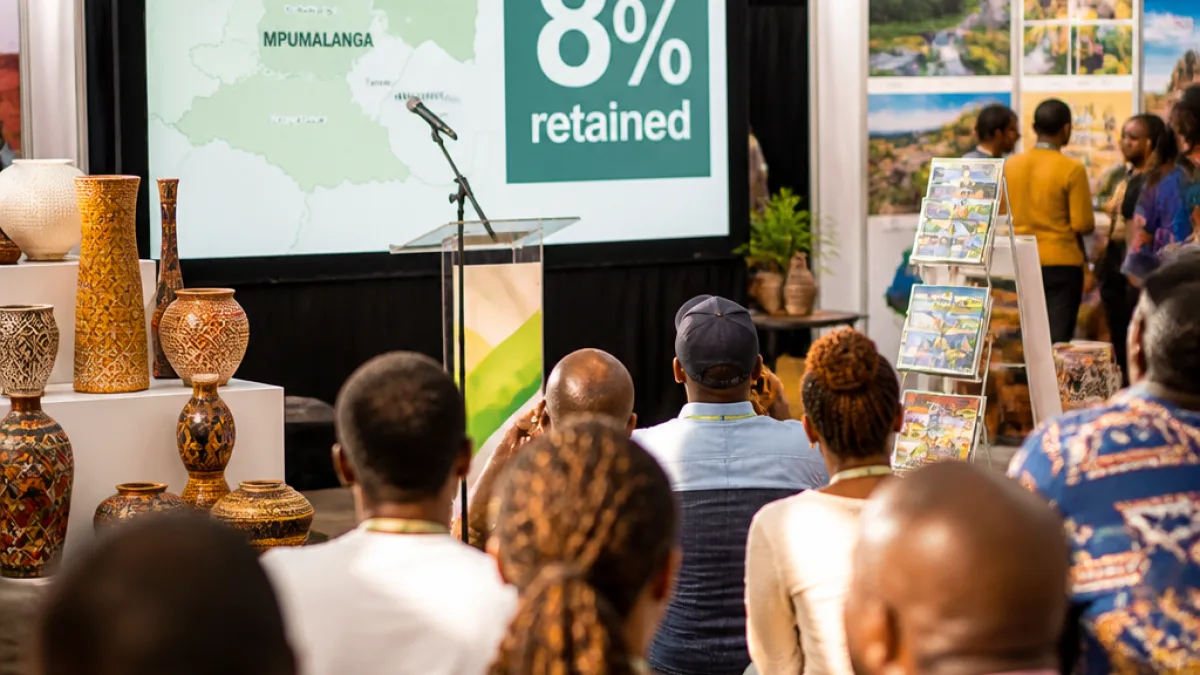
Mbombela — Mpumalanga remains a major draw for national and international travellers, but the province is failing to convert visitors into meaningful local income, the chief executive of the Kruger Lowveld Chamber of Business and Tourism said at a tourism expo in Mbombela on Friday.
High arrivals, low local spend
Oupa Pilane, CEO of the chamber, told the expo that roughly 2.7-million people visited the province in 2025. Yet only about 8% of what tourists spend is retained in Mpumalanga. "Of every R100 tourists spend, only about R8 is spent in the province," he said, warning that the sector was not delivering its economic potential.
"The numbers are there," Pilane said. "What we have a problem with is that the tourists are coming to a showroom. They are not spending money."
Pilane framed Mpumalanga as a "showroom": attractions draw visitors who buy an entrance ticket and then move on, with few opportunities to spend on food, activities, crafts or services that would multiply the economic benefit for local communities.
Where spending happens — and where it does not
The tourism chief contrasted two local attractions to illustrate the gap. At Bourke’s Luck Potholes, Pilane said, visitors typically pay an entrance fee and have "limited further opportunities to spend money on food, drinks, activities or other services once inside." By contrast, Graskop Gorge has developed additional facilities and commercial activities that have increased the average spend to about R500 per person.
Those differences help explain why many tourists pass through Mpumalanga quickly. Pilane noted that visitors may spend a day or two in the province and then continue on to places such as Cape Town, where longer stays and higher per-person spending are common.
Practical gaps highlighted
At the heart of the problem, Pilane identified a shortfall in on-site services and attractions that extend the visitor stay and wallet. He said attractions need to replicate the kinds of ancillary offerings seen at sites such as Graskop Gorge if the province is to capture more tourism revenue and create jobs.
- Develop additional activities and experiences beyond entrance fees
- Improve on-site food, beverage and retail options at popular attractions
- Address safety concerns that discourage longer stays and higher spending
Pilane also raised safety as a factor influencing visitor behaviour, saying that concerns about security reduced the amount of time tourists spend in the province and their willingness to spend more.
Implications for jobs and small business
Tourism is often promoted as a driver of economic growth, job creation, poverty alleviation and enterprise development. With only a small share of tourist expenditure retained locally, those downstream benefits are constrained. Small businesses that could provide food, guided activities, transport and crafts miss out when visitors merely transit through attractions without additional spending.
| Indicator | Figure |
|---|---|
| Visitors to Mpumalanga (2025) | 2.7-million |
| Share of tourist spend retained in province | 8% (R8 of every R100) |
| Average spend at Graskop Gorge | R500 per person (example cited) |
Increasing local capture of visitor spend would require co‑ordination between attraction managers, municipalities, small enterprises and provincial tourism authorities to create and market additional paid experiences, improve retail and food services, and ensure visible safety measures.
Next steps for the province
At the Mbombela expo, Pilane urged the replication of successful models — such as Graskop Gorge — at other sites across the province. That approach would mean identifying what visitors value and packaging those offerings into activities and services that extend stays and encourage higher per‑person spending.
For local communities and entrepreneurs, the opportunity is clear: developing guided experiences, food and beverage outlets, craft markets and transport services could help redirect a greater share of tourism revenue into the provincial economy. For provincial planners, the challenge is to coordinate investment and to remove practical and safety barriers that currently limit what tourists can buy once they arrive.
Longer, better‑served stays would not only boost income for businesses but also create more sustainable employment and enterprise development across Mpumalanga’s tourism nodes.
Nomsa Mahlangu is the Mpumalanga correspondent based in Mbombela.













