
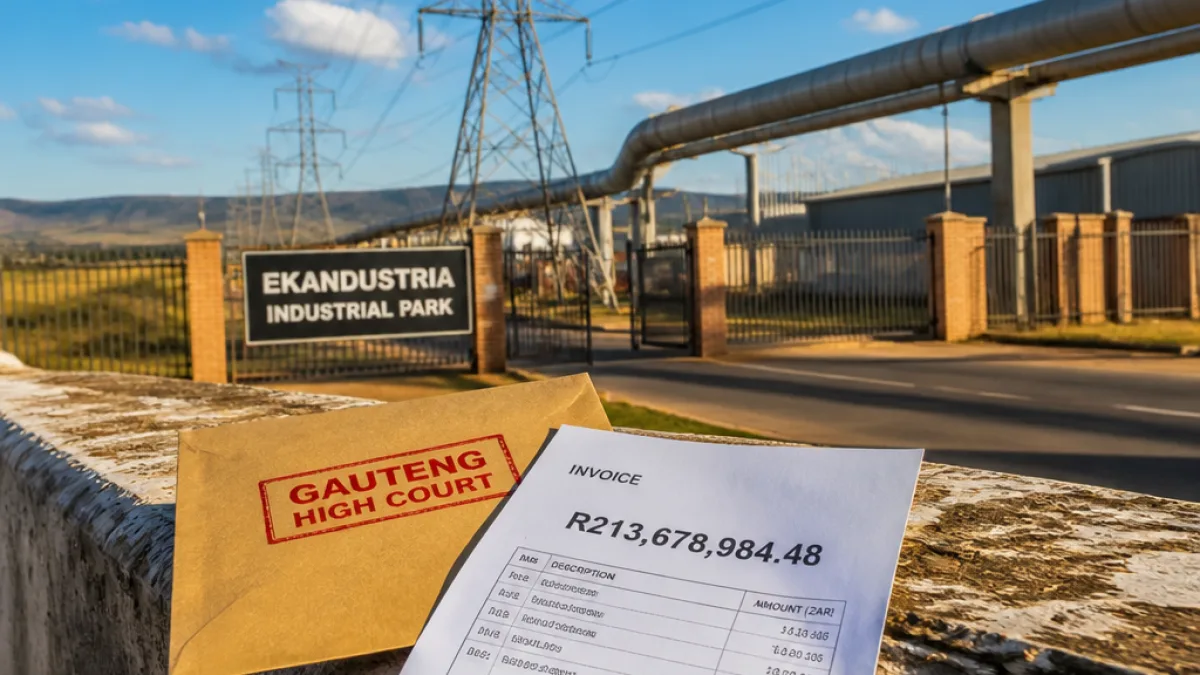
The Mpumalanga Economic Growth Agency (MEGA) has confirmed it will seek leave to appeal a Gauteng High Court judgment that ordered the agency to pay R213,678,984.48 to the City of Tshwane for municipal services supplied to its property at the Ekandustria Industrial Park outside Bronkhorstspruit.
What the judgment says
According to MEGA, the court order — handed down on 17 September — requires the agency to pay a total of R213,678,984.48, made up of:
| Service | Amount (R) |
|---|---|
| Water and sanitation | R28,614,967.95 |
| Electricity | R185,064,016.53 |
MEGA said the judgment also directs payment of interest at the prescribed legal rate.
Agency will challenge part of the process
MEGA chief executive Isaac Mahlangu told Sunday World the agency does not dispute the underlying debt but intends to apply to the appellate court for leave to appeal on a procedural point. The challenge focuses on whether the City of Tshwane complied with section 45(1) of the Intergovernmental Relations Framework Act before approaching the courts.
“MEGA does not dispute that it is indebted to CoT for municipal services rendered and remains committed to settling the debt,” Mahlangu said.
Section 45(1) requires that organs of state exhaust intergovernmental dispute-resolution processes before embarking on litigation. MEGA said its lawyers believe the City of Tshwane did not follow those prescribed steps.
Discrepancies in reported figures
The agency also disputed higher figures that have circulated in public statements. Tshwane executive mayor Dr Nasiphi Moya had said the city secured a court order for more than R231-million and warned MEGA to pay within 10 days, and later suggested the debt had ballooned to as much as R461-million.
MEGA said neither the R231-million nor the R461-million appears in the Gauteng High Court judgment and insisted the judgment amount is R213,678,984.48.
What is at stake
The dispute centres on services supplied to MEGA’s property within the Ekandustria Industrial Park near Bronkhorstspruit. Ekandustria is an industrial node that relies on secure municipal services — particularly electricity and water — to attract and sustain tenants. Unresolved payments and legal uncertainty can affect the municipality’s revenue recovery as well as long-term investor confidence in the park.
- For MEGA: a legal route to challenge procedural compliance and potentially delay enforcement while preserving the right to contest the merits later.
- For the City of Tshwane: the judgment is a court-backed order for payment that it may seek to enforce if appeals fail or are dismissed.
- For businesses at Ekandustria: prolonged disputes between organs of state can create uncertainty over municipal supply continuity and the cost of services.
How the appeal process may proceed
MEGA has said it will apply for leave to appeal. If leave is granted, the matter would move to the appellate division for adjudication on the specified grounds, likely focusing on compliance with intergovernmental dispute-resolution requirements rather than re-litigating the full merits of the debt. If leave is refused, MEGA would be obliged to comply with the High Court order or seek other lawful remedies.
Context and wider implications
Intergovernmental disputes over municipal service charges have become more visible as provincial agencies, state-owned entities and municipalities navigate revenue pressures and the costs of providing electricity and water. MEGA’s statement that it is committed to settling the debt underscores the underlying financial obligation while highlighting the institutional friction that can arise when state organs take disputes to court.
For residents and businesses in Mpumalanga, the case is a reminder of how governance and legal processes between provinces and metros can ripple into local economies. Secure, properly billed municipal services are essential to sustaining industrial parks and encouraging investment; contested accounts and legal delays can raise costs and dampen confidence.
MEGA’s application for leave to appeal will determine whether enforcement of the R213.7 million judgment is postponed and on what grounds the agency seeks redress. The outcome may also clarify expectations on how organs of state must engage one another before initiating litigation.
Further developments will depend on court filings and any subsequent rulings from the appellate courts.













