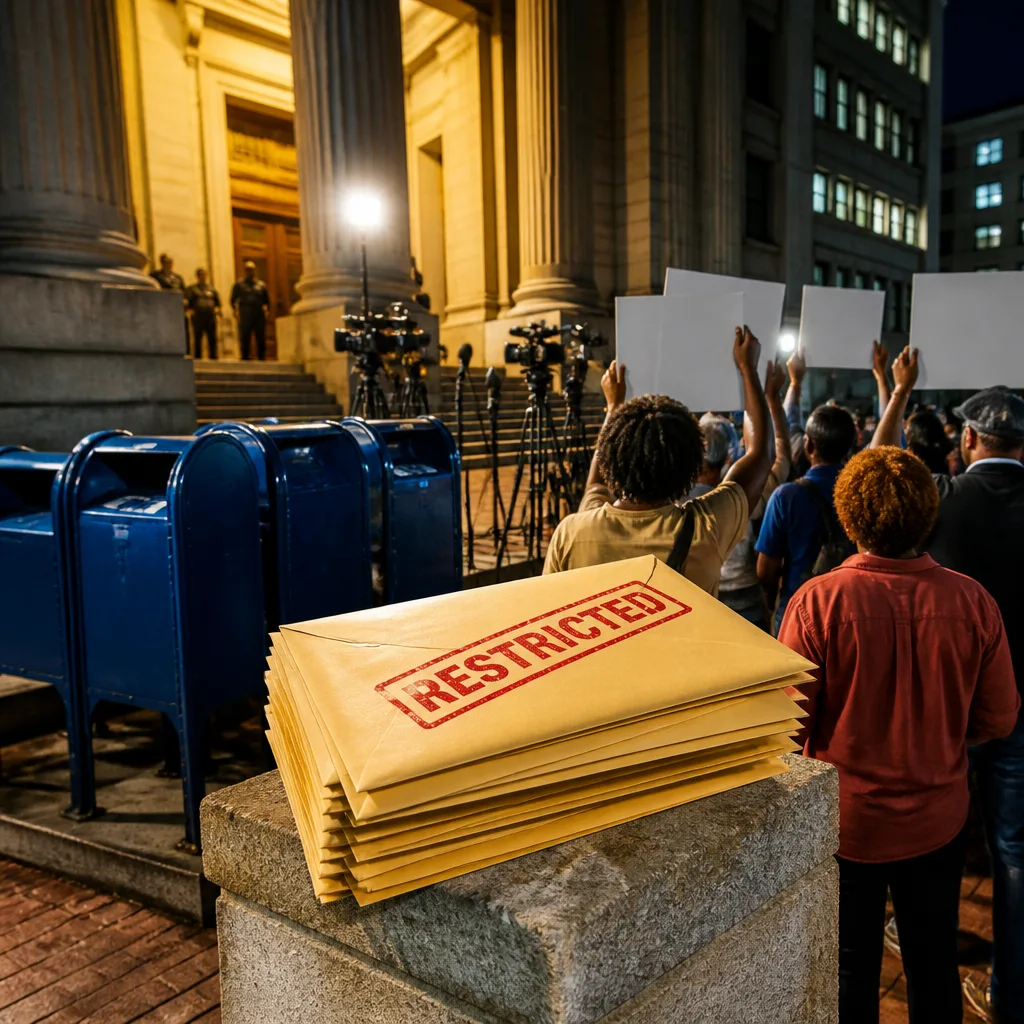
WASHINGTON — The leader of the United States Postal Service (USPS) has come under fire after rapidly moving to implement an executive order from President Donald Trump restricting mail voting, a manoeuvre that critics say risks politicising an agency supposed to shield the mechanics of elections from partisan interference.
Push to implement Trump order
David Steiner, who runs the USPS, finalised a rule to give effect to the president’s directive on mail ballots soon after it was issued, according to reporting compiled by the Los Angeles Times and The Associated Press. The rule included plans for an online portal through which electoral officials could share voter‑roll information with the Postal Service — a measure that proved controversial and was later halted after the US Supreme Court rejected parts of the administration’s approach.
Steiner told The Associated Press that work on the portal had stopped following the court’s decision and insisted that he was focused on implementation rather than policy advocacy. "I don't get to decide what rules that are put on us that I decide to accept or not accept," he said, adding the USPS is "an independent agency of the executive branch," according to the AP report.
"We are an independent agency of the executive branch," the Postal Service chief said, defending his role in carrying out the administration’s instructions, according to The Associated Press.
Political reaction and worries over impartiality
Steiner’s actions have prompted sharp criticism from Democratic state officials who warned that the Postal Service could be used to interfere with the administration of elections. Jena Griswold, Colorado’s Democratic secretary of state, labelled Steiner a "Trump lackey" in public remarks reported by the LA Times. Nevada Secretary of State Cisco Aguilar, also a Democrat, urged Congress to authorise observers to ensure postal employees could process and scan ballot envelopes without interference, the reporting said.
The controversy highlights a tension inherent in the USPS’s structure: legally independent, but operationally embedded within the executive branch. That arrangement can leave the agency vulnerable to political pressure when the executive seeks to direct its activities — especially on matters as sensitive as voting methods.
How Steiner has framed his role
Steiner has sought to portray himself as an implementer rather than a policy decision‑maker. He told audiences in earlier public remarks that he was uncomfortable with theatrical displays of leadership — a comment from a 2007 speech at the University of Arkansas Clinton School of Public Service about Donald Trump on television that the Los Angeles Times included in its profile of Steiner. In that address he quipped that if imitating Trump’s hair were a leadership requirement, "you can definitely count me out."
Yet the swift move to execute the presidential order has left observers asking whether the USPS can remain neutral when asked to carry out directives that directly affect how and when citizens vote.
- Action taken: Steiner pushed to finalise a rule implementing the Trump administration’s executive order restricting mail ballots.
- Judicial check: The US Supreme Court rejected key parts of the administration’s plan, after which work on an online voter‑roll portal ceased, according to The Associated Press.
- Political response: Democratic secretaries of state called for safeguards and called Steiner a partisan actor, per Los Angeles Times reporting.
| Actor | Role | Reported action |
|---|---|---|
| David Steiner | USPS chief executive | Finalised rule to implement presidential order; halted portal work after court ruling |
| President Donald Trump | President of the United States | Signed executive order restricting mail ballots |
| US Supreme Court | Judiciary | Rejected elements of the administration’s plan |
The episode is part of a broader debate in the United States over the administration of elections, trust in postal services and how independent public agencies can be protected from partisan aims. For South African readers tracking global trends in the politicisation of administrative institutions, the Steiner episode is a case study in how quickly operational decisions at a service‑deliverer can acquire national political significance.
Reporting by the Los Angeles Times and The Associated Press contributed to this article.