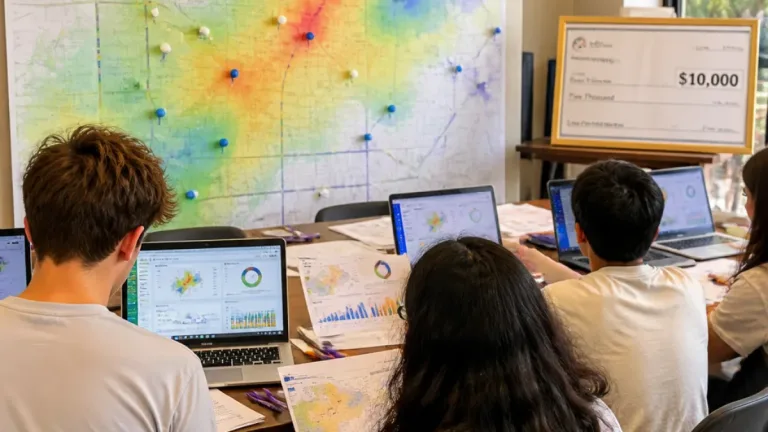
Schmidt Sciences said Thursday it will invest as much as $20 million to support eight new researchers selected as Schmidt Polymaths, part of an effort to back scientists who apply expertise across disciplines to high-impact problems.
Flexible funding aimed at high‑risk, high‑reward work
Each awardee can receive up to $2.5 million over five years in unrestricted support intended to let established investigators pursue questions outside their usual specialties. The program prioritizes projects in areas identified by Schmidt Sciences as strategically important, including artificial intelligence, advanced computing, biosciences, climate and astrophysics and space.
The 2026 cohort marks the sixth group of Schmidt Polymaths and expands a community that now numbers 35 researchers. Schmidt Sciences, created in 2024 by former Google CEO Eric Schmidt and his wife Wendy Schmidt, said the award structure is designed to remove the method and scope constraints typical of many conventional grants.
"Each of these researchers has already shown real range and originality in their work. Now they're ready to bring that to an entirely new set of questions,"
James Ricci, director at Schmidt Sciences, made the comment in the organization’s news release accompanying the announcement.
Topics and selection criteria
Schmidt Sciences said the new cohort will pursue diverse lines of inquiry. Examples provided by the organization include exploring whether invertebrate immune systems can point to new therapies for humans, devising ways to make food crops more resilient to climate change, and using AI models trained on human behavior to probe the nature of cognition and the mind.
To be eligible, nominees must have reached a milestone equivalent to tenure within the prior three years and demonstrate a research record that spans more than one domain. Universities worldwide submit nominations; candidates are evaluated on both their past accomplishments and the ambition of their proposed future work.
- Total program commitment: up to $20 million
- Awards per recipient: up to $2.5 million over five years
- Cohort size: eight new Schmidt Polymaths (sixth cohort)
- Community size: 35 Schmidt Polymaths to date
Early outcomes from earlier cohorts
Schmidt Sciences pointed to tangible outcomes from previous award cycles. Earlier recipients have pursued projects that include developing rechargeable molecular computing devices powered by heat, detecting community dietary patterns by analyzing food DNA in wastewater, and discovering new mathematical formulas with assistance from AI. Those examples illustrate the program’s emphasis on interdisciplinary experimentation and translational potential.
| Metric | Value |
|---|---|
| New Polymaths announced (2026) | 8 |
| Maximum award per recipient | $2.5 million (5 years) |
| Total potential commitment | $20 million |
The program’s flexible funding model reflects a broader conversation in U.S. science policy about how to encourage exploratory research that may not fit neatly into traditional grant mechanisms. By prioritizing breadth of expertise and willingness to cross disciplinary boundaries, Schmidt Sciences seeks to seed projects that institutions or standard grantmakers might consider too speculative.
Observers say that private philanthropic initiatives like Schmidt Sciences can accelerate certain types of work by cutting administrative friction and offering longer time horizons. At the same time, dependency on private funding raises questions about how research priorities are set and whether such efforts will be sustained or widely scaled.
Schmidt Sciences did not list all nominees or full project details in its initial release. The organization said the new Polymaths were chosen from nominations submitted by universities across the globe and will join existing awardees to form a broader network intended to share ideas and collaborate where possible.
As the new cohort begins its funded work, the impact of these awards will be measured by the extent to which recipients convert interdisciplinary freedom into reproducible discoveries, practical technologies or new frameworks for scientific inquiry.