
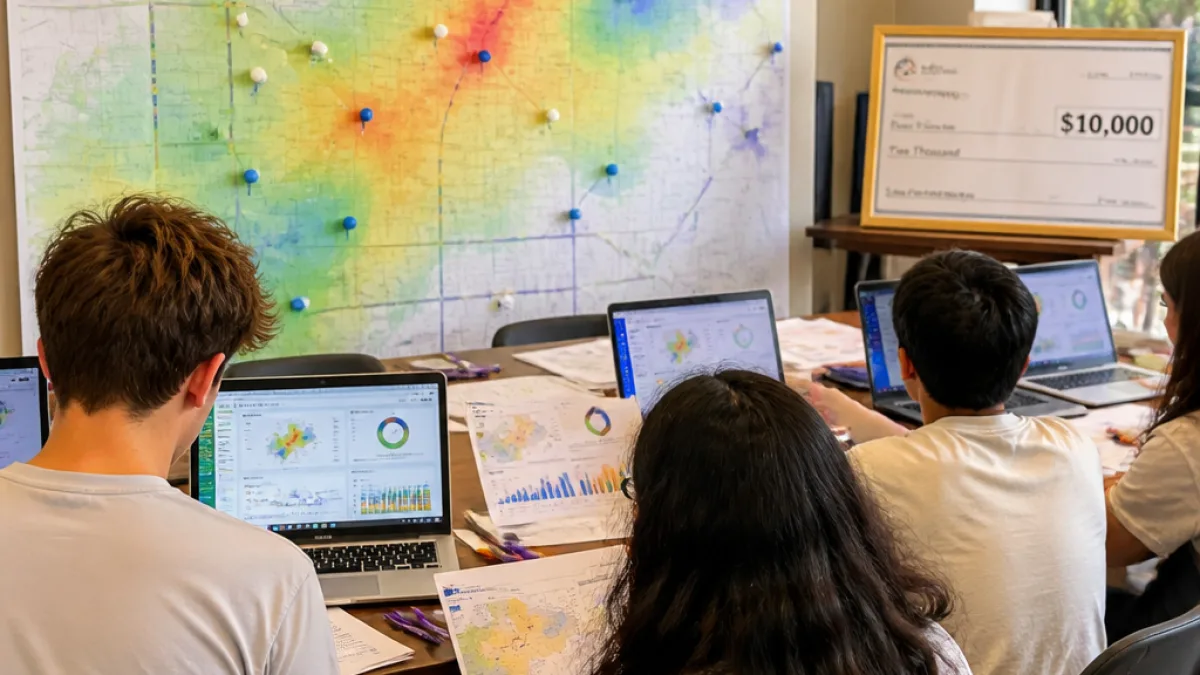
A 17-year-old Plano student has turned personal health concerns and neighborhood volunteering into a technology and outreach effort that now provides real-time air-quality information to roughly 1,000 Texans and has trained some 300 youth ambassadors, according to local reports. The project earned the student the 2026 Gloria Barron Prize for Young Heroes and a $10,000 award.
From local need to a machine-learning solution
The student, who founded the nonprofit Shared Skies Initiative, developed an artificial intelligence program to predict air pollution in areas that lack physical monitoring stations. The approach uses existing official sensors to train models that estimate pollution in neighborhoods where no monitors are present, addressing gaps created by the uneven placement of traditional monitors.
Local reporting noted that only one official monitoring station serves an area of more than 900 square miles in Dallas County, leaving many neighborhoods without reliable, localized data. The student said installing physical sensors everywhere would be prohibitively expensive; instead, the algorithm fills in gaps so residents can see likely air-quality conditions on an online map.
Practical outreach paired with technology
Alongside the digital map, Shared Skies Initiative produces materials and services intended to make scientific information usable by families. The organization has published a 50-page guide on air pollution in English and Spanish and distributes copies in communities. It also provides clean-air units and other practical help to local families, aiming to ensure research informs everyday decisions.
“Research only makes a difference when it reaches the people it is about,” the student said. “A paper in a journal won’t protect a child from polluted air as he walks to school, but a bilingual booklet a mother can read will.”
The combination of a live, AI-driven map and hands-on community resources has led to local uptake: about 1,000 people use the live map to check air quality in real time, according to published accounts. The initiative also emphasizes youth engagement, with reports that approximately 300 young people have been trained as ambassadors to help communicate air-quality information in their neighborhoods.
Recognition and implications for Plano area residents
The Gloria Barron Prize recognizes 25 young leaders across the United States and Canada. The $10,000 award highlights the potential for youth-led projects to address environmental justice issues at the neighborhood level. For Plano-area residents and those in surrounding Dallas neighborhoods, the project offers:
- Access to near-real-time air-quality estimates in areas without monitors.
- Multilingual educational resources aimed at families and caregivers.
- Local youth engagement through trained ambassadors who can help spread information and resources.
Health motivations anchored the student’s work. Reporting said he suffers from a respiratory illness and has lost family members to lung cancer, experiences that helped spur his focus on air pollution and health disparities. While tutoring children in West Dallas, a student’s question about hazy air prompted a deeper look into local asthma rates and monitoring coverage.
| Metric | Reported Figure |
|---|---|
| People using live map | ~1,000 |
| Youth ambassadors trained | ~300 |
| Prize awarded | $10,000 |
| Guide length | 50 pages (English and Spanish) |
| Area covered by single official station | 900+ square miles |
For Plano and neighboring communities in North Texas, the initiative underscores how local actors can use data science and community outreach to fill gaps left by limited monitoring networks. Residents tracking respiratory health or concerned about environmental equity may find the live map and the nonprofit’s materials immediately useful.
City and county officials have not been quoted in the reporting on the project, and it remains unclear whether the Shared Skies Initiative will partner with municipal or regional agencies to expand monitoring or adopt its model at larger scale. Still, the combination of a practical, bilingual guide, distribution of clean-air units and a machine-learning map represents a notable example of youth-driven environmental work rooted in local needs.
The student’s award and the nonprofit’s early reach illustrate how targeted technology and community engagement can make air-quality information more accessible to families across the Dallas–Plano area.
















