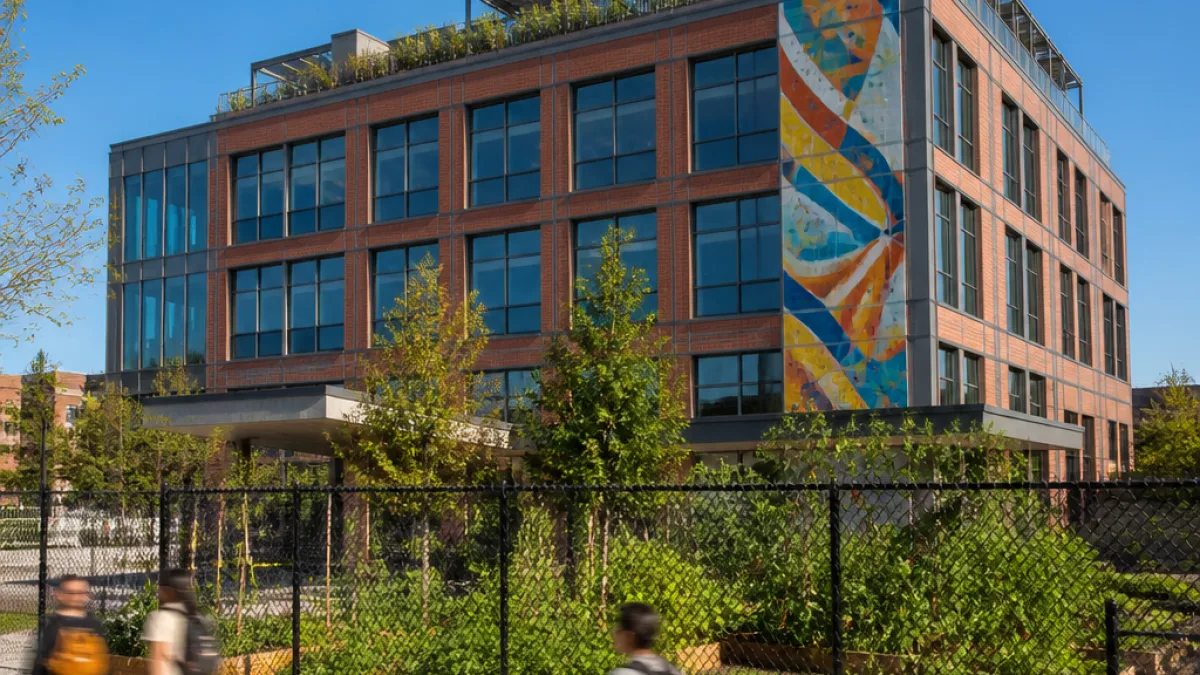
The City of New York unveiled a new public facility Wednesday in the Brownsville neighborhood of Brooklyn, opening a four-story, 60,000-square-foot Brownsville Multi-Service Center that consolidates social services and community programming under one roof.
What the new center includes
Officials said the facility at 452 Thomas S. Boyland Street will house offices for social-services staff, conference and multipurpose rooms, a teaching kitchen and a 1,600-square-foot community garden. The building also incorporates sustainability features, including green roofs and rooftop solar panels, and the city has said the project was expected to meet or exceed LEED Gold environmental standards.
- Project cost: $128 million
- Size: 60,000 square feet
- Stories: Four
- Community garden: 1,600 square feet
- Public art: “I Am Protected” by Jazmine Hayes
The unveiling, scheduled for 10:30 a.m. Wednesday, included representation from the NYC Department of Design and Construction and the Department of Cultural Affairs, along with Department of Social Services leadership and Brooklyn-based artist Jazmine Hayes, who created a permanent public-art installation for the site.
“I Am Protected”
The four-part installation titled “I Am Protected” was commissioned through the Department of Cultural Affairs’ Percent for Art program, which funds artwork as part of eligible city construction projects. The Public Design Commission included Hayes’ work among its 2025 Award for Excellence in Design selections.
Project delivery, cost and purpose
The New York City Department of Design and Construction (DDC) managed the project for the Department of Social Services/Human Resources Administration through a design-build delivery method. DDC said the approach helped shorten the construction timeline and produced an estimated savings of $10 million compared with traditional delivery methods.
The center replaces a former city-owned community center located on the same site. City officials described the new building as adding public infrastructure and space for community activities and social services in the Brownsville neighborhood, giving residents consolidated access to programs and meeting space under one roof.
Design features and community benefits
Beyond office and program space, the facility includes several elements intended to serve local residents and improve environmental performance:
- Multipurpose rooms designed for community meetings and programs
- A teaching kitchen to support food-access programming and job training
- Green roofs and solar panels to reduce energy demand and improve sustainability
- Permanent public art integrated with a community garden to strengthen neighborhood identity
City officials have framed the center as a long-term asset for the neighborhood’s public-service infrastructure. The combined program space and the art commission aim to create both functional and cultural value for the local community.
| Item | Detail |
|---|---|
| Address | 452 Thomas S. Boyland Street, Brooklyn |
| Cost | $128 million |
| Size | 60,000 sq ft |
| Garden | 1,600 sq ft |
While this Brownsville is a neighborhood in Brooklyn, the opening illustrates a broader municipal trend in concentrating social services, community programming and green design features in purpose-built facilities. For residents and providers in the neighborhood, the new Multi-Service Center is intended to be a centralized point for services, meetings and cultural activity, supported by sustainable design choices and a permanent public-art commission.
DDC officials noted that the design-build approach was key to accelerating delivery and keeping costs down, and the Department of Cultural Affairs emphasized the role of Percent for Art in ensuring that the artistic component remains a lasting part of the public realm.
The center’s community spaces and the Hayes installation will remain permanent features of the property and part of the neighborhood’s public-service infrastructure going forward.