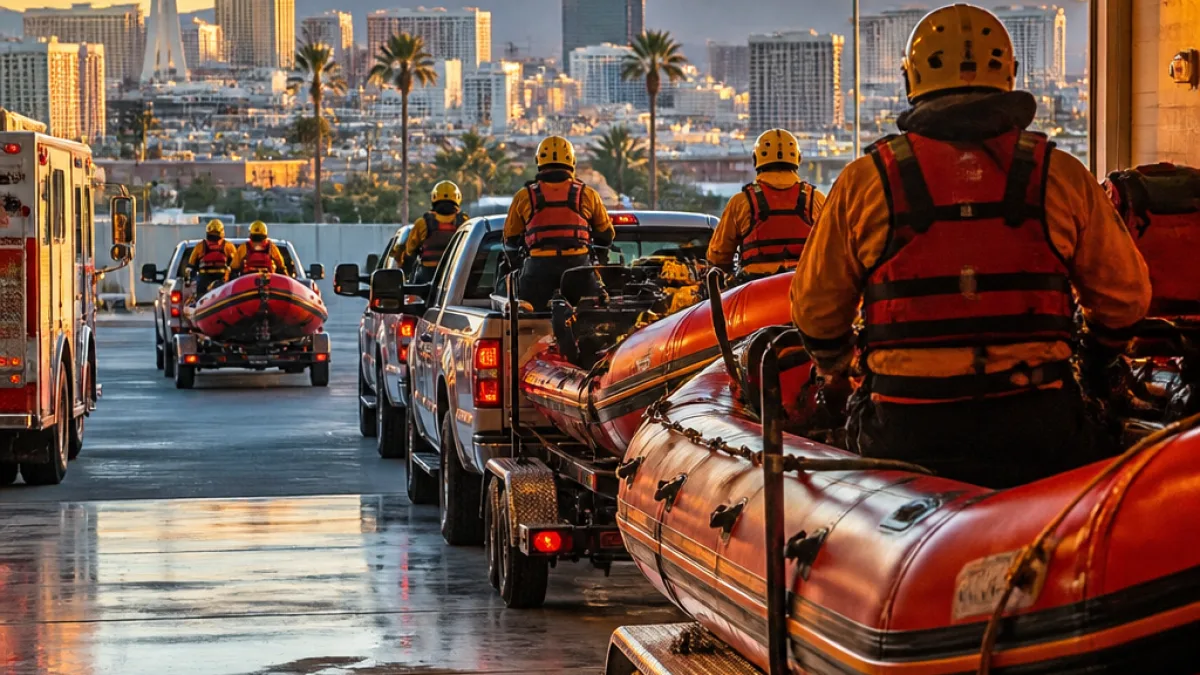
LAS VEGAS — A 45-member Nevada search-and-rescue contingent departed Las Vegas Monday to support communities in New Mexico bracing for flash flooding tied to Hurricane Polo.
Rapid water-rescue response dispatched
The team deployed as a Type 3 Water configuration, organized to perform water-rescue operations in urban and rural settings. The specialized unit includes multiple boat crews and personnel drawn from several local fire agencies across the Las Vegas Valley and surrounding jurisdictions.
Officials said the Nevada task force is one of 28 federal Urban Search and Rescue teams and currently is the only one assigned to this activation. The Nevada deployment is expected to remain in place for as long as two weeks, though federal and state incident managers will reassess needs as the situation evolves.
Which agencies make up the task force
- Clark County Fire Department
- Las Vegas Fire & Rescue
- North Las Vegas Fire Department
- Boulder City Fire Department
- Henderson Fire Department
- Several civilian volunteers
Representatives from those agencies form the Nevada contribution of what is commonly known as Nevada Task Force 1, which works under federal coordination when activated for interstate incidents.
Why Nevada is sending crews to New Mexico
Emergency managers anticipate heavy rainfall and flash flooding across parts of Arizona and New Mexico as Polo moves inland. The presence of trained water-rescue teams enables faster search and rescue for people stranded by rapidly rising water and supports local agencies overwhelmed by a sudden surge in calls for help.
Though the exact operating location for Nevada crews was not immediately disclosed, the team is traveling east through Arizona and into New Mexico. Officials acknowledged travel through regions expecting significant precipitation and warned crews to remain prepared for hazardous driving and flood-prone conditions en route.
Deployment details at a glance
| Element | Detail |
|---|---|
| Personnel | 45 |
| Configuration | Type 3 Water (boat teams) |
| Participating agencies | Multiple Las Vegas-area fire departments + volunteers |
| Estimated duration | Up to two weeks |
What this means for Nevada residents
Although the task force is deployed out of state, the activation underscores Nevada’s role in regional disaster response and the burden placed on local agencies when personnel are committed to out-of-state missions. Residents should expect normal local emergency services to continue operating, but officials often shift resources or mutual-aid arrangements when teams are away.
Authorities urge Nevadans to keep routine preparedness supplies on hand year-round: a three-day supply of food and water, a battery-powered radio, flashlights, and an emergency plan for family and pets. While Nevada is not directly threatened by Hurricane Polo, the deployment highlights the interconnected nature of Western emergency response amid increasingly frequent extreme weather events.
Federal coordination and potential for extended operations
Nevada Task Force 1 functions within a national network of urban search-and-rescue teams that can be activated by state or federal emergency-management agencies. When a single team is assigned to an activation, its resources are often used for rapid-impact operations such as life-saving water rescues, structural search, and technical rescue support.
Officials said the duration of the activation will depend on the storm’s impact and the needs reported by New Mexico authorities. Teams typically demobilize when the immediate threat subsides or when local resources recover sufficient capacity to manage ongoing operations.
As crews travel east, dispatch centers encourage motorists in affected corridors to exercise caution and allow emergency vehicles to pass. Local leaders reiterated that while the task force’s work will be out of state, preparedness at home remains essential.
Reporting from Las Vegas.