
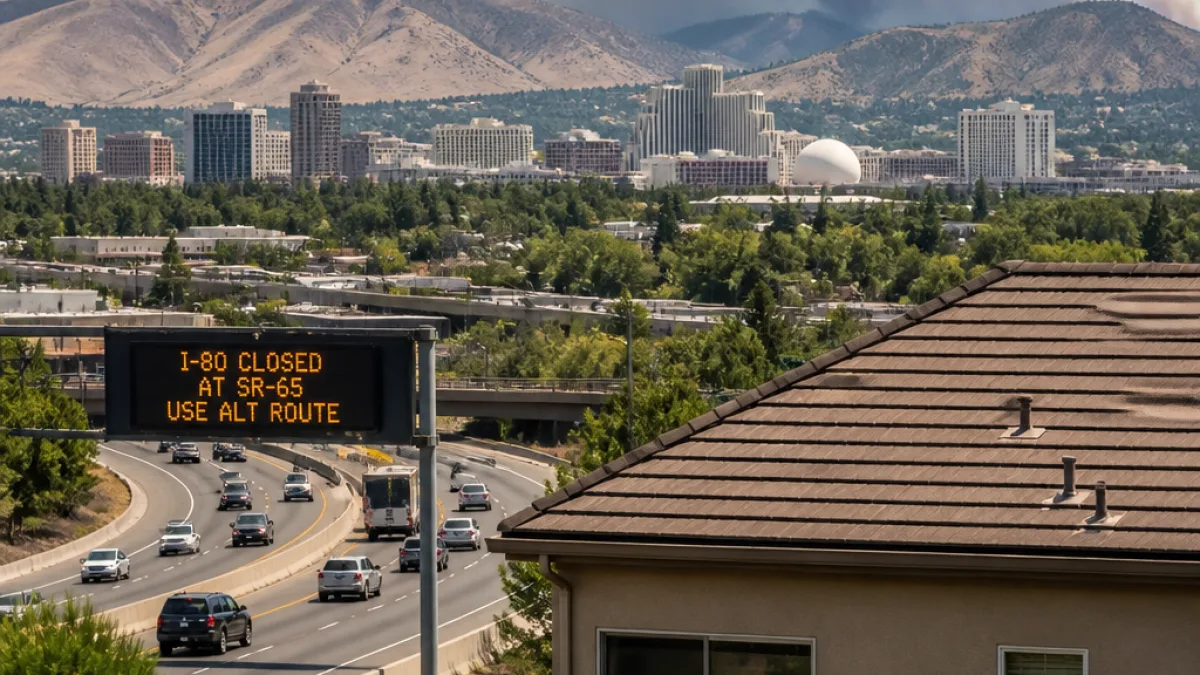
Northern Nevada Public Health issued an air quality advisory for the Reno-Sparks area on Sept. 16 as smoke from the Floriston and Dome fires in California moved into western Nevada. Officials warned that fine-particle pollution could reach levels considered “unhealthy for sensitive groups” to “unhealthy” in parts of the region through Thursday morning.
Where conditions are expected to worsen
Public health officials said the heaviest impacts were likely in the Verdi and North Valleys, where smoke from the Floriston Fire could push air quality into the “unhealthy for sensitive groups” to “unhealthy” range. In eastern Sparks and Spanish Springs, smoke from the Dome Fire near Yosemite National Park was expected to produce conditions ranging from “moderate” to “unhealthy for sensitive groups.”
Areas closest to and downwind of the fires typically bear the worst smoke impacts, and officials cautioned that conditions can change rapidly depending on wind shifts and fire activity. Earlier Wednesday, much of the Reno area registered “moderate” air quality, but that measure can deteriorate quickly.
“The Nevada Department of Transportation described it as a ‘major forest fire.’”
Fire activity and travel impacts
The Floriston Fire ignited late Wednesday morning near Floriston, California, along Interstate 80 and expanded swiftly. The blaze doubled from 10 acres to 20 acres then grew to about 298 acres by midday, prompting a westbound I-80 closure and evacuation warnings for areas near Floriston just west of the Nevada-California border.
Officials said the Floriston and Dome fires were the primary sources for the smoke drifting into the Reno-Sparks area. Transportation and public-safety agencies have been monitoring conditions, and closures or travel advisories may be modified as the situation evolves.
Current air-quality readings and forecasts
Local and national air monitoring services showed variable conditions across the region on Wednesday. According to public reporting cited by health officials:
- Areas west of Reno, closest to where the Floriston Fire burned, recorded moderate air quality around midday.
- Parts of eastern Reno and Sparks were also listed as moderate, while central Reno remained in the good range at that time.
- Third-party services such as IQAir and AccuWeather similarly reported moderate conditions for the Reno area, with coarse particles noted as primary pollutants by IQAir.
| Area | Expected AQI category |
|---|---|
| Verdi, North Valleys | Unhealthy for sensitive groups to Unhealthy |
| Eastern Sparks, Spanish Springs | Moderate to Unhealthy for sensitive groups |
| Central Reno (midday) | Good |
What residents should do
Northern Nevada Public Health and air-quality services recommend precautions for residents, particularly those in areas forecast to see poorer air. Actions to reduce exposure include:
- Avoid prolonged or heavy exertion outdoors when smoke is present.
- Keep windows and doors closed and use air conditioning when available; ensure filters are clean.
- Consider wearing N95 or equivalent masks if outdoors and smoke is heavy.
- People with heart or lung disease, older adults, children and pregnant people should limit outdoor time and follow medical guidance.
Health officials pointed readers to national and local monitoring tools, including airnow.gov, for near-real-time air-quality data. Media outlets covering the events urged residents to follow updates from Northern Nevada Public Health and local emergency management as conditions change.
Authorities continue to track the Floriston and Dome fires and their potential to affect western Nevada. Motorists and residents near I-80 and the Nevada-California border should remain alert for changing travel conditions and possible evacuation notices.

















