Pennsylvania health officials announced Wednesday that the statewide measles outbreak has reached 835 confirmed cases in 2026, spanning 39 counties and resulting in 164 hospitalizations and four measles-associated deaths.
Concentration in several counties
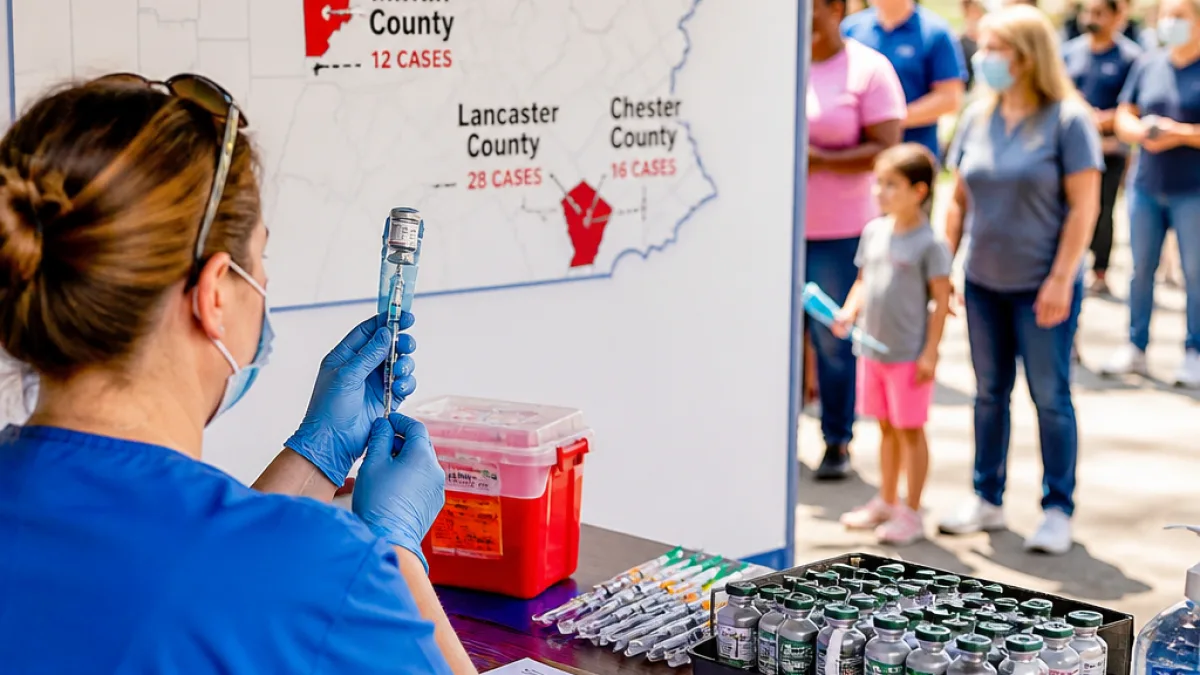
Public records show the outbreak has been concentrated in a handful of counties. Lancaster County alone accounts for the largest share with 342 cases, equivalent to about 41% of the statewide total. Mifflin and Chester counties are also reporting elevated case counts, with 94 and 78 confirmed cases, respectively.
| County | Confirmed Cases |
|---|---|
| Lancaster | 342 |
| Mifflin | 94 |
| Chester | 78 |
Recent trends and scope
Health department updates indicate 43 new positive cases were added since Sept. 21. Officials have confirmed that fewer than 1% of cases — four infections — occurred in people who had been vaccinated against measles. The department continues to monitor cases in counties across the commonwealth.
Hospitalizations and fatalities
The outbreak has placed a notable burden on medical facilities, with 164 hospitalizations recorded amid efforts to treat severe complications linked to measles. State health data also list four deaths confirmed as measles-associated.
Vaccination remains primary protection
State health officials reiterated that the best protection against measles is the MMR vaccine, which is administered in two doses. According to the department, two documented doses of MMR provide about 97% lifetime protection. Adults who can verify they received two doses do not need an additional shot.
- Adults with only one documented MMR dose, or those unable to locate records, should discuss vaccination with their health care provider or pharmacist.
- Residents seeking vaccination are advised to contact a trusted health care provider or local pharmacy for availability and scheduling.
- Health officials emphasize timely vaccination for those at higher risk of complications, including young children, pregnant people and individuals with weakened immune systems.
Public health response and advice
State and local public health agencies continue case investigations, contact tracing and outreach to affected communities. Measures typically include identifying close contacts of confirmed cases, recommending quarantine for susceptible individuals, and prioritizing vaccine access for those unprotected.
Officials are urging residents to verify immunization records now rather than wait until exposures occur. For many, immunization status can be confirmed through a primary care office, school records or a pharmacy immunization record.
What to watch for and when to seek care
Measles typically begins with fever, cough, runny nose and red, watery eyes, followed by a characteristic rash. Anyone who suspects they have measles or who has had close contact with a confirmed case should contact their health care provider before visiting a clinic or emergency room, to avoid exposing others. Health care providers can advise on testing, isolation and treatment options.
State officials have not publicly named additional containment strategies beyond ongoing vaccination encouragement and routine public-health containment activities. The department continues to post regular case counts and guidance as investigations progress.
As the outbreak evolves, health authorities are focusing on increasing vaccine uptake and ensuring that people at risk can access care and accurate information. Residents with questions about measles, vaccination or what to do if exposed should reach out to their local health department or primary care provider.
This report will be updated as state health agencies release further data.