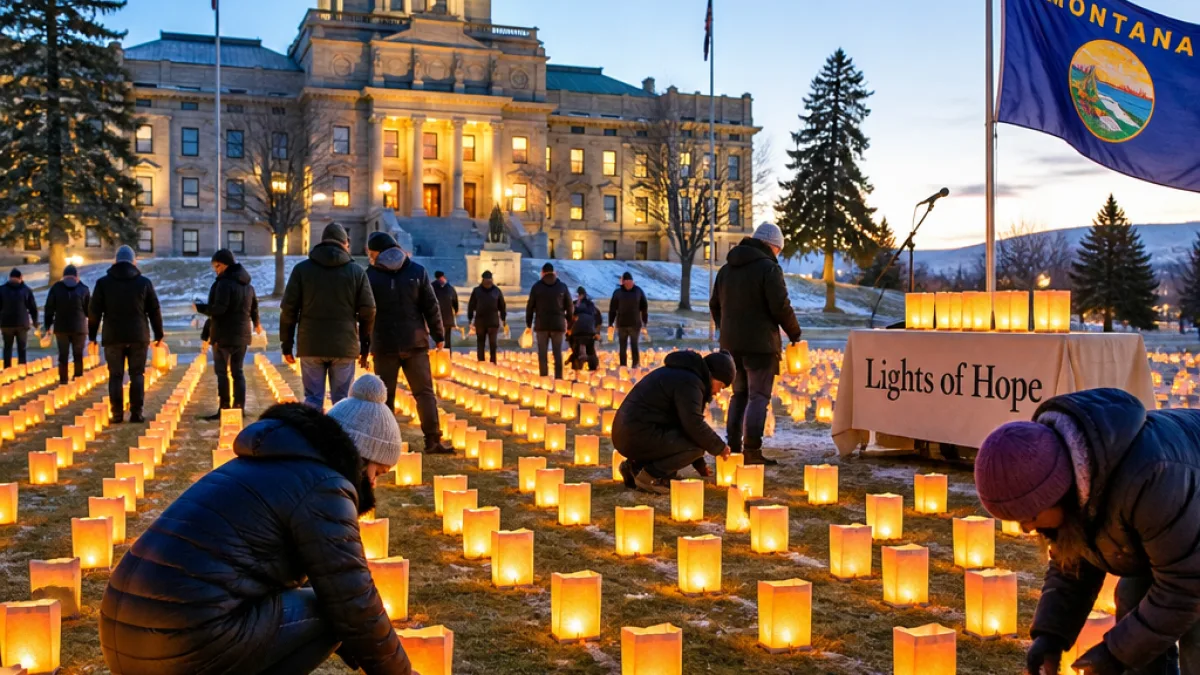
HELENA — Dozens of luminaria glowed on the grounds of the Montana State Capitol Monday evening as volunteers with the American Cancer Society Cancer Action Network brought a visual reminder of cancer’s toll to lawmakers and the public.
The display, part of the organization’s Lights of Hope campaign, sought to underscore two persistent realities in Montana: cancer remains the state’s second-leading cause of death, and outcomes vary considerably among communities.
Advocacy returns home after Washington trip
Organizers said the event followed an advocacy trip to Washington, D.C., and intended to translate those national conversations into state-level action. Keri Yoder, the network’s Montana state lead ambassador, said the lighting ceremony is a way to personalize the statistics lawmakers encounter.
“Every name has a story,” Keri Yoder, American Cancer Society Cancer Action Network Montana state lead ambassador, said.
Yoder told attendees the network focuses on pushing for stronger funding for cancer research, broader access to health care, and enhanced cancer prevention and screening programs. Volunteers lined the Capitol plaza with paper bags, each representing a survivor, someone currently fighting cancer, a person lost to the disease or a caregiver.
Disparities highlighted: American Indian and rural communities
The Montana Cancer Coalition’s data shared at the event shows American Indian populations in the state experience a cancer rate roughly 35 percent higher than Montana’s white population. Advocates emphasized geographic isolation and socioeconomic factors as barriers to timely screening, diagnosis and trial participation.
“We see a lot of people that are not able to participate in a cancer trial because Montana is so isolated,” Yoder said, stressing that participation in clinical trials can affect access to newer therapies.
Karrie Fairbrother, the network’s Montana state lead, said the Lights of Hope ceremony is both a community ritual and a tool for keeping cancer issues visible to policymakers.
“I see it as a wonderful community support, as well as individual support, as well as monetary support,” Karrie Fairbrother said.
What advocates are pressing for
Speakers and volunteers at the event outlined practical areas they say need attention. They include improved access to screening and diagnostic services in rural areas, expansion of prevention programs, and measures to increase clinical trial availability for Montana patients.
- Increased state and federal funding for cancer research and prevention.
- Expanded access to screening and diagnostic services in rural and tribal areas.
- Policies to reduce socioeconomic barriers to care, including transportation and broadband for telehealth.
Organizers did not present specific legislative proposals during the ceremony. Instead, they framed the lighting as a visual and emotional prompt to keep cancer-related needs in the minds of lawmakers and residents alike.
Visible reminder with public-health implications
Health advocates said the luminaria serve two broad functions: to commemorate and to catalyze action. The visual display aims to make abstract statistics more tangible, linking individual stories to broader patterns of health disparity and access.
| Measure | Montana figure |
|---|---|
| Rank of leading causes of death | 2 (cancer) |
| American Indian cancer rate vs. white population | ~35% higher |
Volunteers and organizers said they will continue outreach efforts in communities across the state while pressing lawmakers for resources that could improve screening, diagnosis and treatment access. They urged Montanans to use Lights of Hope as a moment to reach out to elected officials, share personal stories and advocate for policy changes.
The ceremony at the Capitol concluded as dusk deepened and the luminaria cast a steady glow across the lawn, a quiet counterpoint to the often clinical language of health statistics — and a reminder, organizers said, that behind each number is a name and a story.
Travis Wheeler is the state correspondent for WE NEWS.