
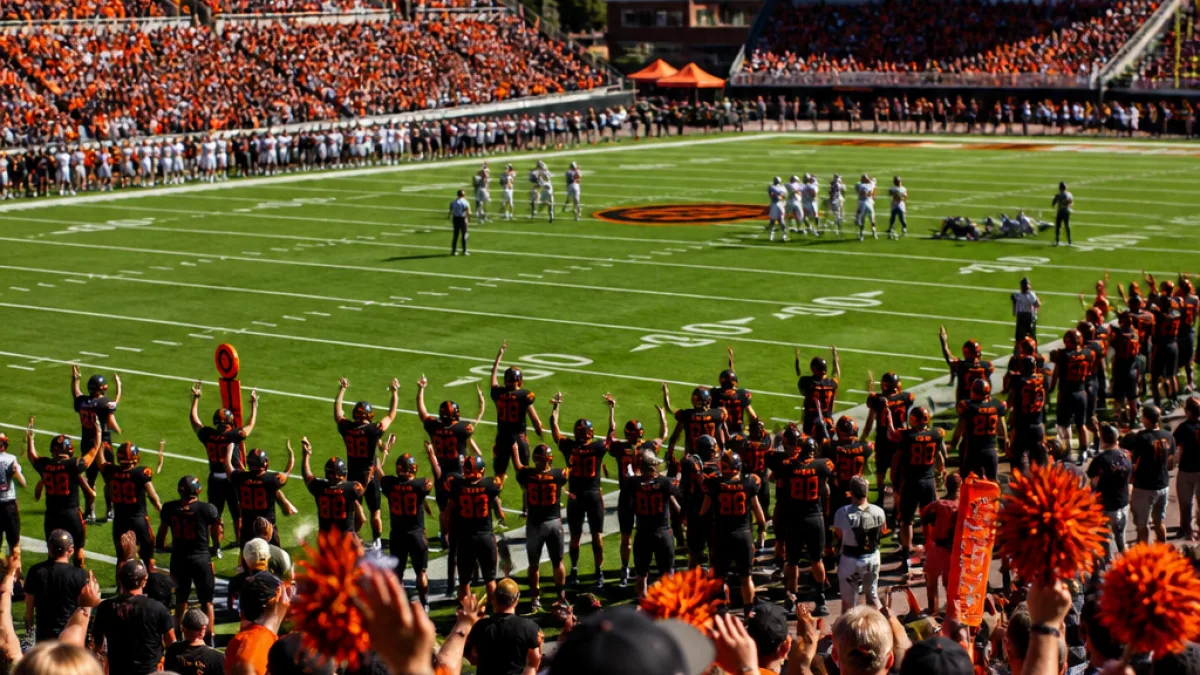
Beavers dominate in Corvallis; Grizzlies search for answers
CORVALLIS, Ore. — Oregon State delivered a decisive 52-17 victory over the University of Montana on Saturday at Reser Stadium, handing the Grizzlies a lopsided loss that highlighted mismatches on both sides of the ball.
The Beavers put up a balanced and explosive attack, spreading the ball to multiple playmakers while the Montana defense struggled to adjust to tempo and spacing. On offense, Montana could not sustain drives consistently and failed to slow down Oregon State’s playmakers in space.
Score
| Date | Location | Final |
| Sept. 12, 2026 | Reser Stadium, Corvallis | Oregon State 52, Montana 17 |
Mismatch in coverage: freshman emerges as a problem
One consistent thread for Oregon State was the emergence of freshman receiver Jesse Legree as a difficult matchup against zone coverages. Legree routinely found soft spots in the Grizzlies’ secondary, turning separation into yardage after the catch. That tendency became a recurring issue for Montana defenders and forced constant schematic adjustments that failed to fully close the gap.
Montana’s struggles in the defensive backfield were compounded as the Beavers did not rely on a single receiver; Braden Atkinson’s offense used multiple targets to stretch coverage and create mismatches in space.
Offensive balance for Oregon State
Oregon State displayed a diversified attack, getting contributions from several skill players rather than leaning heavily on one star. The passing game frequently got different receivers involved, and running backs combined to produce a more productive ground game than in previous outings. The distribution helped the Beavers keep Montana’s defense off balance throughout the contest.
While the scoreboard was tilted early, the variety in targets and consistent execution allowed Oregon State to maintain momentum and control possession for extended stretches.
Montana’s rushing effort shows flashes but lacks consistency
On the ground, Montana showed some signs of life but failed to translate individual moments into sustained drives. Oregon State finished the game with a more effective rushing attack, while the Grizzlies’ backs had limited opportunities to establish rhythm.
Two Montana running backs who drew attention in the game were AJ Newberry and Tre Garrison. Newberry demonstrated power and contact balance on designed runs and in open-field opportunities, while Garrison handled a heavier workload than some other backs had earlier in the season. Both produced positive plays but not enough to consistently change the game’s momentum.
Coach’s aggressiveness pays dividends for Beavers
Oregon State’s coaching staff also showed willingness to be aggressive on fourth downs, a strategy that contributed to extended drives and sudden-change scoring opportunities. An early fourth-down conversion that led to a chunk play illustrated the Beavers’ intent to sustain drives and keep Montana’s defense on the field.
That approach put pressure on the Grizzlies to convert on key third- and fourth-down situations, which they were unable to do at a rate necessary to remain competitive in the contest.
Special teams and other notes
Oregon State’s kicking game and complementary special teams plays helped preserve field-position advantages and convert points when drives stalled. The Beavers’ secondary contributors stepped up in several phases, further widening the gap between the teams.
- Key performer: Jesse Legree — consistent creation of separation against zone coverages.
- Rushing: Oregon State produced more consistent ground gains; Montana’s backs showed flashes but lacked sustained success.
- Coaching: Fourth-down aggression by Oregon State extended drives and produced big plays.
Looking ahead for Montana
The loss raises questions about Montana’s ability to contain speedy receivers in space and to generate sustained offensive drives against physical, well-coached opponents. The Grizzlies will need to tighten coverage schemes and find a more consistent rushing presence to regain balance on offense.
For Montana fans and program planners, the game provides a clear set of areas to address: versatility in defensive coverage, tackling in space, and play-calling that helps the offense control tempo and field position. How quickly the team adjusts will determine whether this result was an outlier or a sign of deeper problems as the season progresses.
This game underscored the gap that can appear when a well-rounded FBS opponent executes across phases. For Montana, the next steps will be identifying fixes and restoring consistency on both sides of the ball.

















