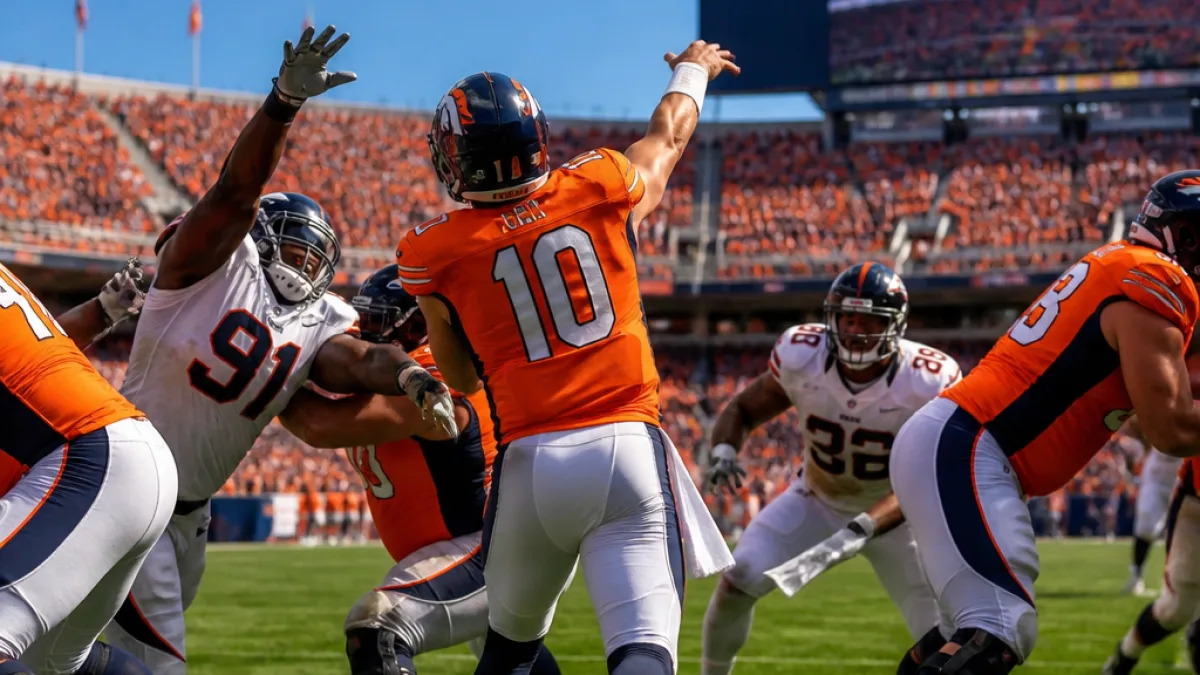
The Denver Broncos face a growing offensive concern through the first three games of the season: several of quarterback Bo Nix's throws have been getting knocked down at the line of scrimmage. That trend — measurable and uncommon for a team that has shown strong protection at times — is undermining the passing game and prompting questions about how the Broncos can sustain drives and avoid risky turnovers.
How a batted pass changes a play
A pass batted at or near the line of scrimmage eliminates a receiver's chance to catch the ball and can instantly halt momentum. It can also create unpredictable opportunities for the defense when the ball pops up in the air, sometimes resulting in interceptions. Through three games, Bo Nix has recorded 4 such batted balls; rival quarterback Jared Goff has 5.
"batted balls at the line of scrimmage"
The significance of that stat is magnified because a knocked‑down throw functions in many ways like a sack — it stops the play and kills potential yardage — without the defender having to register a tackle in the backfield. For an offense trying to establish rhythm, repeated batted passes are costly.
Numbers and context
Last season Nix finished with 13 batted balls on the year, which ranked ninth in the NFL. At his current pace, he would be on track for about 23 by season's end, which would have been the most in the league last year by a margin of three.
| Quarterback | Batted passes (through 3 games) |
|---|---|
| Bo Nix | 4 |
| Jared Goff | 5 |
| Bo Nix (2025 season total) | 13 |
Observers have pointed to several possible explanations for the spike in batted passes. One theory is that opposing defensive linemen and linebackers are timing jumps better or are getting their hands up more often when they cannot reach the quarterback. Another hypothesis noted in recent coverage is that defensive players, frustrated by limited penetration, will leap to try to knock a pass down rather than risk being blocked into oblivion.
- It deprives receivers of any chance to make a play.
- It can lead to tipped passes that turn into interceptions.
- It disrupts offensive rhythm without a loss of yardage, similar to a sack in effect.
What this means for Denver
For Denver, a team that has fielded high expectations for its offensive front in some matchups, the batted‑pass issue is paradoxical. If the offensive line is generally holding up, the defense's ability to get hands up and alter throws still creates critical negative plays. Coaches will likely study pocket depth, release points and quick‑throw concepts that can lower the chance of passes being knocked down.
Practically, the Broncos will want to reduce the frequency of these plays to avoid stalled drives and the increased risk of turnovers. That may require schematic adjustments — quicker passes, altered launch windows or different footwork and throwing mechanics — as well as continued offensive‑line attention on hand placement and leverage to prevent defenders from elevating into passing lanes.
The stat also serves as a reminder that protection is not only about preventing sacks; it’s about preventing any defender from getting a free tip or deflection at the line. For Denver fans and coaches watching game by game, the early trend is a clear item on the list of in‑season fixes if the team hopes to keep its offense clicking as the schedule progresses.
Coaches and analysts will continue to monitor the metric as the Broncos return to play. If the rate of batted passes persists, it could shape play‑calling and personnel decisions moving forward.