
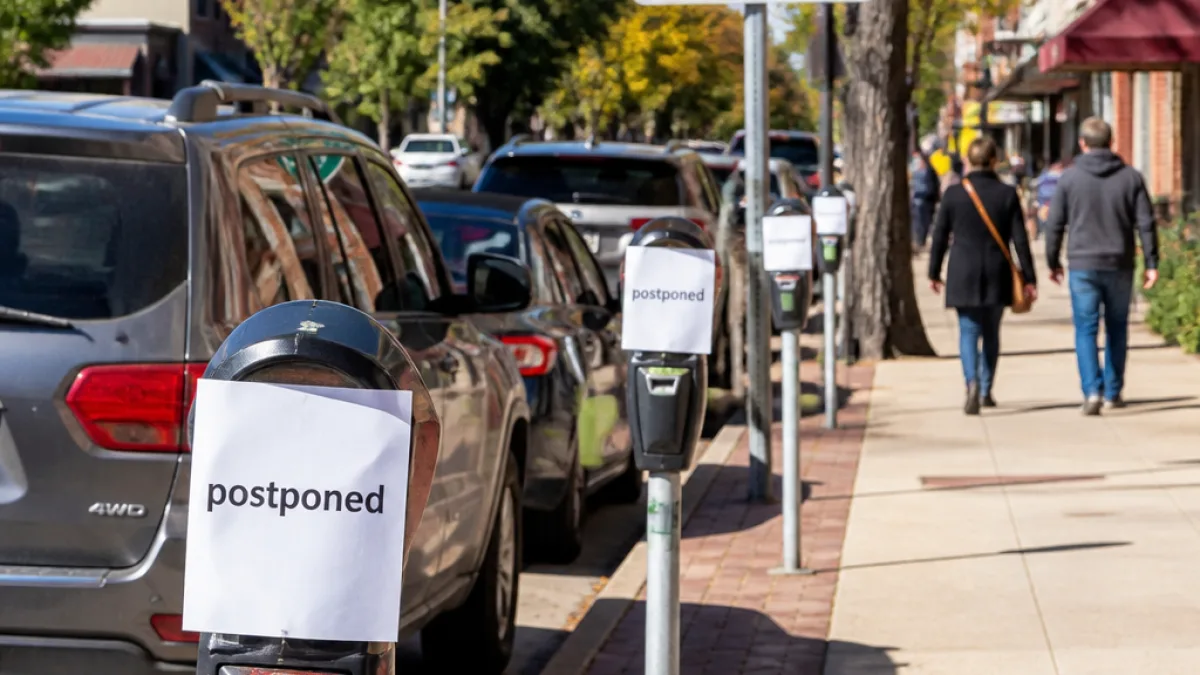
Arvada City Council voted Tuesday to pause a proposal that would have replaced free on-street parking in Olde Town with a paid-parking program, responding to sustained objections from business owners and residents who said the change could hurt commerce and neighborhood access.
Council cites public pushback, wants more work before moving forward
City staff had recommended a paid-parking program to address what a 2025 study identified as high parking demand in Olde Town. That study found an average on-street occupancy of 92% during peak periods—above the city’s 85% threshold for considering paid parking. But at a study session, councilmembers directed staff to delay implementation and to focus on other priorities first, including improving signage to free lots, collecting additional parking data and making upgrades to the RTD Olde Town Transit Hub garage.
City officials emphasized the program was intended to manage parking demand rather than to generate revenue, saying any revenue would be used to cover parking operations.
- Occupancy data: City study shows 92% on-street peak occupancy in Olde Town.
- Transit hub: The 600-space RTD garage has a peak occupancy of roughly 35%, according to staff.
- Public input: More than 4,000 people submitted feedback to the city survey on the proposed program.
Business owners warn paid parking could push customers away
Several Olde Town merchants told the council the parking situation is not as urgent as the study suggests and warned that paid parking would deter short-stop customers. Dorn Neinaber, co-owner of Outside The Box, told councilmembers many customers have said they would "not go out of their way to pay to park to rush in and get a greeting card" and feared shoppers would choose other destinations if Olde Town began charging for curbside parking.
"We are one of the only municipalities left in Denver that has free parking, and we ought to be celebrating that," Dorn Neinaber said.
Councilmembers said they have heard broadly from constituents who oppose the change. Councilmember Michael Griffith said he had not heard of a single business owner or resident who favored paid parking. Councilmember Sharon Davis noted she had not heard support either but highlighted an alternative put forward at public meetings: allow the first two or four hours free, then charge for additional time—an approach similar to Golden’s system and one suggested by Debbie Hansen, owner of La Dolce Vita Coffee Shop.
Next steps: data, signage and transit-hub improvements
During the session, council directed staff to take several concrete steps before revisiting the concept:
- Improve wayfinding and signage to free parking lots in and around Olde Town;
- Collect additional parking utilization data to refine the analysis;
- Coordinate upgrades and accessibility improvements at the RTD Olde Town Transit Hub garage;
- Continue public outreach to merchants, residents and transit users.
| Location | Peak Occupancy |
|---|---|
| Olde Town on-street | 92% |
| RTD Transit Hub (600 spaces) | 35% |
Councilmember Shawna Ambrose, while not opposing efforts to manage parking demand, said she wanted staff to better understand how recommendations would affect businesses and neighborhood streets before moving ahead. The pause gives the city time to address immediate concerns and gather more nuanced information on how residents and customers actually use parking and transit in Olde Town.
For now, Olde Town will retain its current mix of two-hour and four-hour time-restricted curb parking and access to the free 600-space transit hub on Vance Street while staff and council continue to evaluate options.
The council’s decision reflects a broader tension in growing Denver-area communities: balancing demand management and equitable access to downtown shopping districts without discouraging the small businesses that rely on convenient, low-cost parking.

















