
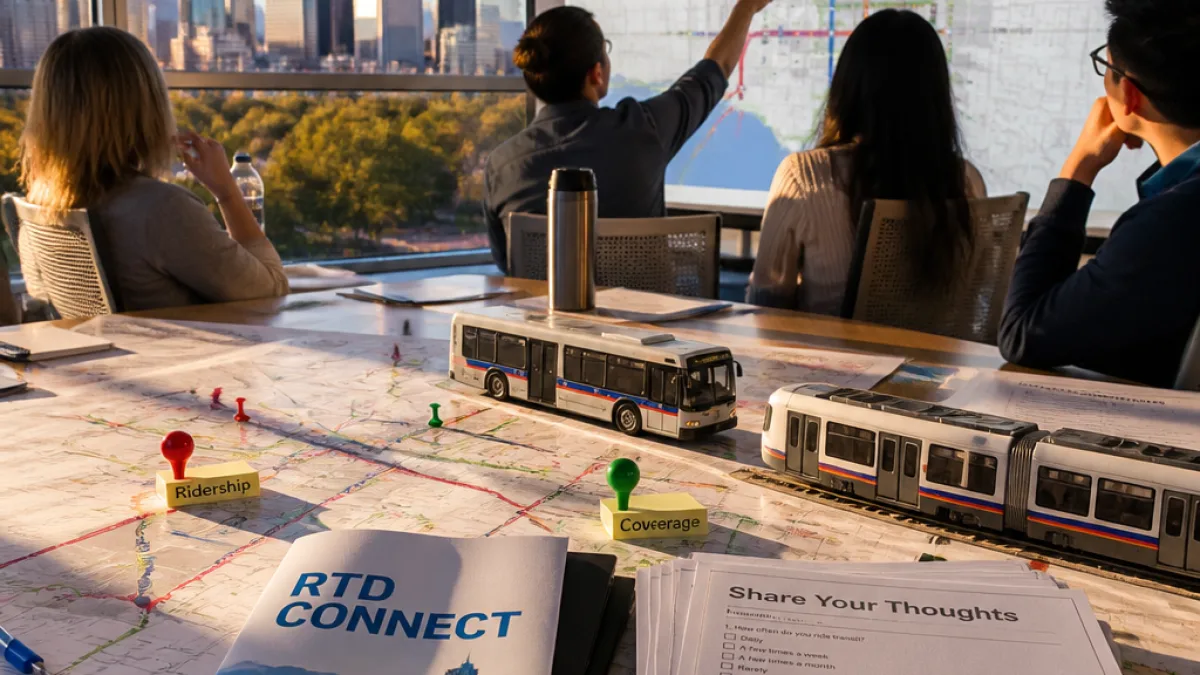
The Regional Transportation District is beginning a public outreach push this fall as it confronts a central trade-off that could reshape transit across metro Denver: should the agency prioritize moving the most riders with faster, more frequent service on fewer routes, or should it prioritize coverage by offering basic lifeline service to the largest geographic area?
The two paths: ridership or coverage
RTD officials previewed the question for the agency's Board of Directors last week and will present concept maps and more detailed analysis at a study session Tuesday. The effort, called RTD Connect, will include six weeks of public engagement across the region in which staff will travel to hear from community members, advocacy groups and local leaders.
Project manager Doug Monroe told the board that a network designed to maximize ridership would concentrate service where demand is highest, offering faster and more frequent trips on fewer corridors. He said such a network could also yield environmental and land-use benefits by reducing pollution and traffic and encouraging more walkable communities.
“These two contrasting networks are really a values judgment for our constituents, our customers, our directors and stakeholders,”
By contrast, a coverage-focused plan would aim to provide basic transit service to as many people and jurisdictions as possible, ensuring lifeline access for riders who depend on transit even in lower-density or less-served areas.
Timing, budget pressure and public input
The planning push comes as RTD faces near-term budget constraints. Agency staff are considering cuts totaling $20 million in routes and services beginning in the spring to help balance a budget deficit. Staffers plan to present concept maps showing coverage possibilities for the two scenarios at the upcoming study session, with a draft plan expected in the first half of 2027.
Community outreach will begin immediately and run through early November, including both in-person and virtual events and a public survey asking residents to weigh RTD's priorities and how to balance ridership and coverage goals.
Local reactions and governance concerns
Some board members expressed hesitation about staff traveling into jurisdictions that currently receive limited RTD service but still contribute tax revenue to the agency. That objection highlights the political sensitivity of any shift toward a ridership-first model, which could be perceived as leaving some paying communities with reduced access.
RTD officials have framed the choice as fundamentally a values decision for elected directors and the communities they represent. The outreach effort is intended to surface those values across a diverse metropolitan area before staff advance detailed design recommendations.
- Six-week outreach tour across metro Denver
- Public survey to prioritize rider vs. coverage goals
- Concept maps and scenarios presented at a board study session
- Draft RTD Connect plan due in the first half of 2027
- Potential $20 million in route/service cuts starting next spring
Implications for Denver riders and communities
For Denver residents, the choice will affect commutes, access to jobs and services, and the appearance of neighborhoods. A ridership-oriented network could mean more frequent buses and trains on core corridors serving dense employment and activity centers, shortening travel times for daily commuters. It may also concentrate investments in multimodal connections and station-area development aimed at increasing transit use.
Conversely, a coverage model would preserve or expand basic service in outlying neighborhoods and suburbs, prioritizing equity and mobility for riders who have no other transportation options. That approach could maintain transit access for seniors, low-income residents and essential workers living in lower-density areas, but might result in slower overall travel and fewer frequent corridors for high-volume trips.
RTD leaders will have to weigh those trade-offs publicly as staff collect feedback. The outcome could influence land-use patterns, environmental goals and which communities gain or lose service — decisions that will echo beyond transit policy into broader debates about growth and taxation in metro Denver.
| Item | Detail |
|---|---|
| Planning effort | RTD Connect; outreach now through early November |
| Budget gap action | Possible $20 million in cuts, beginning spring |
| Next milestones | Concept maps at study session; draft plan H1 2027 |
RTD's outreach schedule and survey will determine how widely divergent viewpoints — from dense Denver neighborhoods to taxpaying suburbs with limited service — are weighted in the final recommendations. As the agency moves from conceptual scenarios to concrete proposals, residents and local officials will have multiple opportunities to make their priorities known.
The board's upcoming discussions will be closely watched by commuters, city leaders and suburban governments alike as metro Denver confronts a fundamental question about who transit is for and how scarce resources should be allocated.

















