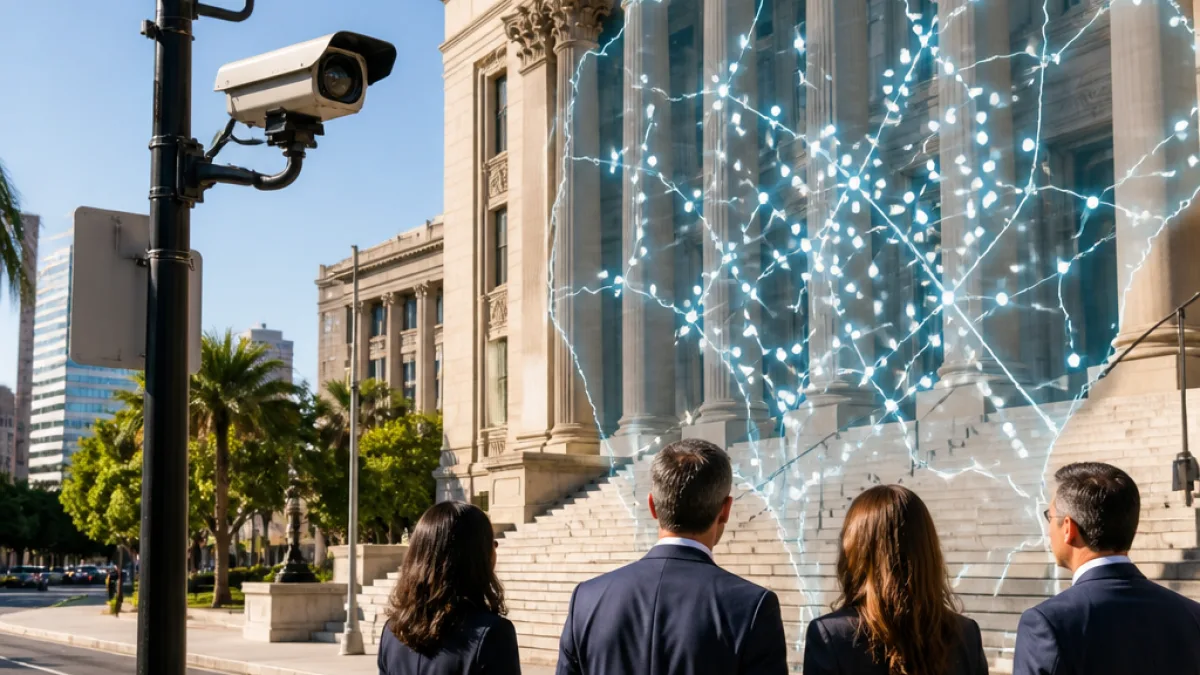
A Santa Clara County judge has dismissed a lawsuit challenging San Jose’s network of automated license plate readers, handing a legal win to the city and marking a setback for residents and civil liberties groups who argued the program amounts to intrusive, mass surveillance.
Court rejects privacy claims
The judge concluded that the city’s use of license plate reader data does not violate the privacy protections guaranteed by the California Constitution or the state’s prohibition on unreasonable searches. The ruling follows an earlier California Appellate Court decision that said drivers generally lack a reasonable expectation of privacy while traveling on public streets.
San Jose operates about 500 automatic license plate readers (ALPRs), a network its officials say helps locate stolen vehicles, identify wanted persons and assist in investigations. Plaintiffs argued the size and density of the system transformed lawful observation of the public right-of-way into a pervasive, unconstitutional surveillance apparatus. The court, however, rejected those arguments.
- Network size: approximately 500 ALPR units operated by the city.
- Legal basis: judge relied in part on appellate precedent that limits privacy expectations on public streets.
- Opposition concerns: data sharing with federal agencies, including immigration authorities.
Local debate and broader concerns
Opposition to ALPR systems has grown across Bay Area municipalities in recent years. Critics contend that collecting and storing location data at scale can enable long-term tracking of individuals’ movements and that sharing such data with federal agencies, including immigration enforcement, raises particularly acute civil liberties risks. Those concerns have been central to public debate in communities weighing whether to expand, restrict or curtail the use of license plate readers.
The court’s dismissal does not eliminate political or administrative pathways for change: civic groups and some city residents continue to press for policy limits on how the technology is used, how long data are retained and with whom the city may share information. City policymakers and police officials have, in other jurisdictions, adopted rules that restrict retention periods and require audits or reporting on data requests; however, any changes in San Jose would come through the city’s own legislative or administrative processes rather than through this court decision.
| Item | Detail |
|---|---|
| Number of ALPRs | ~500 |
| Court action | Judge dismissed privacy lawsuit |
| Relevant precedent | California Appellate Court: no reasonable expectation of privacy on public streets |
Legal observers say the appellate precedent cited by the judge could be persuasive in other cases challenging surveillance technologies used in public spaces. That precedent centers on a longstanding principle in Fourth Amendment jurisprudence: observations made from public areas are generally not protected by the same privacy expectations that apply to private spaces.
For San Jose residents who opposed the cameras, the ruling will likely intensify advocacy efforts aimed at city officials rather than the courts. Advocates have emphasized non-judicial strategies in other communities, including ballot measures, city council resolutions and negotiated policies that limit data retention and sharing.
San Jose law enforcement officials have argued the system provides operational benefits for public safety, saying ALPRs help recover stolen vehicles and assist in locating suspects. Opponents counter that the potential benefits do not erase the broader civil liberties implications of centralized, searchable location records tied to vehicle identifiers.
The judge’s decision, as it stands, leaves the city free to continue operating its ALPR network under current practices unless the city itself alters policy or a higher court reaches a different conclusion on privacy expectations for public travel. Residents concerned about the program’s future will likely watch both San Jose policymaking and higher court rulings for avenues to restrict or reshape how the technology is used locally.