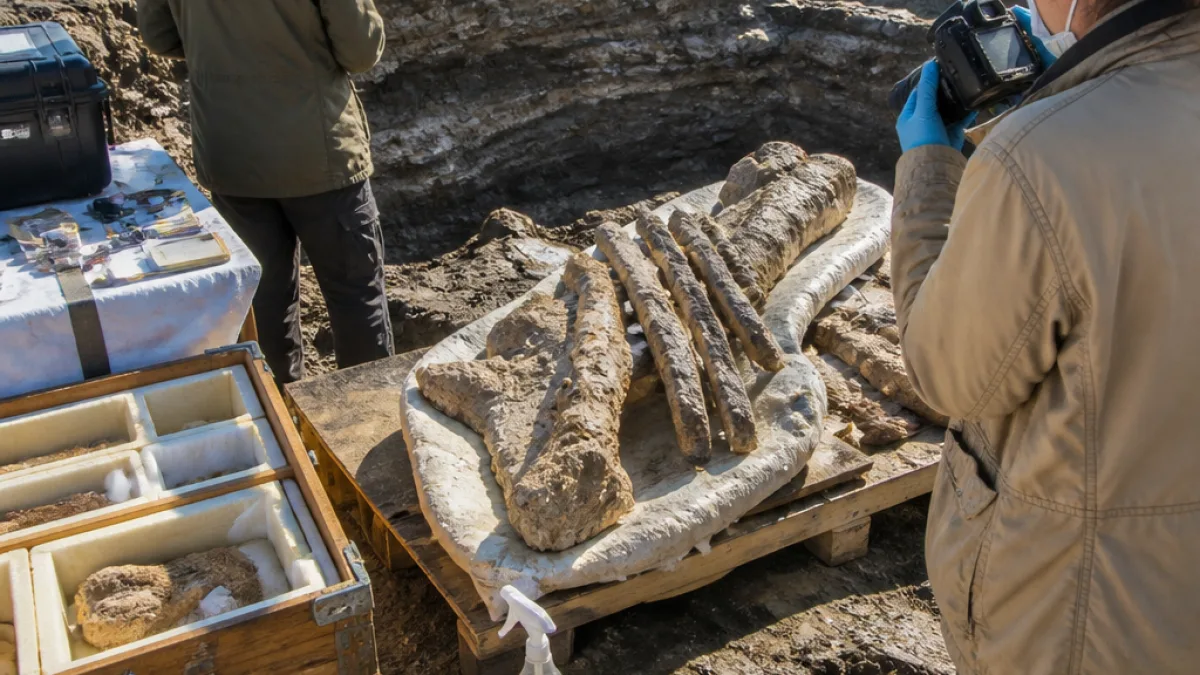
Fossil discovery found beneath an Oceanside construction trench
OCEANSIDE — Excavation work tied to a city infrastructure project turned up fossilized remains of a large, hoofed mammal on Aug. 31, city officials and paleontologists said, providing a rare window into the area’s deep past. The bones, found about 12 feet below the surface, include several limb bones, ribs and other fragments that scientists say date back roughly 40 to 45 million years.
Helix Environmental Planning’s principal paleontologist, Joe El Adli, led the on-site recovery. His team spent the following week exposing the remains and stabilizing them for removal. To protect the specimens during transport, the bones were placed in a plaster field jacket and taken to an off-site laboratory for further study, the city said.
“We dug in to build something for Oceanside’s future and came up with a piece of its ancient past,” said City Manager Jonathan Borrego.
Geologic context and significance
The fossils were recovered from what the city identified as Member C of the Santiago Formation, a sequence of sedimentary rocks that crop out across parts of northwestern San Diego County. That unit is associated with the Eocene Epoch, a period often called the Modern Age of Mammals that followed the extinction of non-avian dinosaurs.
- Discovery date: Aug. 31
- Depth: approximately 12 feet below grade
- Recovered material: limb bones, ribs and additional bone fragments
- Age estimate: roughly 40–45 million years
- Formation: Member C, Santiago Formation
Site protection and next steps
City officials are withholding the exact location of the find to protect both the site’s scientific integrity and public safety. Excavation operations were paused while paleontologists documented the material in situ and removed the fossils. The specimens are now in laboratory care; city staff and the Helix team did not release further details about planned analysis, potential exhibits or long-term storage.
The discovery underscores the intersection of municipal construction and paleontological resources. Under California law, projects that disturb land with paleontological sensitivity typically must monitor ground-disturbing work and follow protocols for discovery, recovery and curation of fossils. In this case, a qualified paleontological monitor was on site and able to respond immediately once material was encountered.
Local implications
For Oceanside residents, the find offers both scientific interest and practical considerations. Short-term, the city’s decision to withhold the location reduces the risk of looting or inadvertent damage. Longer term, the presence of scientifically significant deposits could require additional monitoring or mitigation on future projects in the same geologic unit.
City Manager Borrego framed the find as both a surprise and an opportunity. The discovery invites local residents to reflect on how dramatically the region’s environment has changed since the Eocene, when different climates and ecosystems prevailed.
| Item | Detail |
|---|---|
| Discovery method | Construction excavation with on-site paleontological monitoring |
| Immediate treatment | Seven days of on-site preparation, plaster field jacket, off-site transport |
| Public disclosure | General announcement; exact site location withheld |
The city has not announced a timeline for scientific analysis or public outreach related to the fossils. Museum partnerships, additional research and potential displays are common outcomes for significant local finds, but officials have not confirmed whether those options are under consideration.
With the material now secured, paleontologists will be able to study the bones in controlled conditions and better determine what kind of animal left them, the preservation state, and what the specimen can tell scientists about Oceanside’s prehistoric environment.
This discovery serves as a reminder that construction across Southern California often intersects with important paleontological resources, and that monitoring measures can both protect development timelines and preserve scientific heritage.