PHILADELPHIA — A Philadelphia designer has won the top prize in a NASA competition aimed at creating sustainable, resilient food systems for astronauts on Mars.
Local innovation claims first-place prize
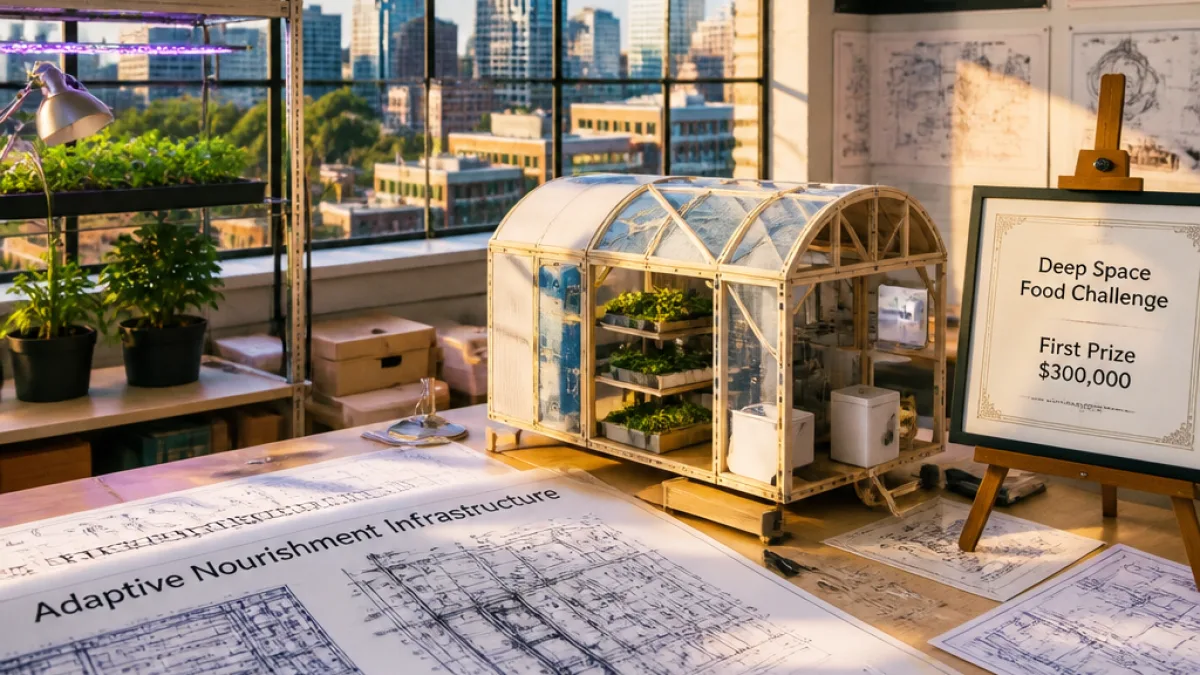
Chinyere Ukeje of Philadelphia received the first-place award of $300,000 for her entry, the Adaptive Nourishment Infrastructure (ANI) food system concept, officials announced Thursday. The award was part of NASA’s “Deep Space Food Challenge: Mars to Table,” which drew 113 entries from 33 countries.
The competition sought integrated food solutions capable of supporting a crew of 15 astronauts for 500 Martian sols — a Martian sol being roughly 24 hours and 37 minutes, which NASA notes totals about 513 Earth days. Entrants were required to propose systems that deliver safe, nutritious meals while coping with the operational limits of space missions.
Design goals and resilience
Ukeje’s ANI concept is described as a modular food ecosystem that emphasizes daily preparation of fresh meals and the ability to persist through shortages of power, water, equipment or crew time. Those resilience features were central to NASA’s priorities for the challenge, which aimed to foster solutions that could operate reliably in constrained, remote environments.
“We’re thrilled to keep advancing the future of space food systems with this challenge,” said Jennifer Edmunson, program manager for Centennial Challenges at NASA’s Marshall Space Flight Center in Huntsville, Alabama. “The future of human space exploration will rely on innovative food systems, and it is amazing how much ingenuity this challenge has helped us identify from participants near and far.”
NASA awarded a total of $650,000 in prizes for the competition. Ukeje’s first-place award of $300,000 was followed by second- through fifth-place winners sharing the remaining $350,000. The contest organizers evaluated entries on multiple dimensions tied to nutrition, safety, system integration, and the capacity to function under mission constraints.
What the award means for Philadelphia
The prize highlights Philadelphia’s contribution to applied design and engineering challenges tied to national science goals. Local universities, research centers and private-sector designers have increasingly sought partnerships and competitions as pathways to visibility and funding; this award places a Philadelphia-based concept on a national stage tied to one of NASA’s long-term exploration objectives.
- Entries: 113 submitted from 33 countries
- Prize pool: $650,000 total awarded by NASA
- Top award: $300,000 to Chinyere Ukeje for the ANI concept
- Mission parameters: Food plan for 15-person crew for 500 Martian sols (~513 Earth days)
| Placement | Prize |
|---|---|
| First | $300,000 |
| Second–Fifth (combined) | $350,000 |
NASA officials framed the competition as one step toward enabling long-duration human spaceflight by identifying creative approaches to food production, storage and preparation that can operate with limited resources. The agency’s Centennial Challenges program, which ran the contest out of the Marshall Space Flight Center in Huntsville, Alabama, has used similar open-competition models to spur innovation in other technology areas.
For Philadelphia, the award reinforces the city’s presence in national science and design conversations and may encourage more local participation in federal innovation programs. The recognition also provides financial support that may allow the ANI concept to advance to further development or demonstration phases, depending on future opportunities and partnerships.
NASA and competition program managers emphasized the range of international entries and the diverse problem-solving approaches they revealed, signaling continued interest in collaborative solutions as the agency prepares for human missions farther into the solar system.