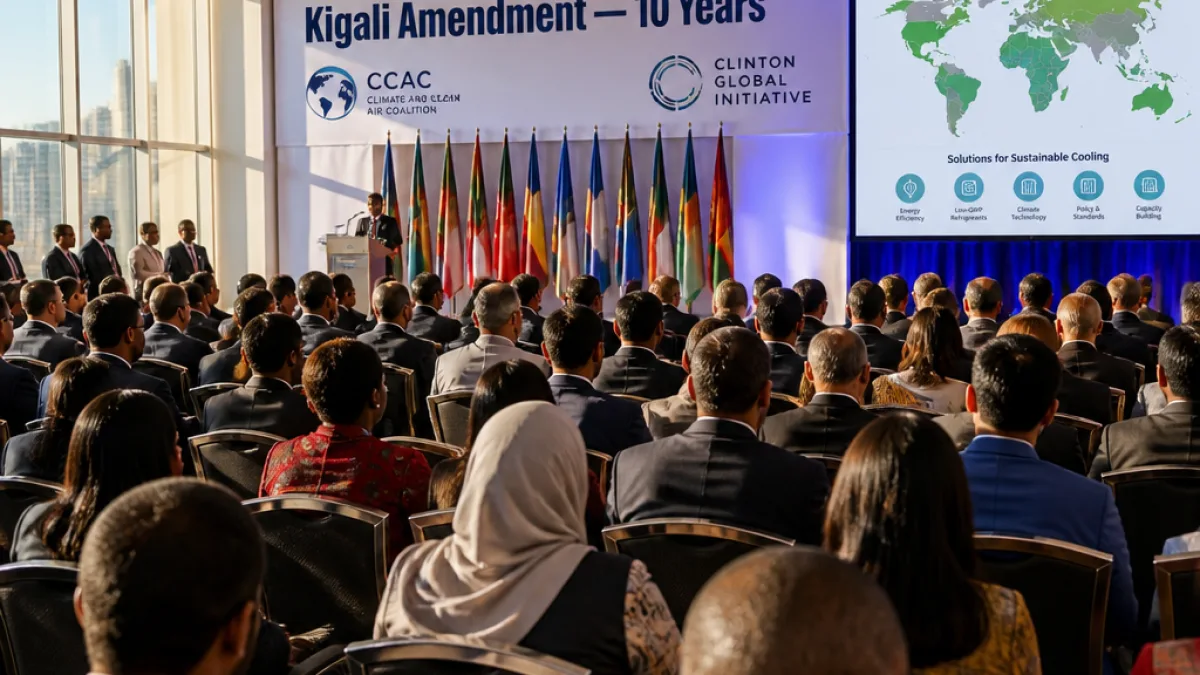
NEW YORK — Delegates meeting at New York Climate Week used Monday’s programming to push the conversation on sustainable cooling into the next decade, marking the approaching 10th anniversary of the Kigali Amendment and unveiling efforts to speed national responses to high‑impact climate pollutants.
Anniversary prompts focus on implementation
The day’s session at the Cool House, convened by the Refrigerant Emissions Elimination Forum (REEF), brought governments, industry and civil society together to review progress under the Montreal Protocol and the Kigali Amendment and to consider what comes next as global demand for cooling surges.
Martina Otto, head of the Climate and Clean Air Coalition (CCAC) Secretariat, joined Rwanda’s Minister of Environment, Dr. Bernadette Arakwiye, and other officials for an opening plenary that emphasized the long‑term consequences of present choices on technologies, refrigerants and investment. Panelists underscored that those decisions will shape economies, energy systems and everyday life for decades.
Speakers highlighted that while the Kigali Amendment has helped move the world away from the most damaging refrigerants, the coming decade will require targeted support for countries seeking to go beyond compliance. That support includes combining political ambition with capacity building, rigorous evidence and practical, in‑country assistance.
From ambition to implementation: a new accelerator
In a parallel strand of events, the CCAC’s Super Pollutant Country Action Accelerator was featured on the Clinton Global Initiative stage as part of the broader Climate Week programming in New York. The Accelerator aims to help countries translate high‑level pledges into on‑the‑ground projects and policies that cut emissions of short‑lived climate pollutants and other super pollutants.
The commitment, presented by the CCAC at CGI, launched with an initial cohort of seven countries. It is designed to bring together political engagement, technical expertise and practical support focused on national priorities and sectors where reductions deliver near‑term climate and health benefits.
- High‑level political engagement to secure decisionmaker buy‑in
- Technical assistance to design and implement policies and projects
- Practical, country‑level support tailored to national circumstances
Officials said the Accelerator seeks to move countries faster from ambition to implementation, prioritizing interventions that both reduce warming and improve air quality.
Cooperation and the road ahead
Discussion at the Cool House also turned to renewed international cooperation. Organizers noted that with the Kigali Amendment turning 10 in October, attention is already shifting toward how partners can sustain momentum and broaden participation in the years ahead.
Delegates flagged an upcoming Beyond Alliance Super Pollutant Action Summit scheduled later in the week, where governments and partners are expected to elaborate additional measures and cooperation mechanisms through a Friends of the Kigali Amendment platform.
| Entity | Role at Climate Week |
|---|---|
| REEF (Refrigerant Emissions Elimination Forum) | Convened the Cool House sessions |
| CCAC (Climate and Clean Air Coalition) | Presented the Super Pollutant Country Action Accelerator |
| Rwanda Ministry of Environment | Participated in opening plenary; Minister Arakwiye spoke on choices shaping the coming decades |
Observers at the events said success in the next phase will require sustained finance, technology transfer and locally tailored policies. Experts stressed that addressing refrigerant emissions and energy efficiency together can unlock compounding benefits — reducing greenhouse gas emissions while cutting energy demand and improving public health.
The conversations in New York reflect a wider debate about how international agreements move from legal frameworks into concrete action. Policy makers at Climate Week repeatedly returned to the theme that technical solutions exist, but scaling them will depend on political will, accessible funding and capacity building at the national and local levels.
For New York and other regions facing increasing cooling needs, the stakes are immediate: reducing super pollutants and improving efficiency can lower electricity demand during heat waves, improve air quality, and limit near‑term warming. The CCAC and partners are positioning the Accelerator as a mechanism to help national governments seize those co‑benefits.
Delegates said more details on partnerships and commitments were expected to emerge later in the week. As the Kigali Amendment’s 10th anniversary approaches, organizers at Climate Week said they hope the momentum built in New York will translate into expanded national action and new financing pathways that make sustainable cooling a practical option for more countries.
Camille Rousseau, WE NEWS