
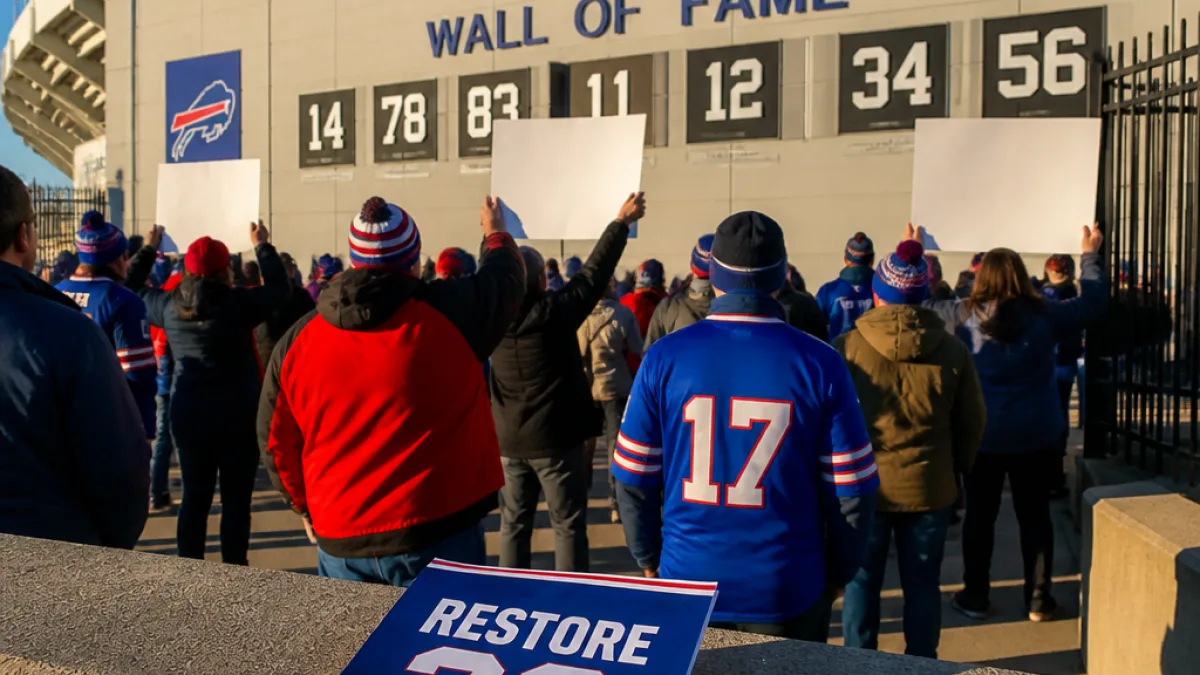
The Buffalo Bills opened Highmark Stadium this week with a visibly altered Wall of Fame: the number 32, long associated with former running back O.J. Simpson, is no longer displayed. The change has prompted a local movement pushing the franchise to reinstate Simpson on the new stadium’s honors, even as others say the exclusion is warranted.
Legacy on the field vs. controversies off it
Simpson, who spent nine seasons with the Bills and captured the NFL Most Valuable Player award in 1973, was the first person enshrined on Buffalo’s Wall of Fame in 1980. His number remained on the wall at the team’s previous stadium for decades, through highly publicized legal troubles and later developments in his life and career. Simpson died in 2024.
When the Bills unveiled the new Highmark Stadium for the first regular-season game, supporters scanning the new Wall of Fame noted Simpson’s absence. The decision has drawn mixed reactions among fans and civic leaders.
Local activism seeks reinstatement
Betty Jean Grant, a local activist, is leading a campaign urging the Bills to restore Simpson’s place on the Wall of Fame. Supporters say the franchise should acknowledge his on-field accomplishments and longstanding place in the team’s history.
“If they had been brave enough to say that ‘we don’t want him on the wall because we think he got away with murder,’ then they should say that,” Grant told reporters. “Not just say he’s not fit. What does not fit mean? He was fit when he ran for 2,000 yards and made Buffalo world famous. He was fit when he got inducted into the National Football League Hall of Fame in 1985. He was fit when he was put on a wall in Buffalo in 1980.”
Grant’s remarks underscore the central point of the push: that historical recognition for athletic achievement should be made explicit and consistent, rather than being left to vague statements about “fitness” for commemoration.
What remains in dispute
The Bills organization has not released a public, detailed rationale tying the change to specific policy language in the team’s honors criteria. Advocates for keeping Simpson off the wall point to the broader ethical and reputational considerations a public institution faces when choosing figures to honor.
- Supporters want restitution of historic recognition tied to Simpson’s records and Hall of Fame induction.
- Opponents emphasize moral and community-image concerns that make honoring certain figures problematic.
- Team officials have so far allowed the new Wall of Fame to stand without Simpson’s number, but community pressure may lead to further statements.
The debate touches on wider questions of how sports teams and cities reconcile athletic accomplishments with a public reckoning over personal conduct — an issue other franchises and institutions have confronted in recent years.
| Year | Event |
|---|---|
| 1980 | Simpson named first member of Buffalo’s Wall of Fame |
| 1985 | Simpson inducted into Pro Football Hall of Fame |
| 2024 | Simpson died |
| 2026 | New Highmark Stadium opens without Simpson’s number on Wall of Fame |
For many in Buffalo, the Wall of Fame is more than a list of statistics; it is a public display in a municipal-adjacent venue that forms part of the city’s cultural and sporting identity. That makes the question of who is honored there a civic conversation as much as a sports one.
Officials with the Bills organization did not provide a new statement about the Wall of Fame decision in reporting on the opening game. For now, a vocal segment of fans, led by Grant, is organizing to press the franchise for a clear explanation and possible reversal.
The outcome could set a precedent for how the Bills and other local institutions handle historical recognition tied to complicated legacies, and it ensures the discussion will continue in Buffalo civic life in the weeks and months ahead.

















