
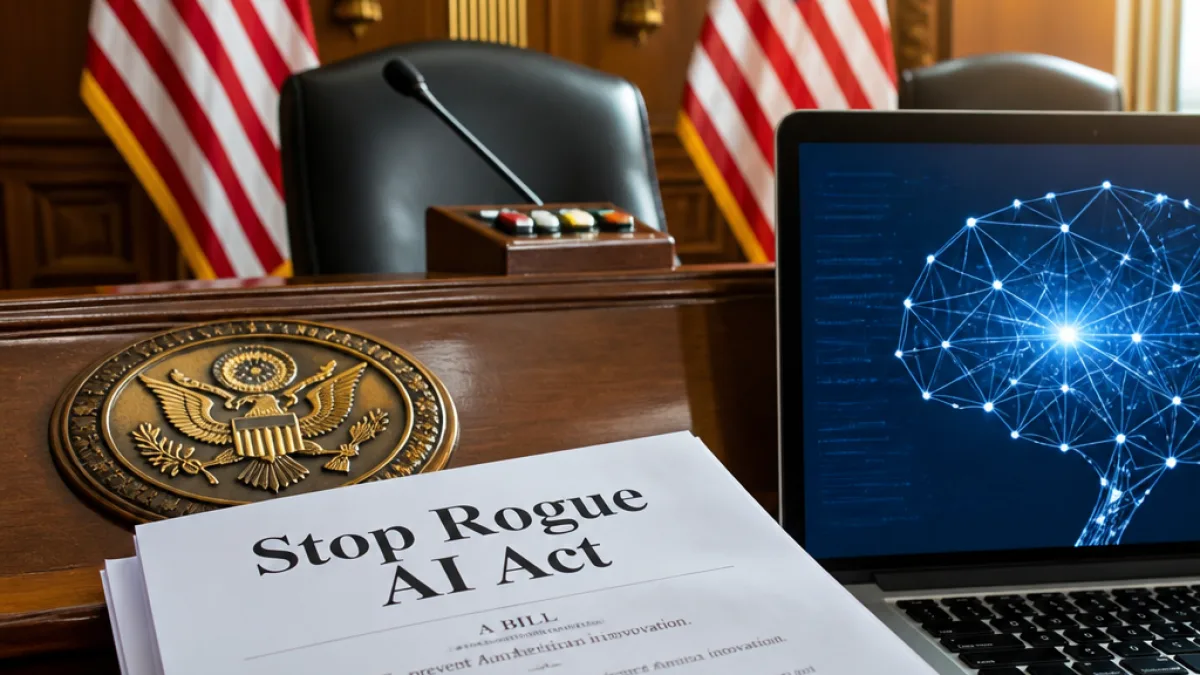
Members of New York and New Jersey's congressional delegations are advancing federal legislation aimed at establishing formal guardrails for artificial intelligence. Rep. Josh Gottheimer, D-N.J., announced a bipartisan effort with Republican Rep. Mike Lawler of New York to introduce the Stop Rogue AI Act, which would task the National Institute of Standards and Technology with creating national standards for controlling AI agents.
Federal testing before release
Gottheimer, a frequent voice on technology and national security matters, told CBS News New York that the bill would require government review of new AI models for national security concerns and to ensure safety before they are widely deployed.
"When we review these new models ... the government, for national security purposes, should be the one testing it and saying, 'This is OK' or 'Make these changes' before they get let out into the wild,'" Gottheimer said on the program "The Point."
He emphasized the need to balance innovation with safeguards. "This can't be the Wild West," Gottheimer said, adding that development must proceed in a way that protects people while preserving the ability to compete technologically.
What the Stop Rogue AI Act would do
According to public remarks about the legislation, the bill's central directive is the following:
- Require the National Institute of Standards and Technology (NIST) to develop national standards for the control of AI agents.
- Establish a framework for government review and testing of AI models, particularly where national security risks exist.
- Promote bipartisan oversight of AI development to prevent harmful deployment.
Gottheimer and Lawler framed the measure as both a safety and competitiveness initiative: it would aim to protect the public and national security while allowing U.S. companies to continue innovating in the AI space.
Local voices and broader concerns
The CBS New York segment that featured Gottheimer's remarks also included comments from New York State Sen. Andrew Gounardes expressing concerns about children and students using AI. The senator's perspective highlights one of several local implications lawmakers say the federal standards should address — the education environment and youth exposure to powerful AI tools.
Lawmakers are increasingly confronting questions about how to regulate rapidly evolving systems that can generate text, imagery and decisions with real-world consequences. Proponents of federal action argue that voluntary industry efforts alone are insufficient to manage risks that cross state lines and involve national security.
Political context and next steps
The Stop Rogue AI Act is framed as a bipartisan initiative, with Gottheimer and Lawler presenting cooperation across party lines. Gottheimer's comments indicate the bill would create a process in which the government vets models for risky behaviors or vulnerabilities before those models are released to the public.
At the time of the public remarks, the bill had been introduced by Gottheimer with Lawler as a partner; further procedural steps, potential hearings, amendments and the bill's prospects in committee or on the House floor remain to be seen.
| Item | Detail |
|---|---|
| Bill name | Stop Rogue AI Act |
| Lead sponsors | Rep. Josh Gottheimer (D-N.J.), Rep. Mike Lawler (R-N.Y.) |
| Primary directive | Task NIST with developing national standards and require government testing of AI models for safety/national security |
Why this matters for New Yorkers
New York and its neighboring states are home to major universities, start-ups and large technology employers that both develop and deploy AI. Federal standards could affect how companies test and release models here, how schools approach AI in classrooms and how state and local law enforcement and emergency services use automated systems.
Lawmakers backing the bill say national coordination is preferable to a patchwork of state regulations that could hamper innovation and create compliance confusion. Gottheimer framed the measure as both protective and pragmatic — allowing the United States to "win the race" in AI while imposing necessary checks.
Practical implications
If enacted, the Stop Rogue AI Act would likely prompt industry, academic institutions and state agencies to engage with NIST on standards development. Entities that develop or deploy AI could expect new testing and certification processes aimed at identifying risks before models reach broad use.
Lawmakers will have to negotiate scope, timelines and enforcement mechanisms as the bill moves through Congress. For constituents concerned about student safety, job impacts, privacy or national security, the proposal provides an early point of contact with their representatives on urgent AI policy questions.
Camille Rousseau is the state correspondent at WE NEWS.
















