
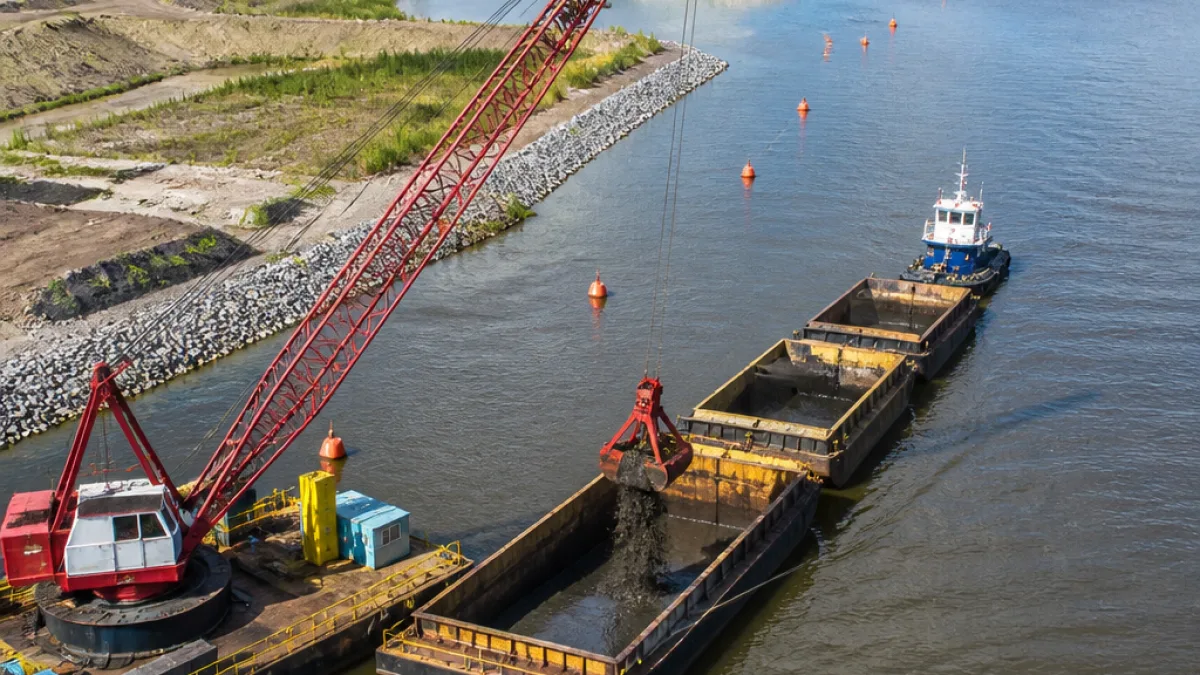
The U.S. Army Corps of Engineers' Buffalo District has launched a maintenance dredging operation that aims to remove about 190,000 cubic yards of accumulated sediment from the Buffalo Harbor and the Buffalo River, work officials say is essential to keep federal navigation channels safe and open for commercial traffic.
Keeping navigation reliable for regional commerce
The $2.3 million project addresses ongoing siltation that reduces channel depths and poses obstacles for vessels using the port. Contractors are mechanically excavating material from the federally maintained channels with a 12-cubic-yard clamshell bucket, loading the dredged sediment into dump scows for transport to a secure disposal site.
"What we're doing here is we're pulling sediment out of the federal navigation channel to allow for ship traffic to get through," said Andrew Kist, Buffalo District Contracting Office Representative for the dredging project.
Work performed under the contract is roughly on a biennial rhythm, depending on funding availability. During active operations, crews can fill approximately eight to ten scows per day; each scow holds about 1,900 cubic yards of material — the equivalent of roughly two Olympic-size swimming pools per scow.
Funding split and site uses
Of the $2.3 million budget, roughly $1.1 million is allocated to dredging in Buffalo Harbor while about $1.2 million supports work in the Buffalo River. A portion of this season's dredged material — approximately 80,000 cubic yards — will be transported to Slip 3 at the Outer Harbor for use in a CAP 204 project that repurposes dredged sediments for ecosystem restoration.
- Project total: 190,000 cubic yards of sediment to be removed
- Funding: $2.3 million total; ~$1.1M for Buffalo Harbor, ~$1.2M for Buffalo River
- Daily capacity: 8–10 scows filled per day, 1,900 cu yd per scow
- Beneficial use: 80,000 cu yd destined for Slip 3 CAP 204 restoration
Once filled, scows deliver the dredged material to a designated confined disposal facility where it is hydraulically pumped and securely managed. The Corps samples and tests removed material to determine appropriate handling and uses, including beneficial placement when suitable.
Local implications and context
Maintaining authorized channel depths is critical to avoid operational restrictions for commercial and industrial users reliant on the port complex. Reduced channel depth can force vessels to carry lighter loads, increase transit times or constrain the types of cargo and ships able to call. By preserving navigation capacity, the Corps' maintenance work supports local and regional supply chains that depend on Great Lakes shipping.
At the same time, the CAP 204 component advances waterfront restoration goals by converting a portion of dredged material into a resource for habitat enhancement at the Outer Harbor. Such beneficial use projects can reduce the amount of material placed in long-term disposal and contribute to ecological improvements along the shoreline.
The Corps' maintenance schedule is subject to funding availability, and projects typically recur about every two years to manage ongoing sediment accumulation. For Buffalo-area stakeholders — from shipping operators to waterfront planners — the current dredging season represents both necessary upkeep for commerce and an opportunity to link navigation maintenance with environmental restoration.
| Item | Amount |
|---|---|
| Total sediment to remove | 190,000 cu yd |
| Dredged material for CAP 204 | 80,000 cu yd |
| Scow capacity | 1,900 cu yd |
| Project funding | $2.3 million |
The corps' contractors will continue operations as conditions permit until the planned volumes are removed. Officials emphasize that the dual goals of sustaining shipping lanes and advancing habitat restoration remain central to the work being carried out along Buffalo's waterfront.
















