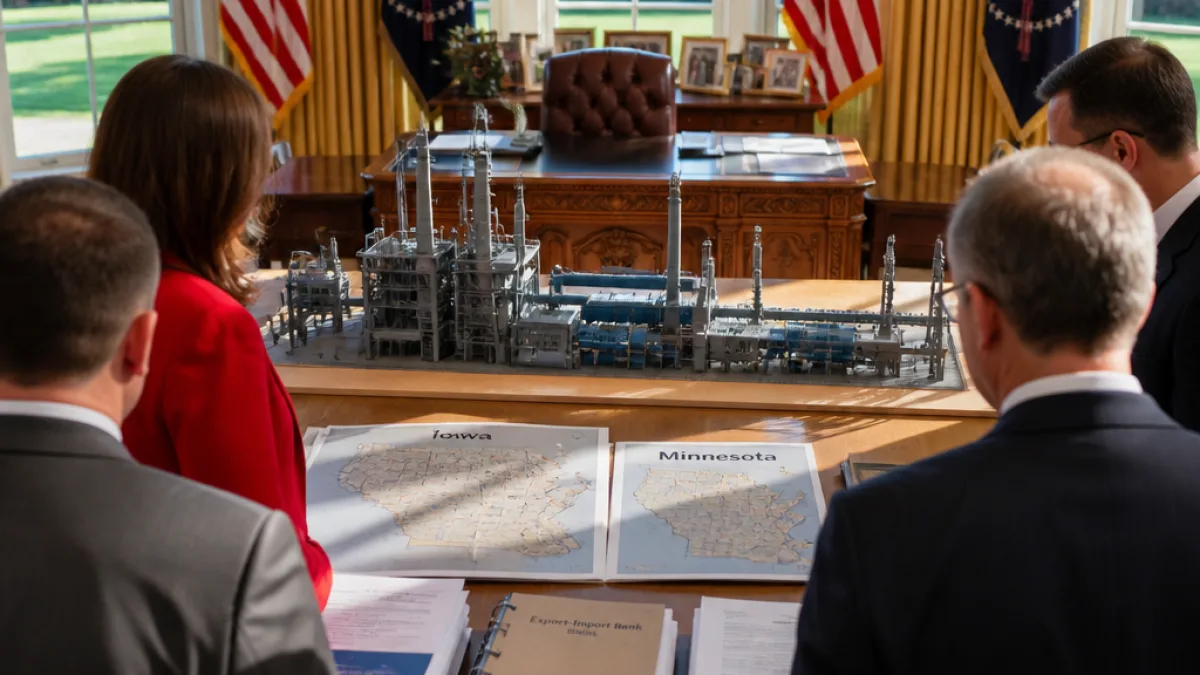
President Donald Trump on Monday unveiled plans for a $15 billion steel mill that federal officials said will be built in Iowa and is expected to produce 10 million tons of steel annually. The announcement, made in the Oval Office, included federal backing and corporate leaders involved in the project.
Project scope and timeline
According to a White House official, the plant is being constructed by Mesabi Metallics and is aimed to begin production by 2030. The company said the facility will produce steel capable of meeting defense-sector requirements for high-grade steel.
“This steel will be mined, melted and made right here in the USA, which is something very unusual,” Trump said at the Oval Office announcement.
The plant is expected to support as many as 1,750 permanent jobs in Iowa, the official said. The announcement also linked the mill to a newly developed iron ore mine in Minnesota’s Mesabi Iron Range that the company invested in separately.
Connections to Minnesota mining and federal financing
Mesabi Metallics recently invested $2.5 billion to build an iron ore mine in Minnesota, which the White House official said will produce about 7.5 million tons of iron per year and create roughly 350 jobs in that state. The mine is located in the Mesabi Iron Range, a region historically significant to U.S. iron production.
“It’s the first new iron ore mine in the United States in more than 50 years,” Trump said, referring to the Minnesota project.
The federal Export-Import Bank has agreed to provide up to $10 billion in financing to support Mesabi Metallics’ expansion in Minnesota, according to an agency release cited by the White House. The bank is the federal government’s export credit agency.
Economic and political context
White House officials framed the mill as part of a broader push to rebuild U.S. manufacturing and reduce dependence on foreign steel. The facilities — the Minnesota mine and the Iowa mill — were presented as domestic supply-chain investments that could supply both commercial markets and defense needs.
The announcement arrives weeks ahead of the 2026 midterm elections, when Iowa figures prominently in competitive races for the U.S. Senate and House. Democrats are also contesting the governorship after more than a decade of Republican control at the state level. The timing of major economic announcements often draws scrutiny for both policy and political implications.
Details at a glance
- Planned Iowa steel mill investment: $15 billion
- Projected annual steel output: 10 million tons
- Estimated permanent jobs in Iowa: 1,750
- Minnesota mine investment: $2.5 billion
- Projected annual iron output (Minn.): 7.5 million tons
- Estimated jobs at Minnesota mine: 350
- Potential Export-Import Bank financing: Up to $10 billion
| Element | Figure |
|---|---|
| Iowa mill investment | $15 billion |
| Annual steel production | 10 million tons |
| Permanent jobs (Iowa) | 1,750 |
| Minnesota mine investment | $2.5 billion |
| Annual iron production (Minn.) | 7.5 million tons |
| Jobs (Minnesota mine) | 350 |
| Export-Import Bank support | Up to $10 billion |
What remains unclear
The White House and company officials provided key high-level figures, but several specifics were not disclosed in the announcement. The precise location of the Iowa mill, details about construction timelines beyond the 2030 production target, local permitting steps, planned wage and benefit levels, and the identities of any local contractors were not detailed in the initial briefing.
Federal financing through the Export-Import Bank was announced for the Minnesota expansion; how much, if any, federal credit or incentives will flow directly to the Iowa facility was not specified by the administration.
Local officials, labor groups and environmental stakeholders will likely seek additional information as planning proceeds. The project’s scale means it could have substantial local economic effects, but it will also face regulatory reviews and community scrutiny typical for large industrial developments.
The White House said the mill will be capable of supporting defense sector requirements and characterized the project as producing “some of the highest quality, most affordable steel anywhere in the world.” For Iowans, the announcement signals a potentially large industrial investment, with further details expected as Mesabi Metallics and federal agencies move forward.