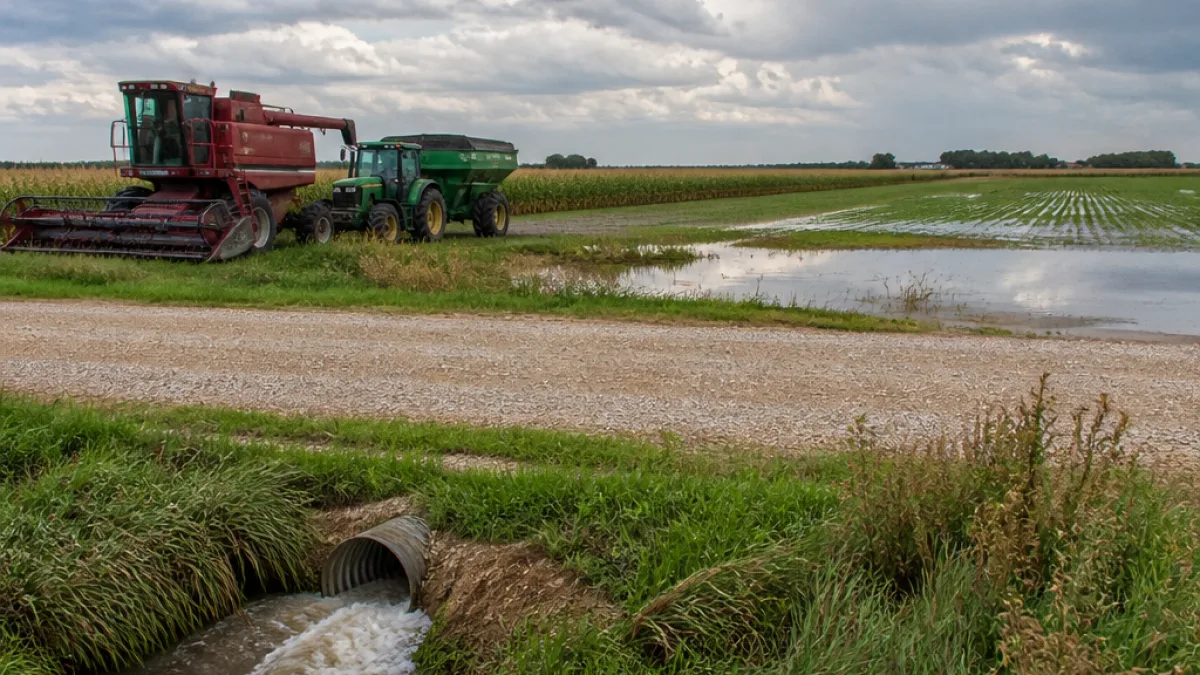
DES MOINES — A week of unusually heavy and persistent rainfall has left Iowa’s 2026 harvest running behind normal pace, according to the latest U.S. Department of Agriculture report and state officials. Farmers recorded just an average of 1.7 days suitable for field work during the Sept. 14–20 reporting period, slowing both maturity and the start of combining across much of the state.
Rainfall totals well above normal
State Climatologist Justin Glisan said preliminary statewide precipitation averaged 3.57 inches for the week — substantially higher than the 30-year climatological normal for September. Many reporting stations recorded totals above 4 inches, with Ainsworth registering the highest weekly amount at 10.63 inches.
The heavier downpours clustered at the beginning and end of the reporting period, and Glisan said the eastern and east-central parts of Iowa received the most dramatic totals. Several counties saw flash flood warnings issued, and officials reported “major flooding” along the Turkey River in Muscatine County.
Harvest and maturity lag behind recent years
According to the USDA crop progress and condition report, Iowa farmers had harvested 4% of corn acres and 2% of soybean acres as of Sept. 14–20. Those figures are behind both the 2025 harvest pace and the five-year average. Corn maturity reached 56% statewide during the reporting period, also trailing last year’s 63% at the same point.
| Measure | Percent / Inches |
|---|---|
| Corn harvested | 4% |
| Soybeans harvested | 2% |
| Corn mature | 56% |
| Statewide weekly rainfall | 3.57 in. |
| Maximum station weekly rainfall (Ainsworth) | 10.63 in. |
Officials urge cautious optimism, watch for more rain
Iowa Secretary of Agriculture Mike Naig described field conditions as challenging but noted some silver linings, particularly for cover-crop establishment. He highlighted the difficulty crews face getting into soggy fields but said the moisture can help aerially seeded cover crops germinate.
“We’re hopeful for a few dry days ahead, but more rain is in the forecast. Conditions are good for flying on cover crops, and the moisture can help get them germinated and growing,”
Naig added that when fields firm up, farmers will move quickly to get combines rolling and advance harvest operations.
Where flooding and field access are worst
Glisan’s analysis indicated the most significant impacts were in eastern counties, where repeated rainfall events produced localized flooding and disrupted farm access. Muscatine County reported major flood impacts along the Turkey River, and several other communities experienced flash flood warnings during the reporting period.
Practical impacts for growers, markets and transport
Delayed harvest affects operations across the supply chain. Wet fields can prevent combines and grain trucks from operating without rutting and compaction; wet grain requires additional drying and can pressure on-farm storage. While the report doesn’t provide statewide yield estimates, slowed maturity and harvest progress can shift the timing of deliveries to elevators and processors.
For farmers considering cover crops, the recent moisture offers favorable conditions for germination where aerial seeding is used, but persistent wetness also raises concerns about sprouting and disease pressure in maturing corn and soybeans.
- Average days suitable for field work last week: 1.7
- Statewide rainfall average: 3.57 inches
- Highest weekly station total: 10.63 inches (Ainsworth)
What farmers say and next steps
Farmers and county extension offices typically respond to stalled harvest by monitoring field firmness, prioritizing high-moisture risk fields, and arranging for supplemental drying capacity when necessary. Local agronomists recommend assessing standability, stalk integrity and disease signs before running combines across fields that have been repeatedly drenched.
State and federal agencies will continue to track weather and crop progress. With additional rain in the short-term forecast, growers face a narrow window to firm fields and begin more widespread combining. Officials said they will be watching for both opportunities to advance harvest and areas needing flood response or recovery assistance.
Meredith Kowalski, State Correspondent