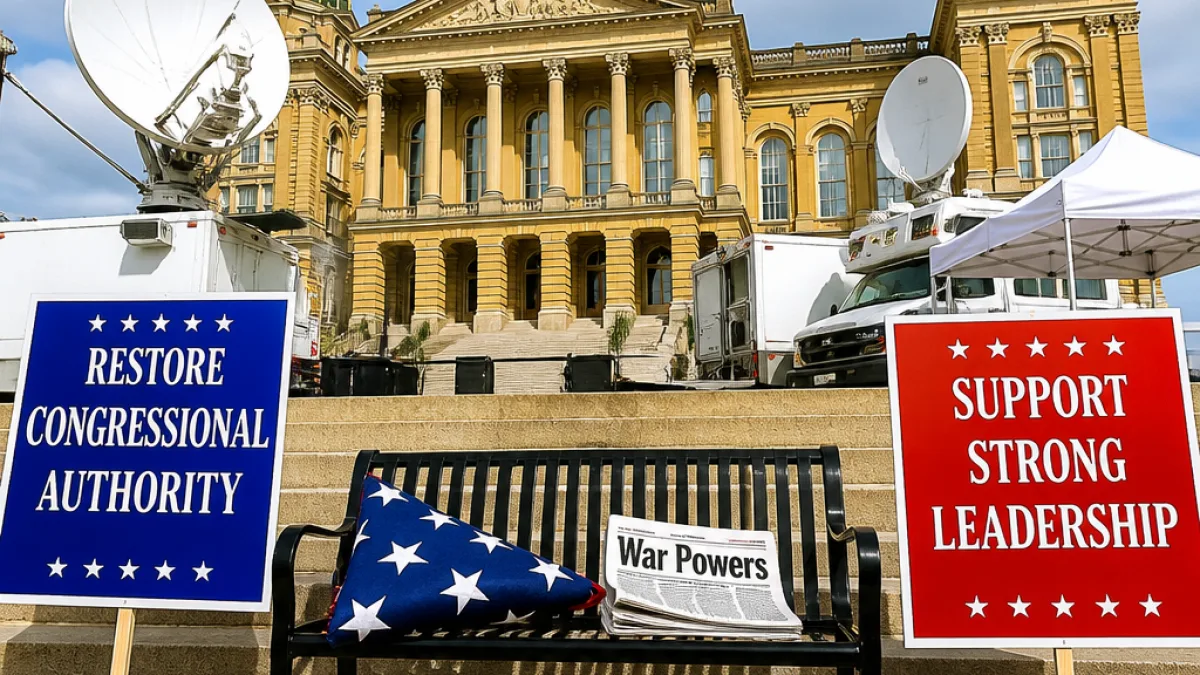
DES MOINES — Two Iowa members of Congress representing competitive districts voted Tuesday in favor of a House resolution intended to constrain the president’s authority to continue military action related to Iran without explicit congressional approval.
GOP defections in closely watched races
Reps. Zach Nunn and Mariannette Miller-Meeks joined Democrats and five other Republicans in supporting the measure after earlier opposing similar efforts. Their shift highlights the political pressure on lawmakers from both parties as November’s midterm contests approach, particularly in districts that could determine control of the House.
Nunn, an Air Force veteran whose re-election campaign attracted national attention last month when U.S. Defense Secretary Pete Hegseth appeared at a fundraiser in his district, said on social media that the negotiating channel with Iran had closed and that sustained combat operations now require congressional authorization. He added he would not back another open-ended military engagement.
"With the negotiating window closed, sustained combat operations now require congressional authorization," Nunn wrote. "I will not support another open-ended war."
Miller-Meeks, also an Army veteran, issued a statement saying the White House must present both Congress and the public with a clear plan to end the conflict so the focus can return to bringing soldiers home and easing costs facing Americans at the pump. She emphasized broad voter opposition to open-ended conflicts.
Local races and national stakes
Nunn is set to face Democrat Sarah Trone Garriott in November in a race that political observers view as competitive. Miller-Meeks is preparing for a rematch with Christina Bohannan, whom she has defeated twice.
Both representatives framed their votes as a response to constituent concerns about prolonged military commitments and economic fallout, including higher fuel prices tied to regional instability.
Political context: pressure on Republicans
The move by Nunn and Miller-Meeks follows months of national attention on the U.S. military response and the role of Congress in authorizing prolonged operations. For Republicans in tight districts, the calculus includes balancing party loyalty, national security considerations and the electorate’s unease about extended conflicts.
Their change in position also contrasts with earlier public support they received from national figures. At an August event at the Iowa State Fair, Secretary Hegseth praised Nunn as a reliable ally, saying he did not need late-night phone calls from the president to back the administration’s agenda. The appearance later drew scrutiny and helped fuel debate about political activity by federal officials.
What the vote means for voters
For voters in the affected districts, the votes are a clear signal that at least some Republican incumbents are responding to public anxiety over continued military action and economic impacts. The lawmakers who switched their votes cited the need for congressional oversight and a defined plan to conclude hostilities.
- Constituent concern: Lawmakers cited worries about another prolonged conflict and rising prices.
- Electoral implications: Both representatives face competitive general election matchups.
- Legislative message: The vote signals a push for greater congressional involvement in war decisions.
Names and matchups in brief
Below is a quick reference of the Iowa lawmakers and their fall opponents:
| Representative | Party | 2026 Opponent |
|---|---|---|
| Zach Nunn | Republican | Sarah Trone Garriott (Democrat) |
| Mariannette Miller-Meeks | Republican | Christina Bohannan (Democrat) |
As the midterm campaign season intensifies, both contested districts are likely to see increased attention and spending from national parties and outside groups. Voters will be watching whether these lawmakers maintain their newly stated positions and how those stances are incorporated into campaign messaging in the weeks ahead.
This development also adds to a broader debate in Washington about the balance of war powers between the executive branch and Congress — a debate that is shaping campaign narratives across the country as control of the House remains in contention.
Meredith Kowalski is the state correspondent for WE NEWS covering Iowa politics.