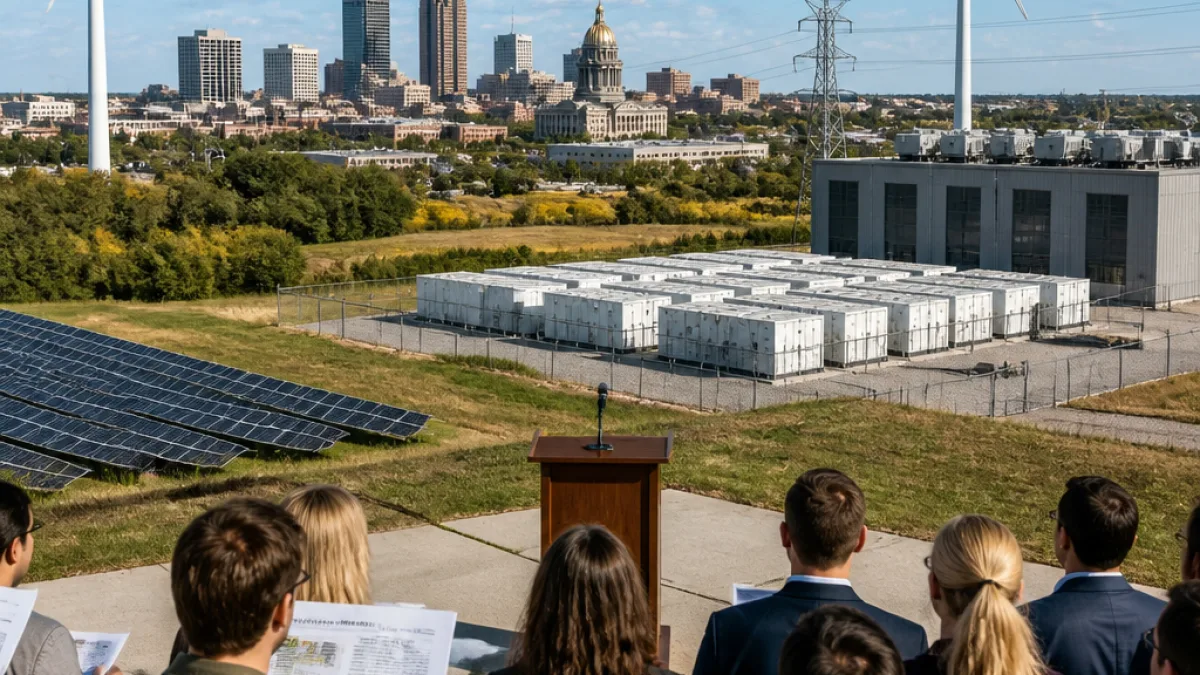
DES MOINES — A coalition of more than 180 Iowa scientists and sustainability scholars on Tuesday published a statewide climate statement urging citizens, utilities and elected leaders to support expanded deployment of wind, solar and battery storage to meet rising electricity needs.
Scientists say state faces a pivotal choice
The 2026 Iowa climate statement frames the present moment as a “fork in the road” for the state’s energy future. The authors argue Iowa can continue its long-running expansion of renewable generation or reverse course by adding new fossil-fuel power plants — a move they say would carry higher costs, public-health risks and emissions.
David Courard-Hauri, a professor of environmental science and policy at Drake University and one of the signers, said a combination of hotter summers, altered precipitation patterns and an influx of energy-intensive data centers makes this an urgent decision point for Iowa.
"We have a choice to make, and we need to make it now,"
At a virtual news conference, Courard-Hauri framed the question bluntly: as utilities and corporations expand generation capacity, should Iowa continue its trajectory toward renewables or revert to fossil-fired plants that carry climate, health and price risks?
Context: demand growth and the data center boom
The scientists pointed to rapidly rising electricity demand across the nation and noted Iowa is seeing increasing interest from large technology companies building independent data centers. Those facilities can significantly raise local power consumption, prompting planners and utilities to evaluate how to serve new load while meeting climate goals.
Researchers on the call highlighted a recent report from the Iowa Environmental Council indicating that coal’s share of electricity generation rose in 2025 after several years of decline. The scientists said that trend underscores the need for accelerated investment in renewable resources and grid storage.
Policy and practical steps urged by researchers
Signers urged a range of actions to favor cleaner generation and smoother integration of renewables into the grid. They asked stakeholders — including ordinary Iowans, tech-industry leaders, local officials and utility executives — to advocate for and adopt cheaper, cleaner and more efficient electricity options while opposing barriers that selectively delay renewable projects.
- Accelerate build-out of wind, solar and battery storage capacity
- Align utility planning with long-term carbon reduction goals
- Ensure permitting and transmission decisions do not unduly hinder renewables
Utility representatives at the event noted that Iowa has continued to add wind and solar projects, and they urged consideration of reliability, cost and grid stability in long-range planning. The scientists and utilities agreed on the need for improved coordination — even as they emphasized different priorities.
Potential local impacts and trade-offs
Expanding renewable generation and battery storage could bring economic benefits, such as construction jobs and new tax bases in rural counties that host projects. At the same time, communities and local leaders will grapple with siting, land use and transmission-line questions that often accompany large-scale energy projects.
Signers warned that choosing to add fossil generation to meet demand would carry volatility in fuel prices and elevated health and climate risks compared with greater reliance on renewables coupled with storage and efficiency measures.
| Issue | Renewable pathway | Fossil pathway |
|---|---|---|
| Emissions | Lower, declining over time | Higher, persistent |
| Price volatility | Lower (fuel-free generation) | Higher (fuel market exposed) |
| Health risks | Reduced | Increased |
As Iowa plans to meet long-term carbon-neutral goals by 2050, the scientists said concerted action across policy, planning and industry decision-making will be necessary to scale up renewables fast enough to match demand growth.
What officials and residents can expect next
The statement is intended to inform public debate ahead of utility planning cycles, local siting decisions and potential state-level policy discussions. Researchers said they will continue outreach to explain technical options and trade-offs to policymakers and community leaders.
For residents, the scientists recommended participating in public utility hearings, engaging with local elected officials on land-use and permitting matters, and encouraging companies and institutions in their communities to prioritize clean energy procurement when feasible.
As Iowa’s energy landscape evolves, the conversation over how to meet rising electricity demand will increasingly shape local economies, environmental health and long-term resilience.