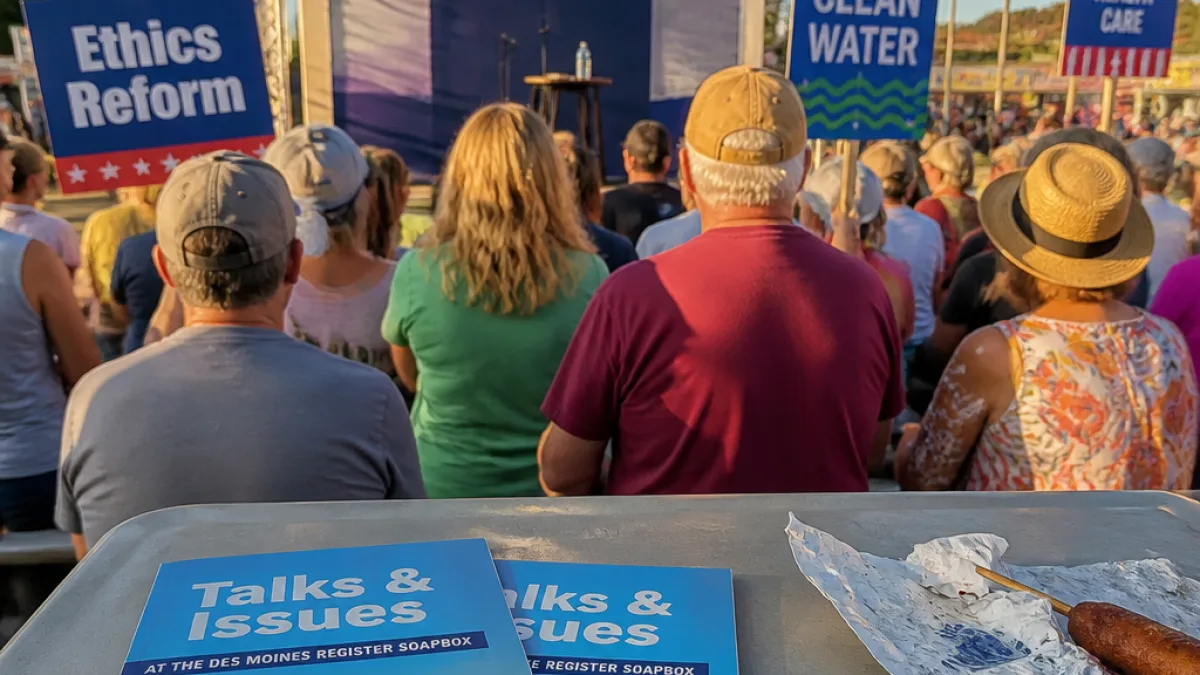
DES MOINES — Republican candidates Joe Mitchell and Zach Lahn addressed dozens of supporters at the Des Moines Register’s Soapbox stage at the Iowa State Fair on Friday, delivering sharply focused messages on ethics reform, local priorities and the role of national politics in Iowa’s future.
Mitchell calls for national investment in his congressional bid
Mitchell, running in Iowa’s competitive 2nd Congressional District, used the fair platform to press supporters and the national Republican apparatus to treat the seat as a higher priority. He framed the contest as winnable but said it requires sustained effort rather than taking the district for granted.
“This district, it stays competitive, but we’re running through the table,”
Mitchell emphasized that victory will require momentum and vigilance. He reiterated policy proposals he framed as anti-corruption measures, including a proposal to impose a 12-year term limit on members of Congress and an end to congressional stock trading by elected officials if he is elected.
The 2nd District matchup has drawn national Democratic attention; Mitchell faces Democratic state representative Lindsey James, who is scheduled to speak at the Soapbox later in the fair. Mitchell suggested that past losses in the district stemmed in part from complacency and urged volunteers and donors to prioritize the race moving forward.
Lahn spotlights state issues, supports limits on data center incentives
Zach Lahn, a Republican candidate for governor, spoke to an enthusiastic crowd despite rainy weather, with supporters chanting as he addressed the stage. Lahn centered his remarks on issues he said affect Iowans directly, including what he termed the state’s “cancer crisis” and concerns over water quality.
“The system is rigged, it’s rigged,”
Lahn blamed national political structures for disadvantaging everyday Iowans and said state leadership should instead prioritize farmers, families and local communities. After his remarks, Lahn told reporters he favors placing moratoriums on some data center construction and plans to establish state-level rules for companies seeking to build those facilities in Iowa. He also said he would support a ban on tax incentives for data center projects.
What the candidates proposed
Both candidates used the high-profile fair venue to sharpen their campaigns’ distinct areas of focus. Their proposals, as described from the stage and to reporters, included:
- Joe Mitchell: greater national party attention for the 2nd District; a 12-year congressional term limit; ending congressional stock trading.
- Zach Lahn: attention to cancer and water-quality concerns; state rules or moratoriums on certain data center projects; banning state tax incentives for those facilities.
| Candidate | Office Sought | Key Issues Mentioned |
|---|---|---|
| Joe Mitchell | U.S. House, IA-2 | Term limits, end congressional stock trading, campaign priority |
| Zach Lahn | Governor (Republican) | Cancer crisis, water quality, data center moratoriums, ban on incentives |
Local context and political implications
The Iowa State Fair’s Soapbox has long served as a venue where statewide and national candidates seek direct engagement with voters. For Mitchell, the stage offered an opportunity to make the case to Republican voters and activists that his race deserves greater investment from the party. For Lahn, the Soapbox allowed him to amplify messaging on issues that can resonate across Iowa’s rural and suburban communities.
National Democrats have identified the 2nd District as competitive, and Mitchell acknowledged that reality while cautioning against complacency. James, his Democratic opponent, is scheduled to speak at the same Soapbox later in the week, underscoring the district’s prominence in the state’s 2026 political calendar.
What voters can expect next
Both campaigns are likely to continue using the fair’s high foot traffic and media attention to mobilize volunteers and donors in the weeks ahead. Mitchell’s request for national party attention may signal a push for increased ad spending or field operations in the district. Lahn’s positions on data centers and incentives could shape debate over economic development policies if those issues gain traction among other statewide candidates or lawmakers.
For fairgoers, the short speeches provided a snapshot of competing Republican priorities as the November elections approach: institutional integrity and campaign urgency on one hand, and state-level economic, health and environmental concerns on the other.
Reporting from the Iowa State Fair provided the accounts of those remarks; additional statements from candidates or campaign representatives were reported to have been made to media following the speeches.