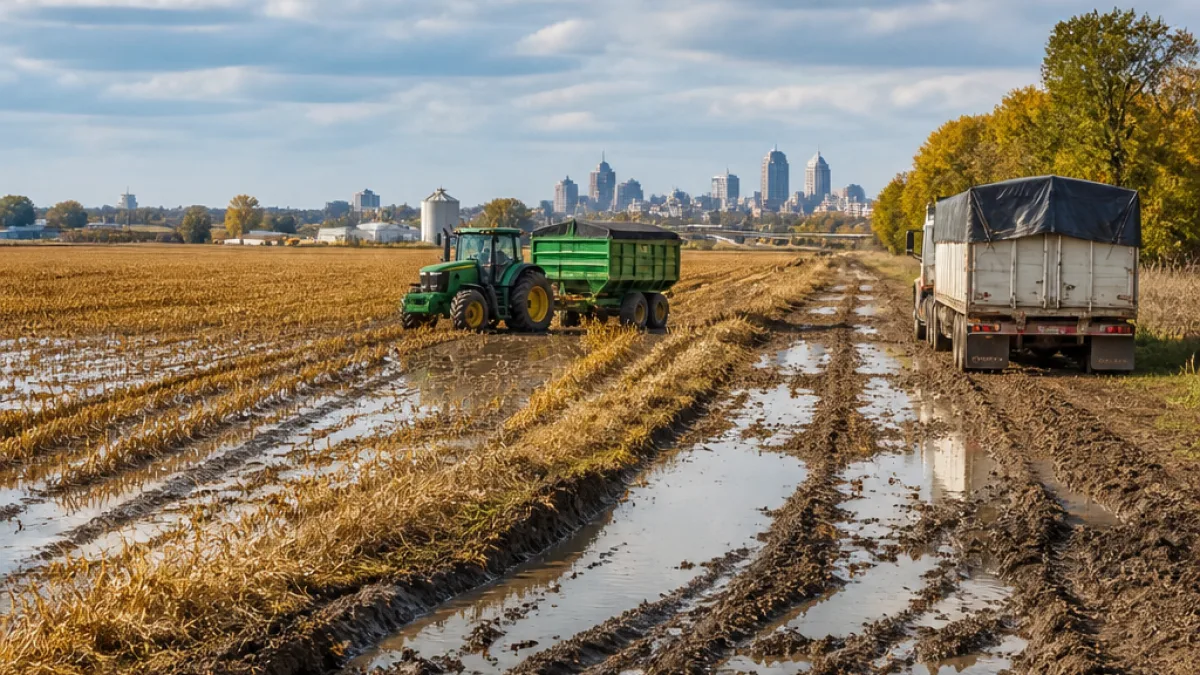
DES MOINES — A week of unusually heavy precipitation has left large areas of Iowa’s cropland saturated and stunted the first signs of harvest, federal and state reports show.
Harvest off to a slow, soggy start
The U.S. Department of Agriculture’s weekly crop progress report for Sept. 7–13 shows about 2% of Iowa’s corn acres had been harvested by the reporting date. The report also indicated that roughly 38% of corn acres had reached maturity — roughly in line with the five-year average but 7 percentage points behind where the state stood at the same time last year.
For soybeans, the report showed no acres yet harvested, although about 22% of that crop had started dropping leaves — a sign of advancing maturity — which is 10 points behind the 2025 pace and 6 points slower than the five-year average.
Rain totals far above normal
State Climatologist Justin Glisan described conditions during the week as "
excessively wet" in his weekly weather summary, noting that several stations recorded rainfall amounts equivalent to 400%–600% of normal for the period. The statewide weekly rainfall averaged 2.05 inches, compared with a normal of 0.84 inch.
Western and central Iowa saw the heaviest totals. Guthrie Center registered the highest single-station amount for the seven-day window at 7.76 inches, according to the climatologist's report.
| Measure | Reported value |
|---|---|
| Corn harvested | ~2% |
| Corn mature | 38% |
| Soybean harvested | 0% |
| Soybeans dropping leaves | 22% |
| Statewide weekly precipitation | 2.05 inches (normal: 0.84) |
Crop condition ratings and what they mean
The USDA rated corn condition as 76% good to excellent and soybeans as 74% good to excellent for the reporting period. Those ratings reflect plant health and vigor but may mask differences at county or farm level, where standing water and ponding can cause localized damage or limit field access.
With more rain in forecast, Iowa Secretary of Agriculture Mike Naig advised growers to shift focus where possible to other pre-harvest tasks and equipment readiness.
"It's a good time for farmers to tackle other important work around the farm, including getting equipment ready for harvest," the secretary said.
- Delayed harvest: Wet fields increase the risk of compaction and slow combine and truck movement.
- Field work alternatives: Equipment maintenance, record-keeping and drainage checks are suggested while waiting for drier conditions.
- Risk management: Farmers may need to monitor mold and grain quality closely once drying and harvest resume.
State officials have already taken administrative steps to ease transport constraints as harvest gets underway: Gov. Kim Reynolds issued a harvest proclamation on Sept. 10 that temporarily allows certain agricultural vehicles to exceed weight limits while transporting farm commodities, a measure intended to keep grain and inputs moving when operations resume.
Local impact and practical considerations
Wet conditions at the start of harvest can ripple through supply chains. Delays in corn and soybean deliveries affect elevators, processors and trucking logistics. Producers may face narrower weather windows later in the season when test weights and moisture content become critical to pricing and storage decisions.
Farmers and ag-service providers told state officials they would prioritize avoiding field traffic when soils are saturated to prevent long-term yield losses from soil compaction — a move that can postpone harvest but protect future productivity.
Producers weighing the timing of field operations should watch local extension service updates and USDA weekly reports for the latest precipitation and maturity information. Conservation practices such as controlled traffic patterns and targeted drainage improvements can help mitigate damage in the weeks ahead, experts say.
As this week's weather unfolds, the balance will be between catching a narrow dry window to bring in grain and protecting soil health for the next season. For now, much of Iowa remains on hold, waiting for fields to dry out enough to allow combines and trucks to move without causing lasting harm.
Meredith Kowalski, State Correspondent