The race for Iowa’s open U.S. Senate seat has sharpened around questions of affordability and tax policy as the state’s two major-party nominees lay out competing proposals ahead of the November general election.
Political observers have flagged the contest as one of the most consequential this year. The Cook Political Report has labeled the Iowa contest a "toss-up," and control of the Senate could hinge on results in states such as Iowa. Republicans currently hold a 53-45 majority in the chamber, with two independents caucusing with Democrats, meaning Democrats would need to flip four seats while defending all of their own to win a majority.
Nominees and the political stakes
Incumbent U.S. Sen. Joni Ernst announced she would not seek reelection, creating an open-seat contest. The Republican nominee is U.S. Rep. Ashley Hinson; the Democratic nominee is U.S. Rep. Josh Turek, a two-time Paralympic gold medalist.
Both candidates have made affordability a central theme of their campaigns and have proposed measures aimed at helping Iowans buy homes, but they differ in specifics and emphasis.
What each candidate proposes
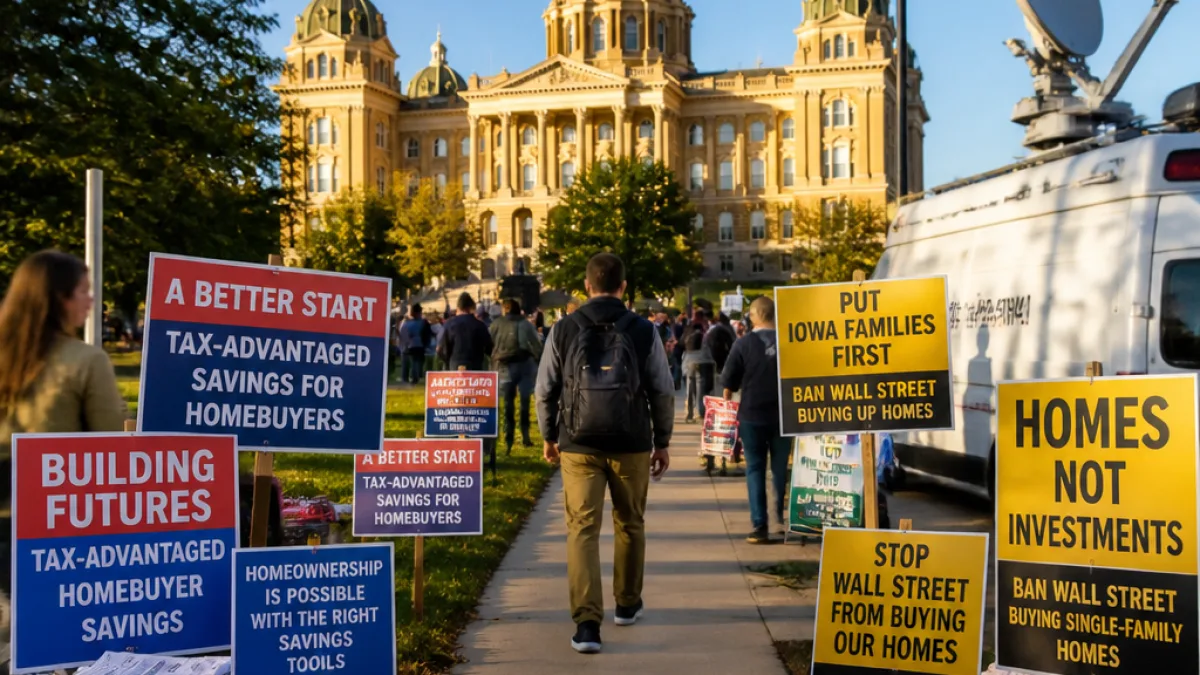
- Ashley Hinson has promoted the First Home Savings Opportunity Act, legislation intended to let prospective first-time homeowners set aside down payments in tax-advantaged accounts so contributions would not be taxed when used to purchase a first home. Hinson said the plan would help more families save for and buy homes.
- Josh Turek also supports limiting institutional buying of single-family homes and has proposed a separate measure that would impose a five-year ban on Wall Street investment firms purchasing single-family dwellings.
“By allowing families to save tax-free to buy a home, we’ll help more families to be able to afford their dream home,”
The preceding comment reflects Hinson’s argument for tax-preferred savings aimed at first-time buyers. Turek has similarly emphasized removing large institutional buyers from the single-family market; his remarks in the source material began,
“Far too many homes are being bought
That partial quote underscores the shared concern between the two campaigns: both candidates identify investor activity in the housing market as a factor reducing access to affordable homes for ordinary families.
Shared ground, divergent paths
While Hinson and Turek overlap in seeking to limit institutional purchases of single-family homes, their policy prescriptions vary. Hinson’s approach leans on tax incentives to assist would-be buyers in accumulating down payments, whereas Turek’s plan targets the market behavior of large investment firms directly with a multi-year ban.
Their differences reflect broader debates about whether tax policy or market regulation is a better lever for addressing housing affordability. Both strategies carry trade-offs: tax-preferred savings accounts may provide direct help to households that can pay into an account, while a moratorium on institutional purchases would alter market dynamics but could raise legal and implementation questions that would need to be resolved at the federal level.
Why Iowa matters nationally
Political analysts are watching Iowa closely because the outcome could help determine which party controls the U.S. Senate. With a narrow majority and several competitive races nationwide, each seat takes on added national significance.
| Item | Number |
|---|---|
| Republican seats in Senate | 53 |
| Democratic seats in Senate | 45 |
| Seats Democrats need to flip for majority | 4 |
What to watch next
As the fall campaign advances, voters can expect more detailed proposals and cost estimates from both campaigns, plus debates and advertising that highlight differences in approach. Housing affordability and taxation are likely to remain central themes in the closing months before the election.
For Iowans focused on housing, important practical questions include which proposals would most directly affect down-payment assistance or the composition of buyers in the single-family market, and how quickly any enacted changes would take effect. Voters should also look for specifics on implementation, eligibility and projected fiscal impact as the candidates flesh out their plans.
Meredith Kowalski, State Correspondent, WE NEWS