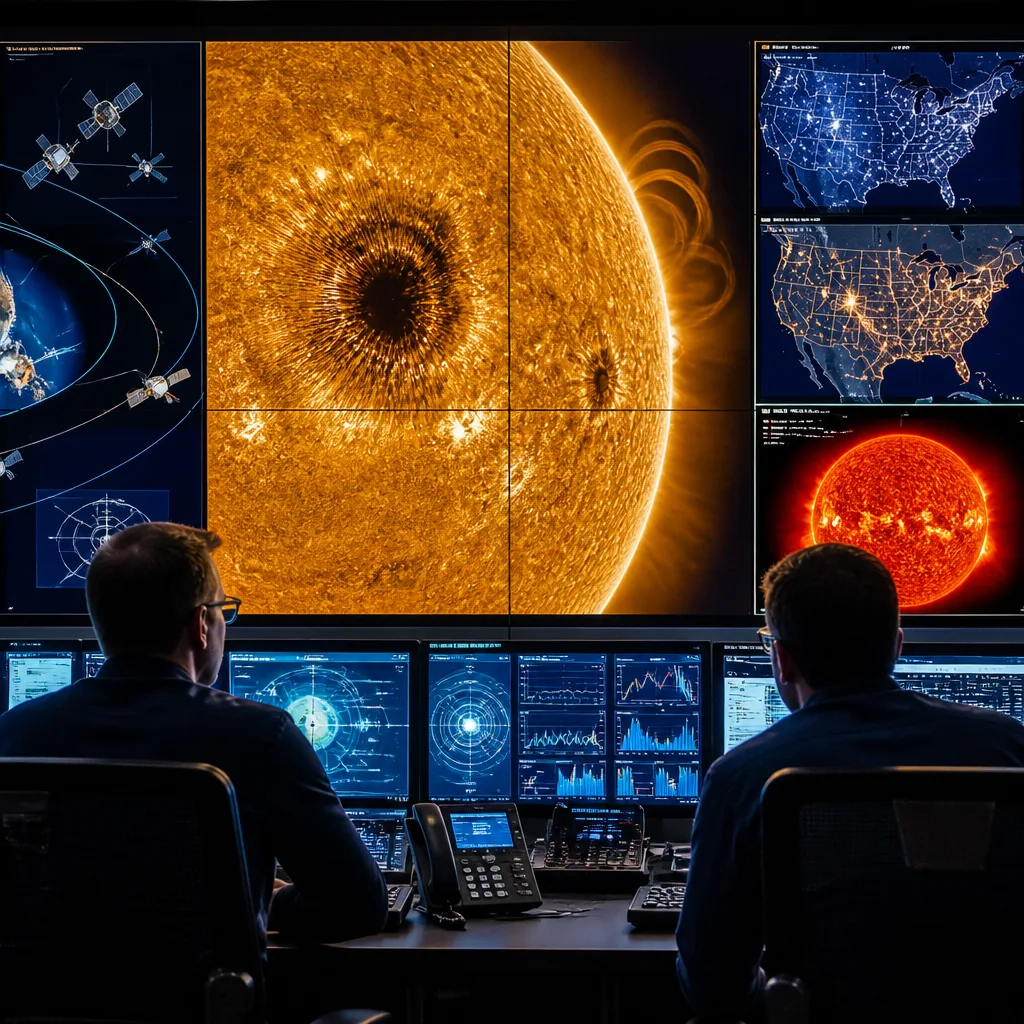
New analysis of the biggest sunspot recorded in the 20th century bolsters the view that our star may be capable of producing a so-called superflare — a burst of solar energy many times greater than the strongest flares reliably observed in the modern era. The finding, derived from historical records and recent modeling, underscores the potential for rare extreme space-weather events that could threaten power grids, communications and satellites.
What the data show
Solar flares are abrupt releases of magnetic energy in the Sun’s atmosphere that can disrupt Earth’s ionosphere, spark auroras and, in severe cases, cause geomagnetic storms that damage electrical infrastructure. The most powerful traditionally cited event is the Carrington event of 1859, which predates modern instrumentation and must be estimated indirectly. That event has been hypothesized to have had a strength near X45 on the solar X-ray classification scale, though precise measurement is unavailable.
By contrast, within the current solar cycle, the strongest flare recorded so far was an X9.0 event on Oct. 3, 2024. Researchers define a superflare as one releasing more than 10^34 ergs of energy — roughly 10 to 100 times the energy of large, typical solar flares and, in one comparison, over 200 times the energy estimated for the Chicxulub impact that contributed to the end-Cretaceous mass extinction.
"From even this simple calculation, I suggested [the superflares] as a possibility," Professor Kazunari Shibata of Kyoto University told IFLScience in 2024. "And of course, this is a big challenge I put to Solar Dynamo theorists. And I encourage many theorists to really study whether this is correct or not."
How a superflare might form
Producing a superflare requires concentrating a vast amount of magnetic energy into a relatively small region, such as an active sunspot group. Models discussed by researchers indicate that while the Sun emits the energy equivalent of a superflare across its disk in seconds, accumulating that energy in a localized region could take years. One simplified model published in 2024 estimated roughly eight years would be required to build up the magnetic energy necessary for a superflare — a long interval but not one that rules out the phenomenon over historical timescales.
Support for the plausibility of such events has also come from stellar surveys. A team at the Max Planck Institute for Solar System Research examined 56,450 Sun-like stars and reported evidence consistent with the possibility that stars similar to our Sun can produce superflares. Those observations motivated renewed attention to whether the Sun itself might generate such extreme eruptions.
Consequences and preparedness
Although superflares are thought to be rare, their potential impacts would be extensive. Effects could range from severe disruptions to satellite operations and navigation systems to widespread electrical outages if Earth's magnetic field were strongly disturbed. The historical Carrington-level event produced telegraph failures and auroras at low latitudes; an event larger by an order of magnitude could have far broader consequences for modern technological society.
- Historic benchmarks: Carrington event (hypothesized near X45), Oct. 3, 2024 X9.0.
- Superflare threshold: >1034 ergs.
- Survey evidence: 56,450 Sun-like stars studied by MPS suggest superflares can occur on similar stars.
| Event | Representative value |
|---|---|
| Carrington (1859) | Hypothesized ≈ X45 |
| Recent top flare (Oct. 3, 2024) | X9.0 |
| Superflare threshold | >1034 ergs |
Scientists caution that translating stellar observations and idealized models into reliable probabilities for future solar superflares is challenging. Key gaps remain in understanding the solar dynamo processes that generate and sustain magnetic fields over years, and in determining how often the Sun could build and release the extraordinary magnetic energy required for a superflare.
Still, the recent work has added urgency to efforts that bridge solar physics, space weather forecasting and infrastructure resilience planning. If the Sun can, on multidecadal to centennial time scales, produce flares in the superflare energy range, governments and industry will face a pressing scientific and policy question: how to anticipate and mitigate the societal risks posed by such exceptionally powerful space-weather events.
Further observational studies of solar activity, improved models of magnetic-energy accumulation, and cross-disciplinary planning for extreme geomagnetic storms are likely to be priorities as the scientific community examines the implications of these findings.