
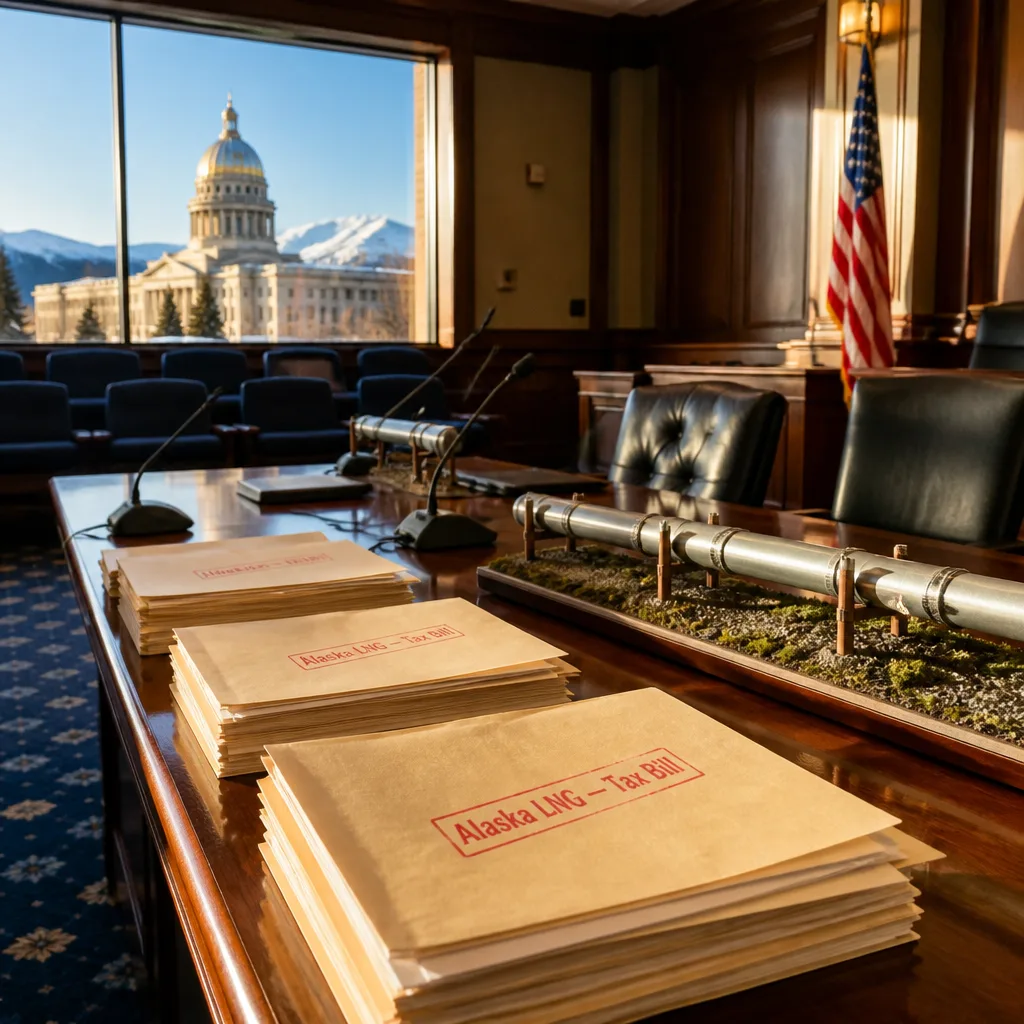
Alaska’s bid to jump-start construction of the long-delayed Alaska LNG project suffered a fresh setback after legislative leaders signaled they will not move forward with Gov. Mike Dunleavy’s new proposal, and prominent business organizations criticized key elements of the plan.
Leaders unlikely to reconvene Senate
The governor filed a bill during a third straight special session that would offer a multibillion-dollar property tax reduction tied to the gas pipeline and include a narrowed expansion of the state’s corporate income tax. But the Senate president told reporters he probably will not call the chamber back for a vote, and House majority leaders said the measure appears short of the support needed to pass.
Lawmakers have repeatedly failed since May to agree on a tax relief package for the project. One central dispute has been over whether to expand the corporate income tax to cover entities that currently do not pay it, such as some large oil and gas producers operating in the state.
Corporate tax expansion at the center of debate
The administration and some legislators favor the proposal to replace property taxes on the pipeline with a tax levied on volumes of gas shipped through the line. But a 14-member bipartisan Senate majority has insisted the legislation must also broaden the corporate income tax so it applies to companies now exempt — for example, certain S corporations and limited liability companies that escape the state C-corporation tax.
The disagreement has been particularly focused on firms like Hilcorp, a major producer on the North Slope and in Cook Inlet, which currently are not subject to the state corporate income tax structure applied to C corporations. Gov. Dunleavy and other supporters of the project have resisted a broadening of the corporate tax base.
Business groups criticize the proposal
Major state business organizations reacted negatively to the governor’s plan when it was unveiled, especially objecting to the proposed corporate tax expansion. Their opposition underscores the political difficulty of finding a compromise that satisfies both the fiscal concerns of the bipartisan Senate coalition and the project’s backers.
Lawmakers also have flagged a lack of information about the project’s costs and benefits as a barrier to approving roughly $1 billion a year in property tax reductions designed to incentivize construction. That uncertainty undercuts arguments in favor of a substantial long-term tax break for a project whose price tag could reach tens of billions.
Scale and timeline of the project
The Alaska LNG initiative aims to move stranded North Slope natural gas to Alaskans via an 800-mile pipeline by 2029 and to international customers as liquefied natural gas beginning around 2031, according to the project's developer. The venture's developer, Glenfarne, holds a 75% stake while the state-owned Alaska Gasline Development Corp. retains 25%.
| Item | Detail |
|---|---|
| Pipeline length | 800 miles |
| Target in-state start | 2029 |
| Target export start | 2031 |
| Estimated cost (developer) | Up to $55 billion |
| Ownership | Glenfarne 75%, State AGDC 25% |
- Key sticking point: whether to expand the corporate income tax to include entities currently exempt.
- Fiscal concern: lawmaker hesitation to authorize roughly $1 billion a year in property tax relief without fuller project data.
- Political reality: bipartisan Senate coalition demands tax changes that the governor and some backers oppose.
The combined effect of legislative division, business pushback and outstanding questions about project economics leaves the governor’s latest pitch for Alaska LNG in doubt. With leadership in both chambers signaling an absence of majority support, the proposal faces long odds of advancing before the special session ends.
How Alaska resolves the impasse will shape whether the project can proceed on the timeline proponents propose and what kind of tax framework — property-based, volume-based or a mix with corporate tax changes — would underpin construction and long-term operations.
















