
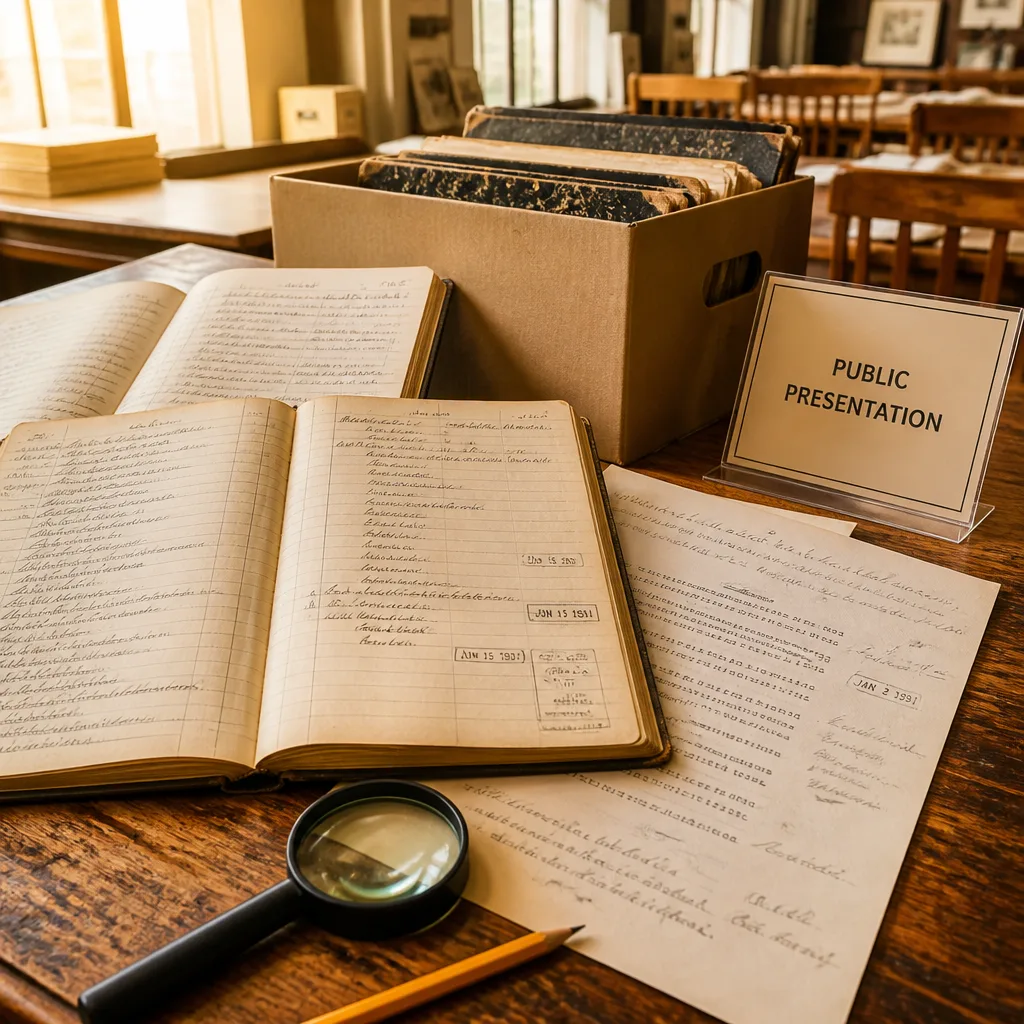
The Fitchburg Historical Society will host a public presentation Oct. 14 on a months-long review of newly acquired police ledgers that document crimes and incidents in Fitchburg from 1930 to 1935, shedding light on how the Great Depression affected everyday lawbreaking and police work.
Researchers Sally Cragin and Dr. Joseph Cronin spent months reading and annotating thousands of pages of typed police records donated to the society earlier this year by the Fitchburg Police Department. Cragin, a Fitchburg City Councilor-At-Large and Sentinel & Enterprise columnist, and Dr. Cronin will present their findings at 6 p.m. Wednesday, Oct. 14, at the Fitchburg Historical Society, 781 Main St. The event is free and open to the public.
Documenting everyday crimes and broader patterns
The researchers cataloged a wide range of incidents recorded in the ledgers, from what they describe as laughable acts of youth mischief to more serious offenses that illustrate the economic and social pressures of the era. Their review identified shifting patterns across categories of crime during the early 1930s.
- Petty crime increased in volume during the years studied.
- Youth mischief escalated, producing anecdotal entries that highlight quotidian behavior and social norms of the era.
- Serious theft involving amounts of $50 or more declined, according to the ledger review.
Cragin and Dr. Cronin say the discrepancies between rising low-level offenses and falling major thefts prompted detailed reading of every entry to identify patterns, contexts and photographic materials of officers from the period.
“We were curious as to why there was such a stark difference in results during the Great Depression,”
Cragin told reporters that the only way to reach answers was painstakingly reading and noting patterns across the ledgers. Among the more colorful entries the researchers highlighted was a juvenile who admitted to bringing pepper from home and blowing it in the balcony of the Cumings Theatre, causing distress to patrons seated below.
Preservation and public access
Fitchburg Police Chief Steven Giannini said the department was pleased to donate the records to the historical society so they could be properly preserved and categorized. In announcing the donation, Giannini emphasized the department’s intent that the collection remain accessible to the community and researchers.
The ledgers, now in the care of the Fitchburg Historical Society, provide a primary-source window into policing, social behavior and community responses during one of the nation’s most severe economic downturns. The researchers also examined period photographs of police officers to situate entries within a broader documentary record.
| Ledger period | Observed trend |
|---|---|
| 1930–1935 | Increase in petty crime and youth mischief; decline in thefts of $50 or more |
Beyond curiosities and anecdotes, the ledgers reportedly contain entries that underscore the link between alcohol and illegal behavior, the researchers said — material that could inform local historians and social scientists studying how economic stressors influence criminal activity.
The public program will present the researchers’ findings and provide residents an opportunity to view the preserved records and photographs. The project underscores an effort by a municipal police department to transfer aging records to an archival institution so that they can be organized, protected and examined by scholars and the public.
Those seeking more information on the Oct. 14 presentation or the ledger collection can contact the Fitchburg Historical Society for details on access and future research plans.















