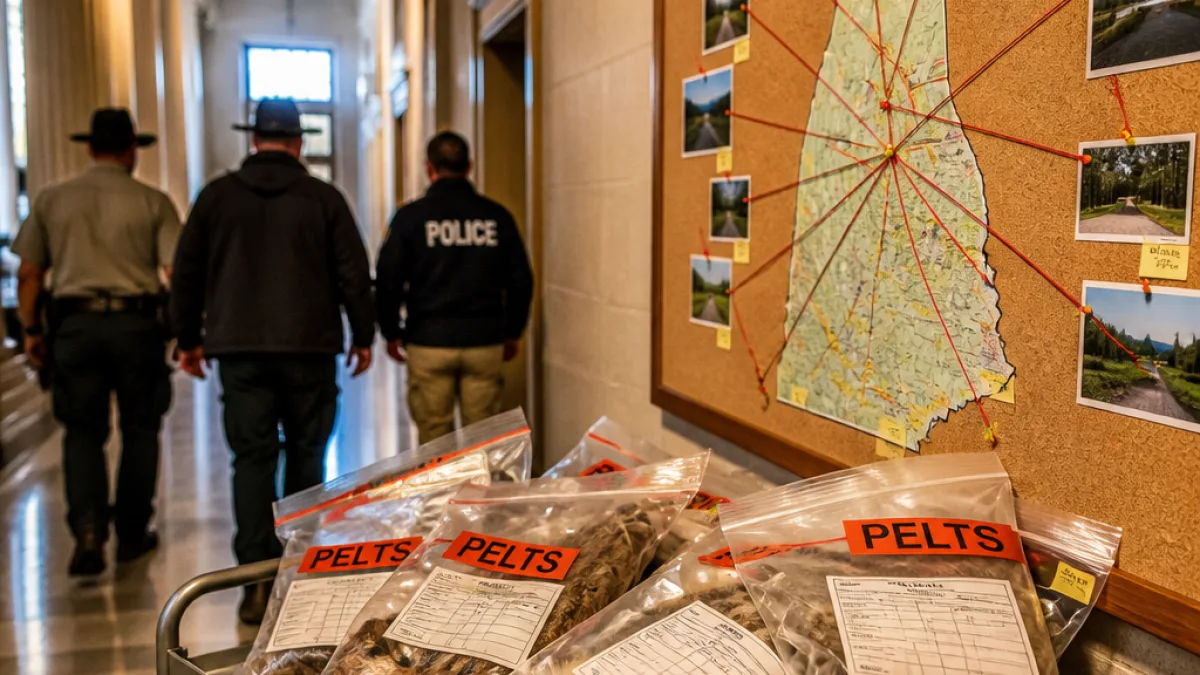
Three men have admitted in federal court to taking part in a scheme that illegally killed more than 40 bobcats in New Hampshire over a four-year period and routed their pelts into the international fur trade, prosecutors said.
Federal charges and pleas
Sherwood Dubrey Jr., 48, and Randy Inman, 49, both New Hampshire residents, pleaded guilty to a conspiracy count under the Lacey Act, a federal law that prohibits importing, exporting, transporting or selling protected wildlife taken in violation of state or foreign law. Sherwood Dubrey Sr., 72, a New York resident, pleaded guilty to a separate Lacey Act violation; court filings say he primarily handled transportation of the animals.
According to the government’s filings, the offenses occurred between 2018 and 2022. Prosecutors say the defendants repeatedly concealed where the bobcats were taken and misused lawful harvesting systems in other states to move the pelts across state and international lines.
How authorities say the scheme worked
Court records outlined a pattern in which bobcats taken in New Hampshire were falsely tagged as having been taken in New York, where regulated bobcat seasons and export programs exist. That allowed the skins to carry the paperwork needed to be processed and ultimately exported, the filings say.
Investigators allege the men used bait piles on private property and on state land to lure bobcats. Some of the kills were documented by rifles equipped to record video or photographs, and images were shared among the participants, the filings say. After tagging, the pelts were shipped to Wisconsin and then placed with an intermediary who exported them to a Canadian fur auction, where bobcat pelts reportedly sold for more than $350 each.
| Period | Alleged activity |
|---|---|
| 2018–2022 | Poaching and falsely tagging >40 bobcats; exporting pelts |
State hunting law and conservation concerns
New Hampshire law prohibits hunting or trapping bobcats. Prosecutors said the defendants undermined systems wildlife managers use to monitor harvests and maintain healthy populations.
“The people of New Hampshire have enacted hunting laws that conserve our resources and define our sense of fair play,” said Erin Creegan, U.S. Attorney for the District of New Hampshire. “Baiting and poaching dozens of bobcats for profit disregards that democratic consensus and the duty of sportsmanship shown by New Hampshire’s hunters. Crossing state or international lines will not protect poachers from accountability for their actions.”
Court documents include a message from Dubrey Jr. indicating he opposed the idea of establishing a legal bobcat hunting season in New Hampshire because it would create “competition.” The filings portray the operation as a commercial effort rather than lawful, recreational hunting.
Investigation and prosecution
Law enforcement built the case through physical evidence, electronic communications and the export trail of pelts. The prosecutions were pursued under federal law because the defendants allegedly crossed state lines and used interstate and international channels to move the bobcat pelts.
The pleas do not end the legal process; sentencing dates and any potential additional charges or civil penalties will be set through the federal court. Prosecutors have framed the case as an effort to protect both wildlife and the integrity of regulated hunting and trapping systems.
What this means locally
Wildlife biologists and conservation officials rely on tagging and reporting programs to estimate population sizes, set seasons and manage predator-prey dynamics. When those systems are subverted, it can hamper management decisions and erode public trust in lawful users of the resource.
- More than 40 bobcats were taken illegally, according to court files.
- Defendants allegedly used out-of-state tags and shipment routes to sell pelts internationally.
- Prosecutions proceeded under the Lacey Act, reflecting the interstate and international aspects of the scheme.
Federal prosecutors and state wildlife officials did not immediately provide additional comment beyond the court filings. Sentencing and any restitution or forfeiture calls will be determined as the cases proceed.
The case underscores how federal wildlife laws can be used to pursue poaching operations that extend beyond a single state’s borders, and officials say it serves as a reminder that illegal take for profit carries criminal consequences.