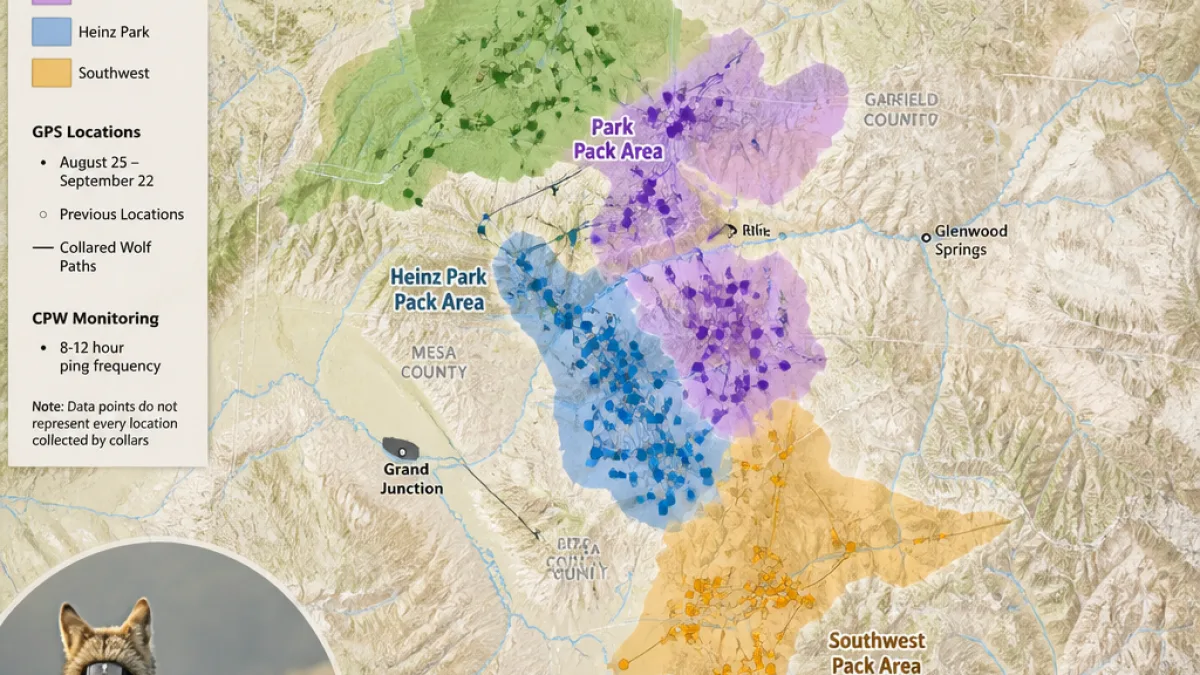
Colorado’s collared gray wolves continued to travel broadly across the Western Slope in September, with GPS tracking showing pack activity concentrated in the northwest while at least one collared animal ranged south into the San Juan Mountains, according to Colorado Parks and Wildlife’s monthly wolf activity map.
Where the collared wolves were tracked
The map, which covers wolf locations recorded between Aug. 25 and Sept. 22, highlights watersheds where GPS collars logged at least one point. Points are recorded roughly every four hours, a cadence CPW notes can leave apparent gaps between highlighted watersheds because wolves can cover large distances quickly.
During the 30-day period, collared wolves were detected in watersheds spanning portions of these counties:
- Jackson
- Routt
- Grand
- Summit
- Eagle
- Rio Blanco
- Garfield
- Pitkin
- Delta
- Gunnison
- Mesa
- Montrose
- San Miguel
- Ouray
- San Juan
- Hinsdale
- Archuleta
Four reproducing packs in the northwest
Most pack-related activity remains concentrated in northwest Colorado, where CPW identified four reproducing packs: the Piney Ridge Pack in Eagle County (the only new pack confirmed this year), the One Ear Pack in Jackson County, the Copper Creek Pack in Pitkin County and the Three Creeks Pack in Rio Blanco County.
CPW said pups from these packs have left den sites and are beginning to move with adults, but remain close to rendezvous areas where adults bring food.
"Pups have left the den sites and are starting to venture 'short distances with other pack members,'"
Population, collars and mortality
CPW estimated Colorado had about 32 wolves as of March 31, roughly half of them collared. That count consisted of 18 adults and 14 yearlings born in 2025; it did not include pups born this spring to the four reproducing packs.
Since March 31, the agency said six uncollared wolves have died. CPW reported that the vast majority of those deaths were the result of agency actions taken after repeated livestock depredations by several packs. The agency’s statements emphasize that pack animals tend to remain tied to territories while lone dispersing wolves can travel long distances in search of food or mates.
How CPW tracks wolves and why watersheds matter
CPW’s monthly map colors watersheds where at least one GPS location was recorded during the 30-day window. Because GPS points are logged roughly every four hours, the map is a snapshot that may not show every route or short-term movement; highlighted watersheds simply indicate presence at some point during the tracking period.
| Item | Value |
|---|---|
| Estimated wolves (March 31) | ~32 |
| Adults | 18 |
| Yearlings (born 2025) | 14 |
| Uncollared wolves dead since March 31 | 6 |
What this means locally
For landowners, ranchers and outdoor users across the Western Slope, CPW’s map provides an updated picture of where collared wolves have been recorded and where managers are focusing monitoring efforts. The extension of collared-wolf GPS points into southern watersheds underscores that some wolves and dispersers continue to traverse wide corridors across mountain ranges and river basins.
CPW’s public tracking and reporting are part of ongoing efforts to balance recovery progress with responses to livestock depredation and public safety concerns. The agency has previously used targeted removals when specific animals or packs repeatedly attack livestock, and those actions account for most of the post‑March 31 mortalities CPW reported.
What to watch for next
CPW issues regular updates as the tracking season continues and as managers investigate depredation reports. Future monthly maps will show whether the current pattern of northern pack residency and intermittent southern movements persists, whether new packs form, and how pup survival and dispersal affect the statewide population estimate.
Readers seeking the latest maps or guidance on coexisting with wolves should consult Colorado Parks and Wildlife’s website and local field offices for current advisories and management notices.