
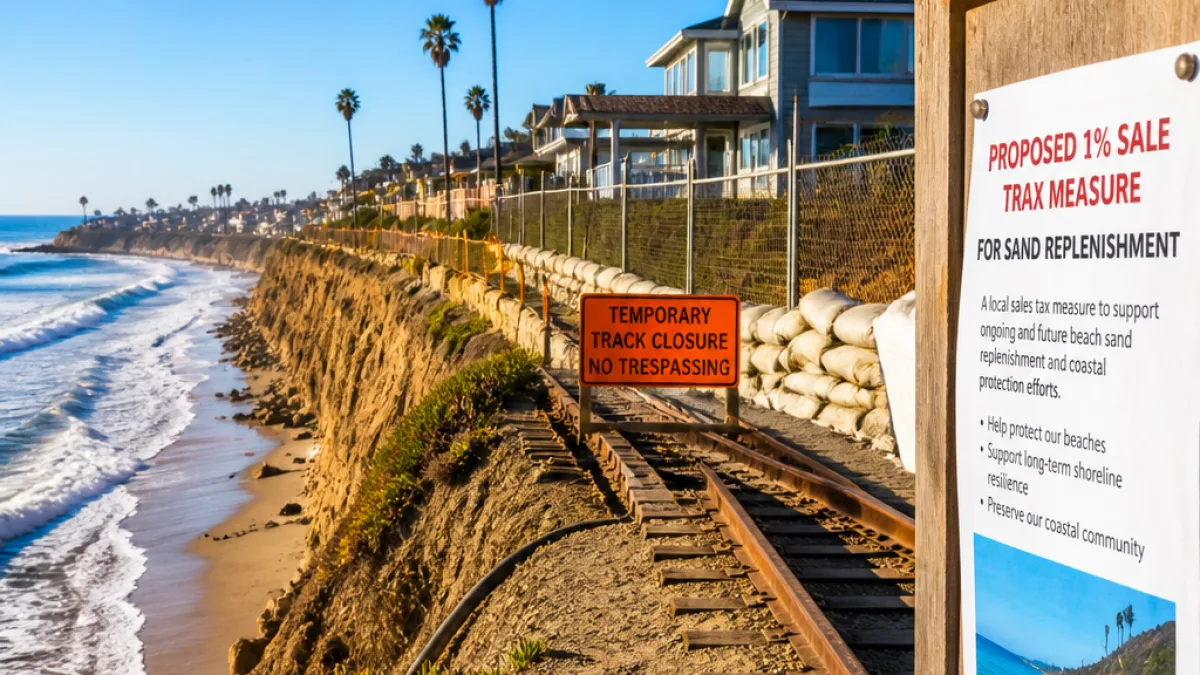
SAN CLEMENTE, Calif. — For decades residents could stroll a mile along cream-colored sand and put their toes in the surf. That walk has been shortened as waves and rising seas push the shoreline inland, splitting the city’s scenic North Beach and eroding seaside bluffs that back oceanfront homes.
Coastline recession, homes at risk
The town long nicknamed a “Spanish village by the sea” is now confronting a steady loss of sand and destabilized coastal bluffs. Experts say the changes are part of a broader pattern along California’s coastline driven by rising sea levels and stronger storm waves.
“The constant pressure is sea level rise,” said Sean Vitousek, a research oceanographer with the U.S. Geological Survey. “It is going to keep rising, and rising, and the beaches will retreat landward.”
Local officials and residents note that urban development has also played a role by reducing the flow of sediment that once nourished beaches. Warmer ocean waters have contributed to higher waves that reach further ashore, accelerating the loss of sand.
Rail service disrupted along a vital corridor
The erosion and bluff instability have prompted repeated closures of a passenger rail line that has run along the coast for more than a century. The line is considered the second busiest passenger rail corridor in the country, and interruptions have put additional focus on the trade-offs between protecting coastal communities and maintaining vital regional transportation.
Statewide context and a looming El Niño
San Clemente is one of many California coastal communities experiencing similar pressures. Officials statewide are preparing for an expected super El Niño this year — a temporary warming of the equatorial Pacific that can drive heavier storms and higher tides along the U.S. coast.
Already this year, the city of Pacifica south of San Francisco closed a cracked concrete pier, and seawater flooded homes in Long Beach during a hurricane-driven surge. A recent study cited by scientists found that El Niño events are getting stronger as a result of human-caused climate change.
Local response: a ballot measure to fund protection
Facing mounting costs to protect beaches and homes, some San Clemente residents are weighing a local tax to raise money for restoration work. On the November ballot is a measure proposing a 1% sales tax intended to fund wildfire protection and sand replenishment.
The proposal reflects a growing willingness among communities — even those that tend to favor smaller government — to consider local funding tools to address problems tied to a changing climate and eroding shorelines.
What’s at stake for residents and travelers
- Recreational access: Beaches that once offered long walks and uninterrupted shoreline are becoming fragmented.
- Property and safety: Crumbling bluffs have damaged oceanfront homes and increased concern about landslides and erosion near residential areas.
- Transportation: The coastal rail corridor’s repeated closures affect commuters and regional travel on one of the nation’s busiest routes.
| Item | Detail |
|---|---|
| San Clemente population | 62,000 |
| Ballot measure | 1% sales tax for wildfire protection and sand replenishment |
| Rail line | Operating along the coast for more than a century; second busiest passenger corridor in the U.S. |
Local leaders and residents must weigh options that include beach nourishment, bluff stabilization, and hard infrastructure — each with trade-offs in cost, environmental impact and longevity. While short-term interventions like sand replenishment can restore beach width temporarily, experts emphasize that sea level rise is a continuing pressure that will require sustained planning.
As San Clemente heads into a potentially stormy season, the community’s decisions over the coming months — including whether to approve the sales tax measure in November — will help determine how the town adapts to a coastline being reshaped by rising seas.
“The constant pressure is sea level rise,” — Sean Vitousek, U.S. Geological Survey
Kevin Nakamura, State Correspondent


















