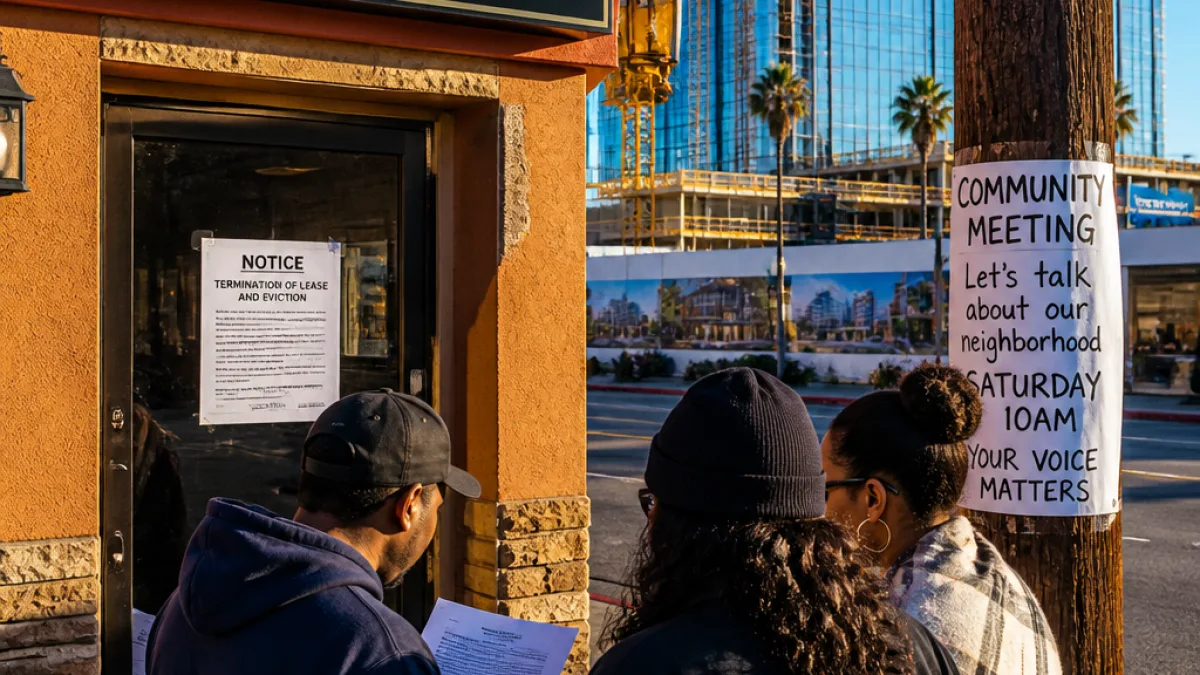
Inglewood’s rapid transformation is colliding with a familiar urban dilemma: which longtime businesses will survive when property ownership changes hands. The recent dispute over the Cuban Leaf Cigar Lounge, a Black-owned establishment that has served the community for years, crystallizes those concerns as local residents and advocates press for clearer protections and answers.
Lease expectations upended after sale
Owner Pahvae Psalms says he invested nearly $200,000 to build out his current location after signing a lease roughly three years ago and that he expected to remain through the 2028 Olympic Games. But in late May he learned that the property had changed hands. New owner Christian Martin told local reporters his family purchased the property in June and that Cuban Leaf had been operating on a month-to-month basis; he said he provided 90 days to vacate.
“When it’s time for them to sell, they didn’t even offer us the chance to buy,”
Those differing timelines and accounts — Psalms’ claim that he was only notified in the last week of May and Martin’s statement that the family purchased the property in June — leave outstanding questions about how the transaction and notices were handled and whether tenant rights were respected.
Local voices frame the situation as broader than one cafe
Community advocate Najee Ali has framed the Cuban Leaf matter as more than a private real estate dispute. He and others say the episode raises a larger question about whether Black-owned businesses can endure as Inglewood attracts new investment and new residents. The incident has become a flashpoint for conversations about preservation of local commerce and cultural place amid redevelopment.
- Investment by tenant: Owner invested nearly $200,000 in space improvements.
- Lease history: Lease signed about three years ago; owner expected renewal through 2028.
- Ownership change: Property reportedly sold; new owner gave 90 days to vacate.
Martin family background and community ties
Reporting has identified the Martin family as Mexican-American entrepreneurs with long Inglewood ties. Esaul and Gloria Martin immigrated from Mexico and opened their first local business in 2009. Subsequent family ventures have included Fiesta Martin, Antojitos Martin and Martin’s Cocina y Cantina. Local coverage has emphasized that the dispute should not be read as a racial or ethnic confrontation — rather, observers say it raises structural questions about which businesses are able to remain amid rising property values and changing ownership.
| Item | Reported detail |
|---|---|
| Tenant investment | Nearly $200,000 build-out |
| Lease term | Signed ~3 years ago; expected through 2028 |
| Ownership transfer | Reported sale in June; tenant notified late May |
| Eviction timeline | New owner reported giving 90 days to vacate |
City leaders, tenant-rights advocates and small-business supporters often point to several recurring pressure points when property changes hands: month-to-month operating arrangements that can be terminated with short notice; rising rents that follow new development plans; and limited access for tenants to acquire properties they occupy. Those factors are frequently cited in discussions of displacement in rapidly changing urban neighborhoods.
Questions for transparency and next steps
Residents and civic groups are seeking clarification about the timeline and whether Psalms was given the opportunity to purchase the property. They also want clarity on any notice requirements and whether local programs exist to help long-standing small-business owners remain in place when ownership changes.
For now, Cuban Leaf’s situation remains a local example of a broader debate shaping Inglewood’s future: who benefits from redevelopment and how the city can preserve commercial diversity that reflects its longstanding communities. As the 2028 Olympics draw nearer and development pressure intensifies, those questions are likely to become more prominent in public meetings and policy discussions.
Local officials and community organizations have options to consider — including measures to increase transparency in commercial property sales, technical assistance or financing for tenant purchases, and enhanced tenant-notice requirements — but any policy responses will require further investigation and public debate.
The outcome for Cuban Leaf will be watched closely by other small-business owners in Inglewood seeking to understand their rights and options when leases, sales and redevelopment collide.