
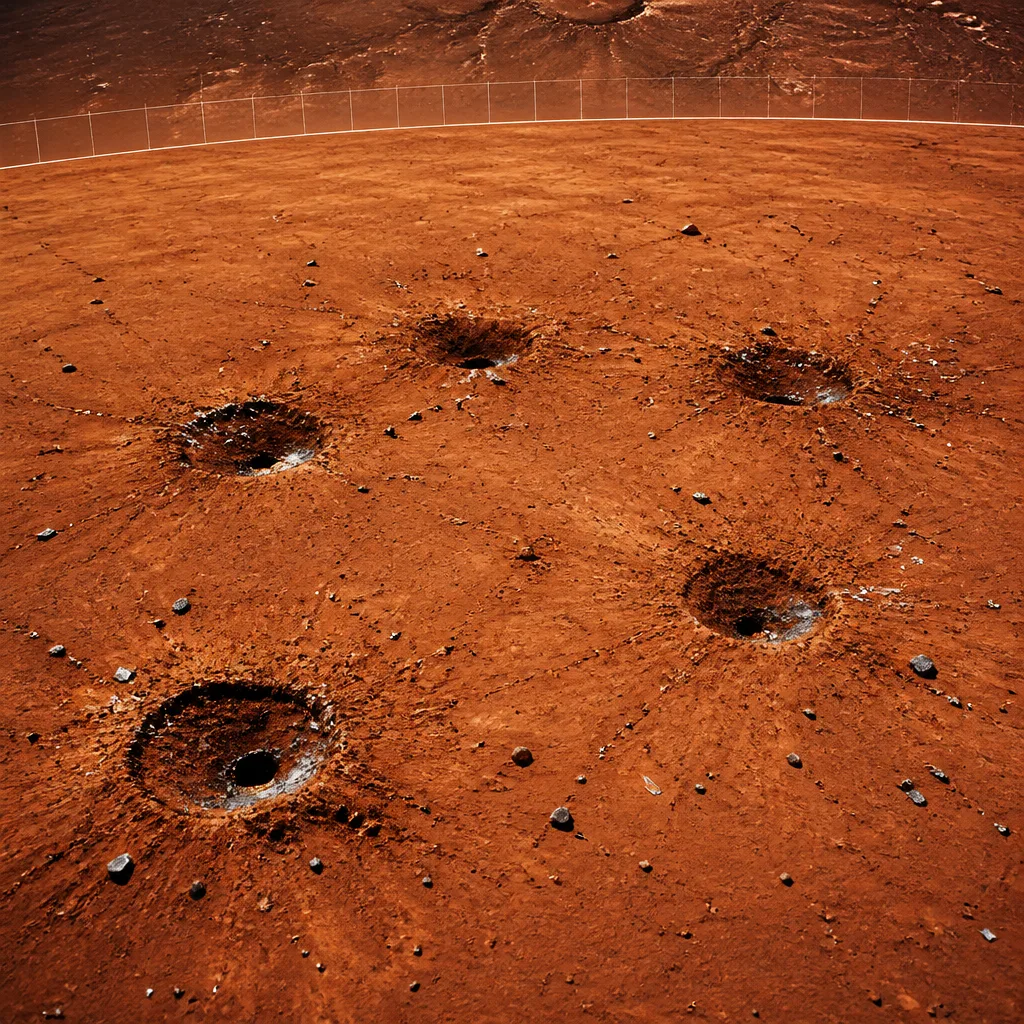
NASA engineers have turned discarded spacecraft parts into an unintended experiment on the Red Planet, identifying five new craters formed when hardware from the Mars 2020 mission struck the surface during Perseverance’s arrival.
Human-made impacts become scientific data
The craters were produced when components from Perseverance’s entry system fell away and hit Mars as the spacecraft approached the planet. The team that documented the features used imagery from two cameras aboard the Mars Reconnaissance Orbiter to compare pre- and post-2020 photographs and confirm the features were new.
Because mission engineers precisely know the masses, shapes and trajectories of the jettisoned pieces, these impacts provide a rare opportunity to test models of crater formation under controlled conditions. Unlike natural meteorites — whose sizes and ballistics are generally unknown — the Mars 2020 debris offers well-characterized projectiles researchers can use to validate and refine impact models.
Known hardware, measurable effects
As the Mars 2020 entry vehicle descended, it released two tungsten cruise ballast mass devices (CBMDs) weighing about 77 kilograms (170 pounds) each. In addition, fragments from a cruise stage component totaling nearly 540 kilograms separated and also struck the ground. At the time of release, the spacecraft was roughly 1,300 kilometers above Mars and traveling at about 4.7 kilometers per second relative to the planet.
| Parameter | Value |
|---|---|
| CBMD mass | 77 kg (170 lb) |
| Cruise stage fragments | ~540 kg |
| Altitude at release | ~1,300 km |
| Relative velocity | 4.7 km/s |
| Number of craters | 5 |
The impacts occurred about 70 kilometers northwest of the rim of Jezero Crater, the landing region that hosts Perseverance and remains a focus for astrobiology and geological study.
What the craters reveal
In a paper published in Geophysical Research Letters, researchers analyzed the newly formed pits to draw inferences about how the Martian surface responds to impacts. Because the projectiles’ masses and velocities are well constrained, the team could apply and compare different crater-formation and material-response models to the same set of events.
Scientists typically rely on natural impactors to learn about planetary surfaces, but those events carry large uncertainties about the impacting object. The Mars 2020 debris removes much of that uncertainty, allowing for a cleaner test of how surface cohesion, porosity and layering influence crater size and morphology.
- Orbital images showed the features were not present in earlier photos and displayed the reflectivity and sharp edges of very recent impacts.
- Known projectile parameters let researchers evaluate competing models for scaling crater size to impact energy.
- Location near Jezero adds context because the area is already of high interest for past habitability and sedimentary geology.
Researchers noted that impacts from human-made debris complement records from natural impacts and laboratory experiments, helping to calibrate estimates of surface strength and crater-production rates across Mars.
Beyond scientific value, the episode underscores the practicality of squeezing additional data from every mission phase: hardware that might otherwise be treated as benign debris instead became a controlled source of field observations.
As Mars missions continue, planned and unplanned impacts from spacecraft components are likely to provide more such opportunities: each event with known parameters can act as a small, deliberate experiment on how Mars absorbs and records energetic collisions.















