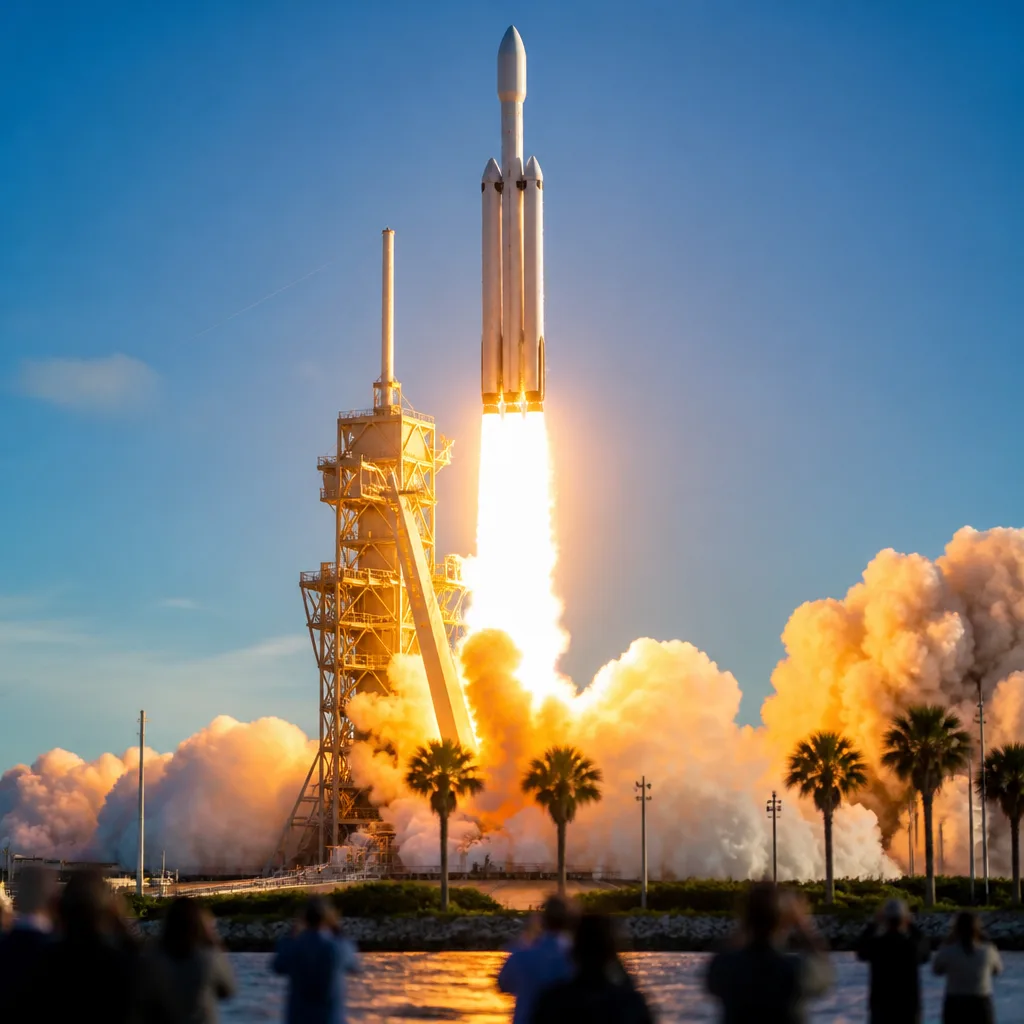
CAPE CANAVERAL, Fla. — NASA’s Nancy Grace Roman Space Telescope launched Sunday aboard a SpaceX Falcon Heavy, beginning a months-long journey to an observation point about 1 million miles from Earth where it will undertake the widest high-resolution surveys of the cosmos yet attempted from space.
Mission and capabilities
Built to search for exoplanets, probe dark energy and map galaxies, the bus-sized observatory represents a major new tool for astronomers. The mission carries a price tag of approximately $4.3 billion and is named for NASA’s first chief astronomer, Nancy Grace Roman. Once on station, Roman will complement other flagship observatories — including the Hubble and Webb space telescopes — by surveying very large swaths of sky at high precision.
NASA officials described Roman’s advantages in breadth and survey speed. The telescope’s field of view is more than 100 times wider than Hubble’s, enabling rapid mapping of distant galaxies, stars and transient events that smaller-field instruments would take many times longer to catalog.
“It’s going to find thousands of supernovae, tens of thousands of planets, billions of galaxies and tens of billions of stars,” said NASA science mission director Nicky Fox.
Launch and early operations
The Falcon Heavy lifted the observatory from Kennedy Space Center in the predawn hours. Shortly after liftoff, the rocket’s side boosters returned to Cape Canaveral and landed successfully, drawing sharp sonic booms as they descended. Ground teams reported Roman separated from the rocket’s upper stage and that controllers applauded the clean separation.
Roman will take more than three months to reach its destination near the second Sun-Earth Lagrange point, commonly called L2, where it will operate in concert with other international and domestic facilities. During that transfer and in science operations, Roman will rely on a network of communications and tracking assets to send data to Earth and maintain precise navigation.
Data, partnerships and next steps
NASA has planned for a mix of communications assets: a near-Earth relay network will handle high-rate science downlinks once Roman begins observations, while the agency’s Deep Space Network will provide critical tracking—precise range and angle measurements—to locate the spacecraft in deep space. International partners, including the European Space Agency and the Japan Aerospace Exploration Agency, are expected to supply additional ground-station support for data downlink.
In the coming weeks, Roman will complete several commissioning activities en route to L2, including deployment of a multi-panel solar array and thermal sun shield that will power and cool the observatory through its cruise and operational phases. After arrival and instrument checkout, the telescope will begin science operations that NASA and the astronomical community expect will transform wide-field surveys.
- Primary science aims: search for exoplanets, measure dark energy, perform wide-field galaxy surveys
- Expected survey strengths: far larger field of view than Hubble, enabling faster mapping and discovery
- Timeline: more than three months to travel to L2, followed by instrument commissioning and the start of science operations
| Item | Detail |
|---|---|
| Launch vehicle | SpaceX Falcon Heavy |
| Mission cost | $4.3 billion |
| Destination | L2, about 1 million miles from Earth |
| Travel time | More than three months to reach L2 |
Roman’s wide-field capability is designed to operate alongside narrower-field observatories. The combined data from Roman, Webb, Hubble and ground-based projects such as the Vera C. Rubin Observatory are expected to provide complementary views of the universe — from high-resolution, narrow targets to broad statistical surveys — that together will help scientists address fundamental questions about the cosmos.
The mission’s early success in reaching orbit and separating from the upper stage marked the first step in a multi-month campaign before Roman begins returning the high-rate science data that researchers anticipate will yield large, statistically powerful samples of supernovae, exoplanets and galaxies.
Follow-up and detailed operational updates will come from NASA as the telescope completes its cruise and commissioning phases en route to L2.