
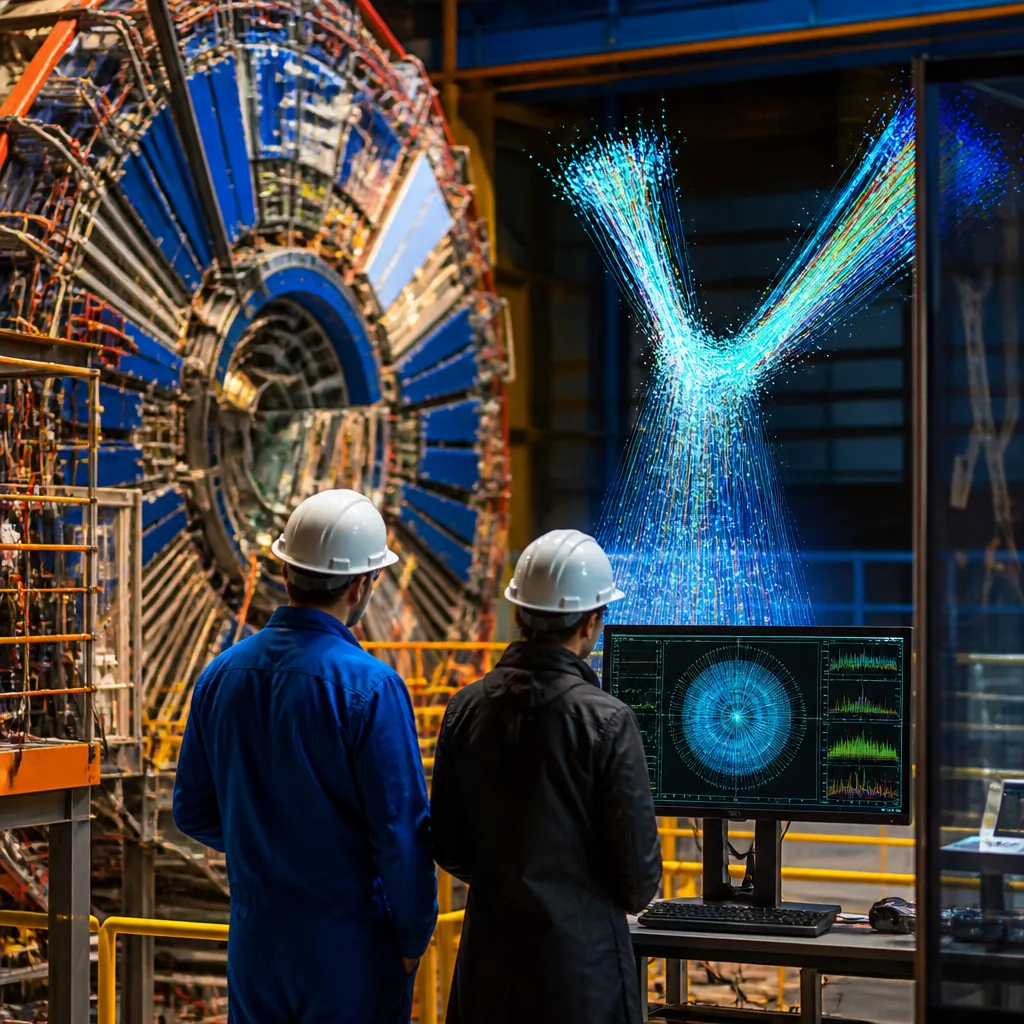
New results from the STAR detector at the Relativistic Heavy Ion Collider suggest that gluons — the particles that bind quarks together — play a central role in preserving a proton’s baryon number, according to a paper published in the journal Science.
Findings challenge a conventional view
Scientists had long assumed that baryon number, the quantum property that distinguishes protons and neutrons from other particles, is carried by the particles’ three constituent quarks. The STAR collaboration’s measurements instead point to baryon number being associated with a Y-shaped “gluon junction” connecting the three valence quarks within a baryon.
The work grew out of efforts to adapt a new experimental method to the STAR detector. Nicole Lewis, a STAR physicist now at Rice University who began the project while a postdoctoral associate at Brookhaven National Laboratory in 2020, said the initial data did not match predictions from the conventional model and prompted additional targeted experiments.
“We started this project simply trying to adapt a new method to the STAR detector,” Lewis said. “Unexpectedly, the data we generated with the new method didn’t align with the predictions based on the conventional baryon number carrier model. So we designed experiments to interrogate this and found that they supported this alternative gluon junction model instead.”
Rice University is listed among the founding members of the STAR collaboration, and multiple Rice researchers contributed to the analysis and detector work, including Geary Eppley, Frank Geurts, Chenliang Jin, Wei Li, Tonko Ljubicic and Daniel Torres Valdares.
Why baryon number matters
Baryon number conservation is a fundamental symmetry used to account for why the total number of baryons — three-quark particles such as protons and neutrons — remains constant in many particle interactions. At accelerators such as RHIC, that conservation governs particle counts before and after high-energy collisions. The concept also connects to cosmological questions: the total number of protons and neutrons in the universe does not change with time, a fact tied to deep unresolved puzzles about the origin of matter.
Identifying whether quarks or gluonic structures carry baryon number affects theoretical descriptions of how baryons are created, transported and annihilated in collisions and in the early universe.
Detector and collaboration
The STAR detector, a 1,200-ton instrument at Brookhaven National Laboratory, records the thousands of particles produced when ions collide inside RHIC. The detector’s capabilities allowed the team to test subtle features of baryon transport and to compare experimental results with competing theoretical models.
| Item | Detail |
|---|---|
| Facility | Relativistic Heavy Ion Collider (RHIC), Brookhaven National Laboratory |
| Detector | STAR (1,200 tons) |
| Publication | Science |
| Key institution named | Rice University |
While the STAR collaboration involves many institutions internationally, the Rice team played a central role in initiating and carrying the analyses that led to the conclusion favoring the gluon junction picture.
Implications and next steps
If borne out by further experimental and theoretical work, the gluon junction interpretation could reshape models of baryon number transport in high-energy collisions and inform broader questions in quantum chromodynamics, the theory that describes quark and gluon interactions.
Follow-up will require both additional measurements at RHIC and detailed calculations by theorists to integrate the junction picture with existing frameworks. The STAR detector’s ability to track vast numbers of particles in each collision makes it a key tool for these continued investigations.
- New method adapted to STAR triggered unexpected results.
- Alternative model proposes baryon number is carried by a Y-shaped gluon junction.
- Publication of results appeared in Science, underscoring peer-reviewed vetting of the measurements.
By clarifying how baryon number is encoded within protons and neutrons, the work helps address foundational questions about the persistence of ordinary matter from the earliest moments of the cosmos to the laboratory today.















