
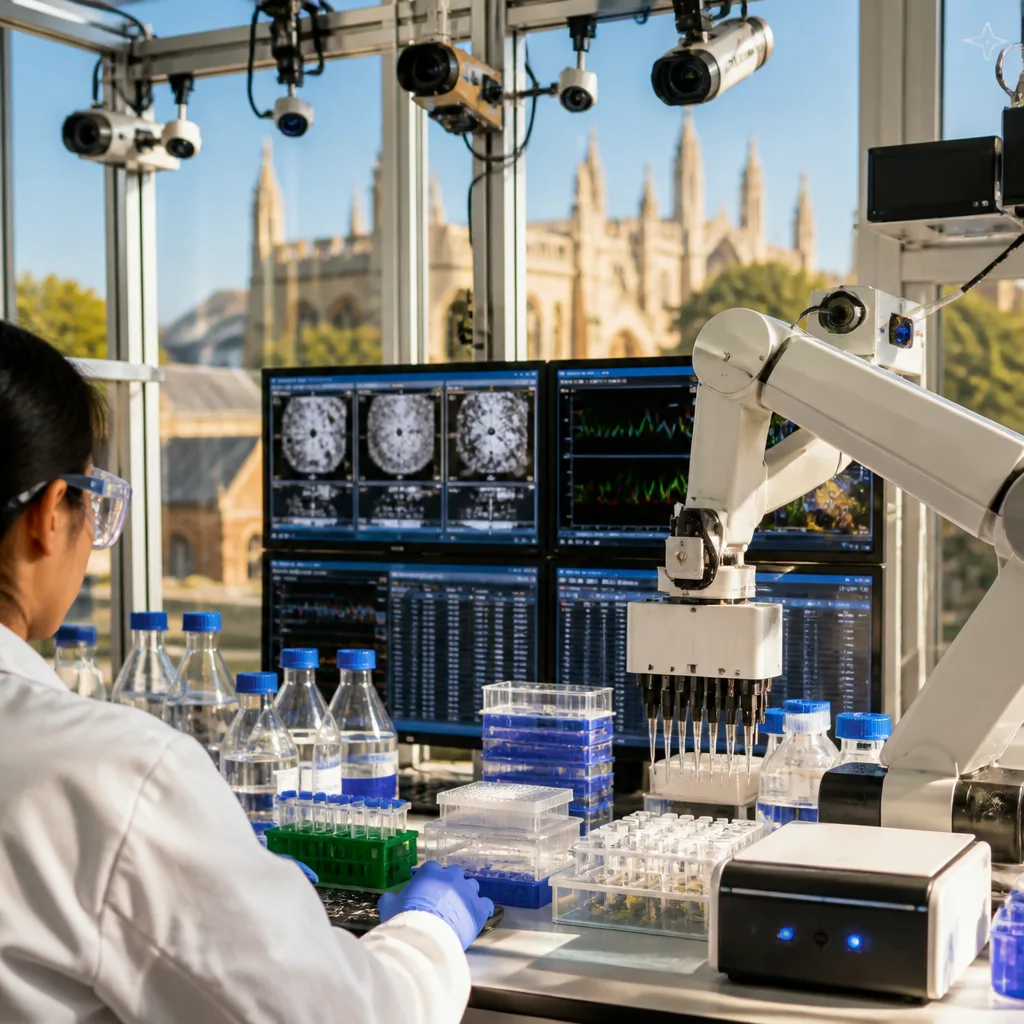
Transfyr, a Cambridge, Massachusetts–based startup, announced a $25 million seed financing to develop a “physical AI” platform that records how scientists perform laboratory work and turns those actions into structured data usable by artificial intelligence and robotic systems.
Capturing the missing layer of laboratory practice
The company says its platform uses sensors and multimodal AI models to collect and integrate data on operator actions, environmental conditions and equipment behavior. The resulting dataset is intended for process analysis, training, technology transfer and automated instructions for laboratory robotics.
Transfyr was co-founded by Anna Marie Wagner, formerly head of AI and corporate development at Ginkgo Bioworks, and Renee Wegrzyn, the founding director of ARPA‑H. The seed round was led by General Catalyst, with participation from Lux Capital, Breakout Ventures, Factory, Neo, SV Angel, MVP Ventures, Underscore VC and Lyda Hill, as well as angel investors.
“Science is missing a critical layer of infrastructure that’s necessary for efficient reproducibility, translation, scaling, and automation,” said Wagner.
Why investors and founders say this matters
Transfyr positions its work as a direct response to gaps between hands‑on laboratory practice and the written records that typically drive scientific communication — papers, protocols and batch records. The company argues that important details about how researchers handle difficult steps, respond to failures and adapt procedures are often lost in translation.
To illustrate the consequences of those gaps, Transfyr points to a recent industry analysis showing a major fraction of drug launch delays traceable to issues in chemistry, manufacturing and controls — a category that includes technology‑transfer failures. The company cited an Accenture report estimating that 64% of drug‑launch delays in 2024 were caused by such issues.
Transfyr already says it is engaged across several application areas, including diagnostics development, academic research, workforce development, robotics and what it calls frontier AI.
- Use cases: process analysis, training, technology transfer, robotic instructions
- Sectors: diagnostics, academia, workforce development, robotics, frontier AI
- Founders' backgrounds: industry AI and synthetic biology (Wagner); government health research enterprise (Wegrzyn)
Funding and strategy
The new capital gives Transfyr runway to develop hardware and software that can instrument lab benches and workflows, translate multimodal sensor streams into structured representations and provide actionable outputs for both human training and machine automation.
| Item | Detail |
|---|---|
| Seed funding | $25 million |
| Lead investor | General Catalyst |
| Other participants | Lux Capital, Breakout Ventures, Factory, Neo, SV Angel, MVP Ventures, Underscore VC, Lyda Hill, angels |
Investors backing Transfyr are among venture capital firms with prior activity in deep tech, life sciences and AI, reflecting confidence in a product that bridges physical laboratory practice and software-driven automation.
Implications and limitations
If successful, the platform could address recurring problems in reproducibility and technology transfer that delay product development and add cost to scale‑up. By making tacit laboratory actions explicit and machine‑readable, Transfyr aims to accelerate training, reduce errors during transfer from bench to production and provide clearer inputs for laboratory automation.
At the same time, converting complex hands‑on work into structured data raises questions about privacy of workforce practices, intellectual property in experimental know‑how and the practical challenges of instrumenting diverse lab environments. Transfyr’s initial focus areas — diagnostics, academic research and workforce development — will test whether the approach can generalize across distinct protocols, instrument types and institutional settings.
The company’s founders bring experience from both the private bioengineering sector and federal biomedical research leadership, and they are positioning Transfyr as infrastructure for a scientific ecosystem that increasingly ties together human expertise, data and robotics.
How quickly such systems can be validated, adopted by laboratory operators and integrated into regulatory and quality frameworks will determine whether the promised gains in reproducibility and technology transfer translate into faster product development and broader automation of laboratory work.















