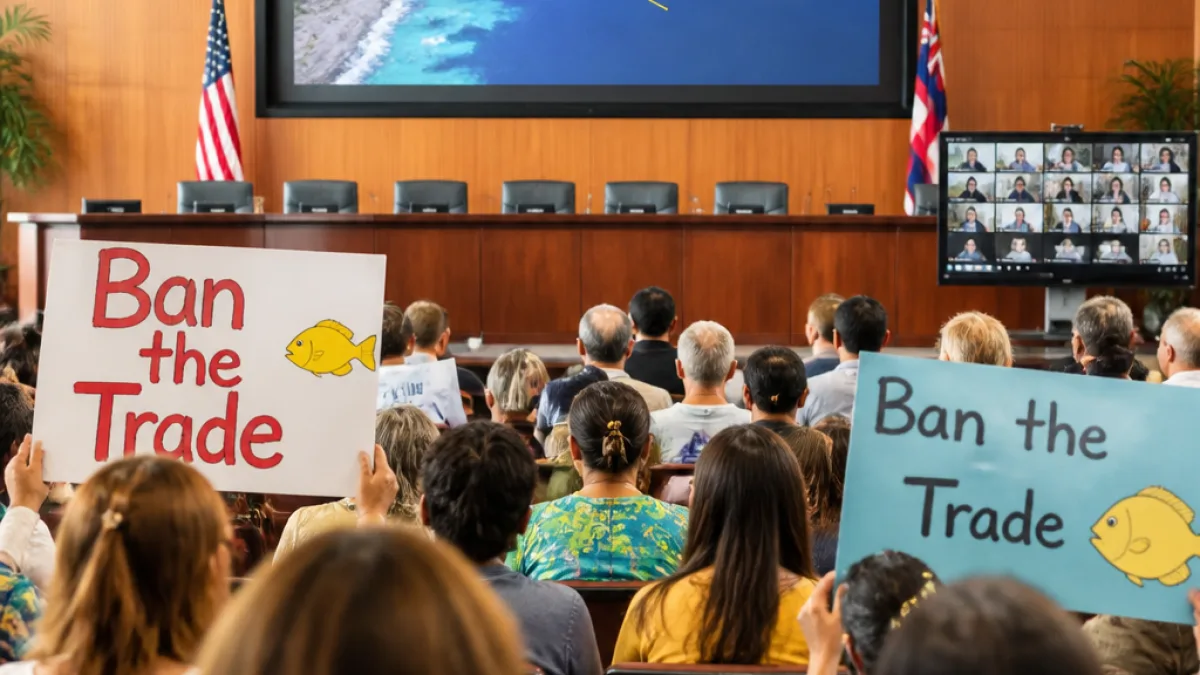
The future of aquarium fish collecting in Hawaii remained unresolved Friday after the Board of Land and Natural Resources heard more than six hours of public testimony and directed state officials to further analyze legal, cultural and technical issues before moving forward.
Public opposition spans the islands
Speakers who appeared in person and online were overwhelmingly opposed to reopening the aquarium fish trade, representing communities on Hawaii Island, Oahu, Maui, Kauai and Molokai. Prior to the meeting, all four county governments submitted resolutions urging the board to ban the practice.
The Division of Aquatic Resources had proposed narrowly allowing commercial collecting to resume in West Hawaii only, under strict limits. The proposal would restrict the fishery to five species and impose annual catch caps intended to control total removals.
Catch limits and who they apply to
Under the draft proposal, annual catch limits for the fishery management area would be:
- Yellow tang: 100,000
- Potter’s angelfish: 1,068
- Mailili: 800
- Hinalea iiwi: 344
- Thompson’s surgeonfish: 182
David Sakoda, fisheries management program manager for the Division of Aquatic Resources, clarified that the caps would apply to the entire fishery management area rather than to individual fishermen.
| Species | Annual catch limit | |
|---|---|---|
| Yellow tang | 100,000 | |
| Potter’s angelfish | 1,068 | |
| Mailili | 800 | |
| Hinalea iiwi | 344 | |
| Thompson’s surgeonfish | 182 |
Board requests more analysis
Rather than adopt the proposed rule, the board instructed DAR to further consider alternatives under the public trust doctrine and to conduct cultural landscape analyses. The board also asked staff to address several technical and legal issues and return with additional information before any rule-making moves ahead.
The meeting offered another chapter in a long-standing debate over how commercial aquarium collecting fits within Hawaii’s legal obligations to manage natural resources in the public interest and to prioritize Native Hawaiian rights.
“A loophole used to get around the recreational permits that were banned in a 2017 decision,”
The commercial fishery has been effectively halted since December 2020, when courts suspended the commercial marine licenses that had been used for the trade and required that any new permitting go through environmental review. Environmental law firm Earthjustice has sued the state twice over the practice, arguing the earlier commercial licenses were a way to skirt bans on recreational collecting.
Legal avenue denied
Aquarium collector Eric Moennich asked for a contested case hearing on the board’s direction, a formal legal process that can be used to challenge administrative actions. The board denied the request, saying contested case hearings are not permitted in rule-making processes.
Members of the public who urged a statewide prohibition said reopening even a limited commercial fishery would undermine cultural and ecological priorities. Those in favor of reopening argued for limited, managed access and the livelihoods of collectors and associated businesses.
What happens next
With the board’s direction, DAR must return with more detailed analyses — including alternatives that account for public trust responsibilities and cultural landscape impacts — before any rule-making proceeds. The agency will also need to refine technical aspects of the proposal and resolve outstanding legal questions identified by the board.
The issue is likely to remain contentious. County resolutions opposing reopening, islandwide testimony and past litigation suggest the debate will continue to play out in public hearings and court filings if DAR moves forward.
For now, the statewide ban stemming from the 2020 court action remains in place while state officials reassess whether and how a narrowly confined commercial fishery could be allowed under Hawaii law.
State residents and stakeholders can expect additional public meetings and formal rule-making steps if DAR advances a revised proposal to the Board of Land and Natural Resources.