
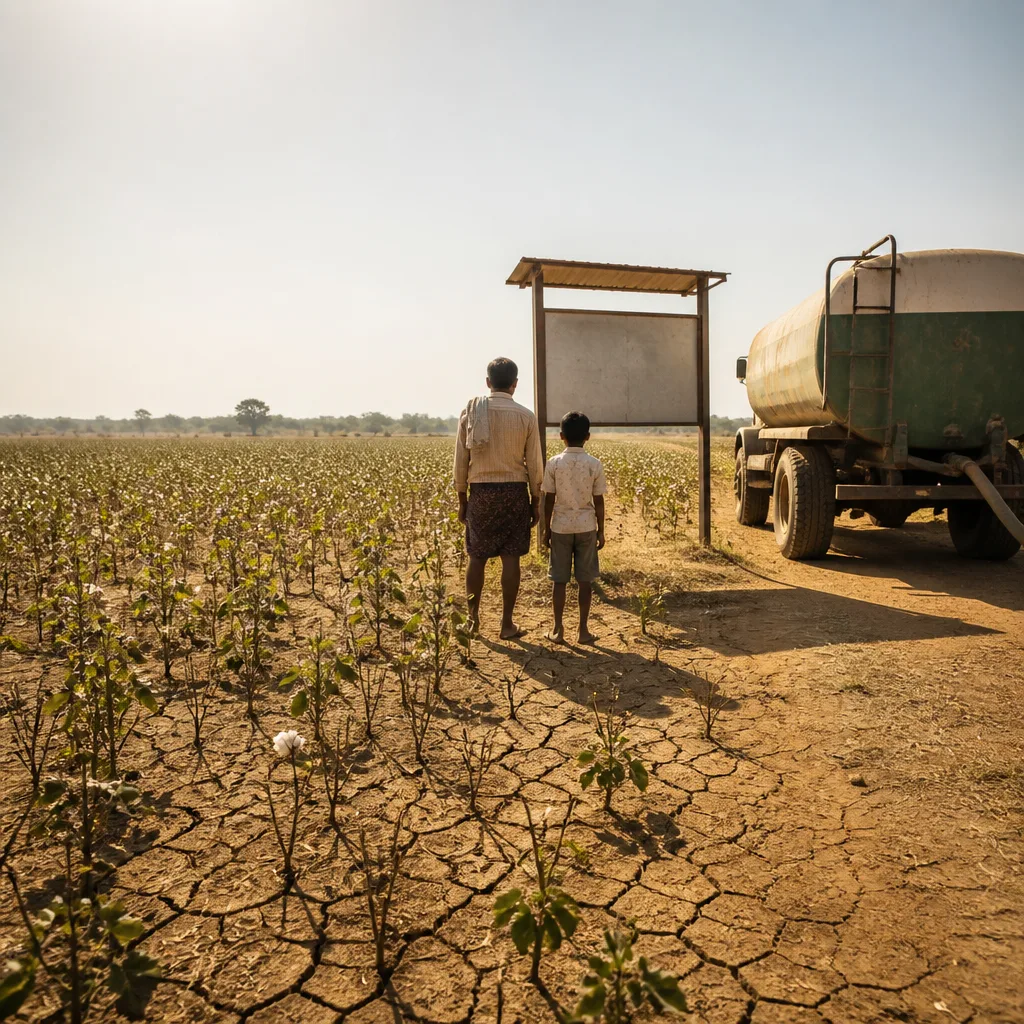
Mumbai, September — Maharashtra has formally declared drought affecting 74 per cent of the state after sustained shortfalls in monsoon rainfall, the state government said, warning of wide-ranging impacts on agriculture, rural livelihoods and food supply chains.
Scope and immediate response
The drought declaration follows a national weather department forecast that India would close the annual June–September monsoon season with below‑average rains. Authorities and scientists have linked the poor monsoon to a comparatively stronger El Niño in the Pacific, which tends to bring drier conditions to South Asia.
The state administration said it will assess crop losses and organise aid to support farmers, farm labourers and rural families affected by the shortfall. Chief Minister Devendra Fadnavis was quoted as saying the government stands committed to support the farming community.
“We stand firmly behind our farmer brethren,”
Hundreds of millions across India rely on the June–September monsoon for water that sustains both agriculture and industry; disruptions to the seasonal rains therefore have consequences well beyond individual farms.
Who and what is affected
Maharashtra, with a population of roughly 130 million, is a major agricultural state. Crops highlighted as vulnerable include cotton, soyabean, sugarcane and pulses, many of which depend on monsoon rainfall or limited irrigation. The state government warned that many farmers who rely primarily on rainfall could face crop failure and the associated financial stress.
- Area affected: 74% of the state declared drought.
- Population: About 130 million residents statewide.
- Key crops at risk: Cotton, soyabean, sugarcane, pulses.
Regional and climatic context
Officials noted that the El Niño climate phenomenon — a periodic warming of Pacific Ocean waters — has contributed to the altered rainfall pattern this season. Meteorologists have long observed that El Niño episodes are associated with reduced monsoon rainfall over large parts of South Asia. Scientists also point out that human‑caused climate change can amplify the intensity and impact of such natural climate drivers by increasing atmospheric energy and moisture variability.
Reduced rains are already prompting neighbouring states to consider or announce relief measures; Karnataka has declared assistance for farmers in drought‑hit districts, illustrating how monsoon shortfalls are cascading across regions.
Consequences and the road ahead
Prolonged rain deficits may raise pressure on groundwater resources, increase irrigation demand and alter cropping choices. For a state that supplies key commodities to national markets, significant yield losses could ripple into supply chains and rural incomes. The government has said it will undertake crop damage assessments and expedite relief measures to mitigate immediate impacts on vulnerable households.
Policy responses likely to be monitored in the coming weeks include targeted cash or input support for affected farmers, loan relief measures, and interventions to conserve water or expand emergency irrigation where feasible. The state and central agencies will also be watching monsoon withdrawal and any late‑season or post‑monsoon rains that could reduce the severity of crop losses.
| Item | Figure |
|---|---|
| Share of state declared drought-affected | 74% |
| State population (approx.) | 130 million |
| Major crops named | Cotton, soyabean, sugarcane, pulses |
The unfolding situation in Maharashtra will be watched closely by agricultural economists and climate analysts, as the state’s outcomes this season may inform relief budgets and adaptation strategies elsewhere in India as the nation copes with increasing climate variability.












