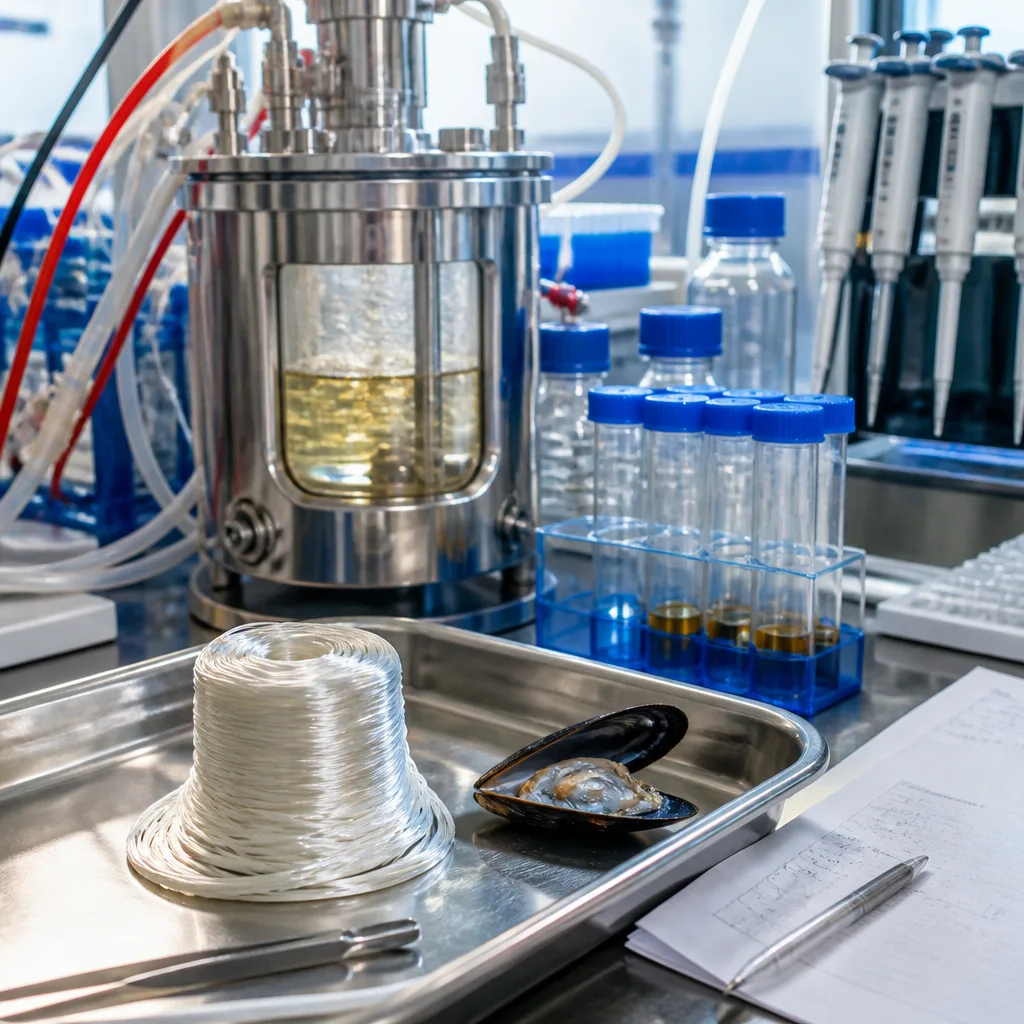
Researchers have engineered bacteria to produce silk-like protein fibres that are markedly stronger and tougher by fusing fragments of a mussel adhesive protein to an artificially designed silk sequence, according to a study published in Nature Communications. The team reports that the bi-terminal fusion increased ultimate tensile strength by as much as 345% and toughness by up to 1,970%, and that the modified protein can be produced in bacterial bioreactors at substantially higher titres than some earlier recombinant silks.
Design and mechanism
The work builds on two elements: an engineered amyloid-silk protein (referred to in the paper as 16xFGA) and fragments of mussel foot protein 5 (Mfp5), an intrinsically disordered adhesive protein secreted by mussels. The authors divided Mfp5 into two shorter segments and genetically attached one fragment to each terminus of the silk protein — a strategy they call a bi-terminal Mfp5 (btMfp5) fusion.
The rationale is physical: Mfp5 contains multiple tyrosine residues that can mediate interactions such as cation–π and π–π stacking. Placing Mfp5-derived fragments at both ends of the silk chain encourages end‑to‑end associations between protein molecules during fibre formation, improving load transfer and energy dissipation when the fibre is strained.
Performance and production data
Across the protein constructs tested, the btMfp5 fusion yielded very large improvements in mechanical metrics. One engineered construct reported in the paper, named NM-16xFGA-CM(YtoS), had a molecular mass around 57.3 kDa and an ultimate tensile strength reported at 481 MPa.
- Tensile strength: up to 345% increase versus unfused controls.
- Toughness: up to 1,970% increase.
- Production: proteins expressed in bacteria and assembled into fibres; authors report substantially higher titres in bacterial bioreactors than some previously reported recombinant silk proteins.
| Metric | Observed change |
|---|---|
| Ultimate tensile strength | Up to +345% |
| Toughness | Up to +1,970% |
| Reported example strength | 481 MPa (NM-16xFGA-CM(YtoS)) |
"Bi‑terminal fusion of intrinsically‑disordered mussel foot protein fragments boosts mechanical strength for protein fibres" — title of the paper in Nature Communications.
Context and caveats
The study demonstrates a promising route to high‑performance protein fibres by combining adhesive motifs and silk‑like sequences. It addresses two long‑standing challenges in recombinant silk research: achieving competitive mechanical properties and producing proteins at practical titres in microbial systems.
However, several caveats remain. The results are reported at laboratory scale and on specific protein designs; translation to mass manufacturing will require validation of fibre spinning, post‑processing, long‑term stability, cost of goods and regulatory pathways for applications such as medical sutures or load‑bearing materials. The study does not claim immediate commercial readiness but shows a molecular strategy that could be adapted and optimised.
Implications
If scalable, the approach could expand the range of sustainable, protein‑based high‑performance fibres. Potential application areas noted in the broader literature for recombinant silk and similar protein fibres include advanced textiles, lightweight composites and biomedical uses where biocompatibility and tunable mechanics are valuable. By demonstrating both a mechanical benefit and improved bacterial production, the work narrows two technical gaps that have hindered broader deployment of recombinant silks.
The study offers a concise design principle: harnessing short, intrinsically disordered adhesive fragments at chain termini to steer intermolecular interactions during assembly. This is a simple conceptual tweak with outsized effects in the reported experiments — a reminder that small sequence changes in protein engineering can yield large materials outcomes.
Further research will need to test durability under real‑world conditions, reproducibility across production runs and the economics of scale. For now, the study provides a robust proof of concept that marine adhesive chemistry can be repurposed to strengthen engineered silk fibres produced in bacteria.