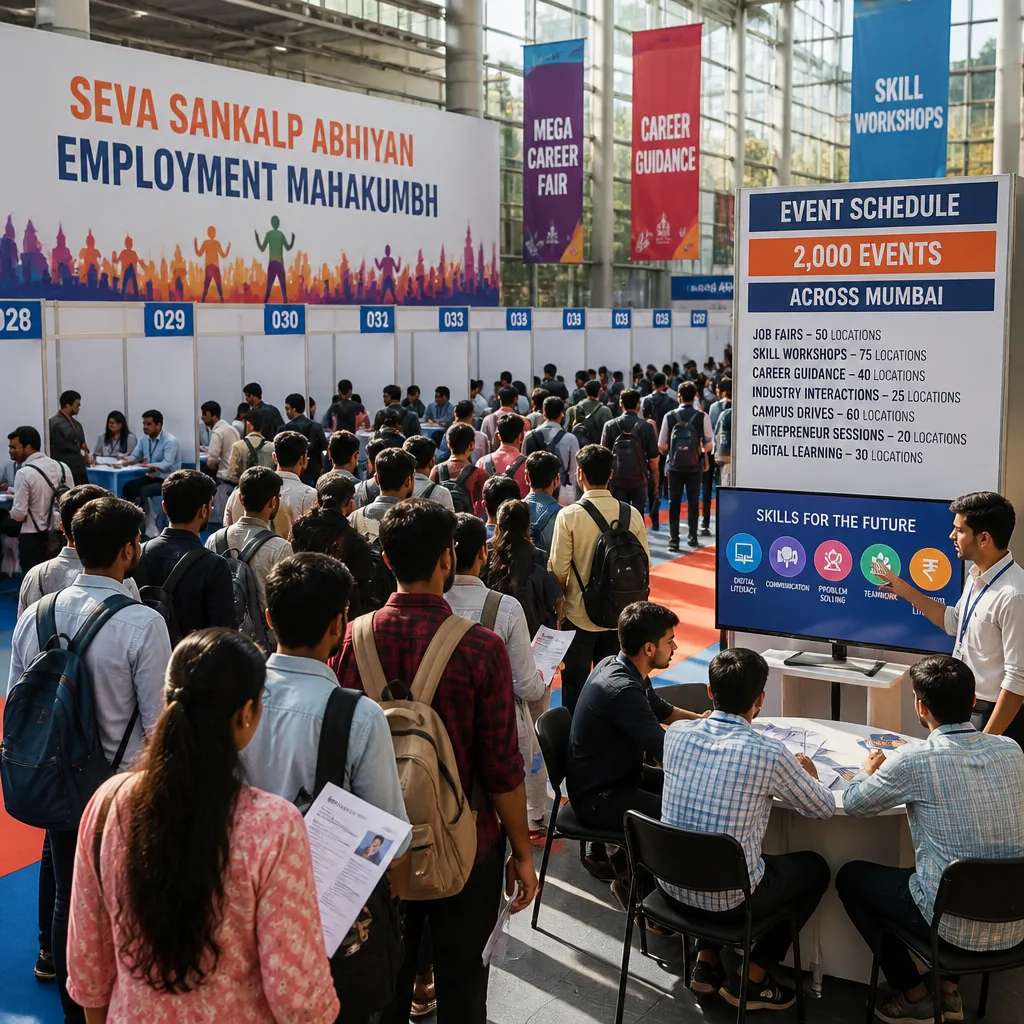
Mumbai, Sept 29: Maharashtra Chief Minister Devendra Fadnavis on Tuesday emphasised that education, training and employment must be treated as the three foundational pillars to build a developed India by 2047, speaking at the Pandit Deendayal Upadhyaya Employment Mahakumbh in Mumbai on September 29, according to a report.
Seva Sankalp Abhiyan and employment outreach
The event was organised as part of the Seva Sankalp Abhiyan, launched across Maharashtra to mark Prime Minister Narendra Modi’s 25 years as head of government. Fadnavis outlined the need for continuous skill acquisition by the youth in the face of rapid technological change and highlighted the role of organised employment outreach in meeting that need.
He said the Skill Development Department has planned roughly 2,000 events under the employment initiative, with over 400 employment fairs taking place on that day at various locations, the report stated.
“Developing education, training, and employment human resources is the most important issue in our country. This is what will help us build the developed India of 2047—moving toward our dream of a poverty-free, unemployment-free, and disease-free India,” he said.
Policy context and philosophy
Fadnavis framed the employment fair in the name of Pandit Deendayal Upadhyaya and referenced the philosophy of Antyodaya, which aims at uplifting the last person in society. He argued that this approach—focused on inclusive employment and ensuring every person has work—constitutes a model distinct from both capitalism and communism.
He said that a thought process preparing people for employment and inclusion will strengthen India economically and that this integrated-humanism philosophy should guide policy and practice, the report added.
Programme scale and immediate outcomes
The state’s large-scale mobilisation under the employment initiative indicates a focused push on demand- and supply-side measures: outreach events, placement drives and skill-building activities intended to connect jobseekers with employers and training opportunities.
| Parameter | Number |
|---|---|
| Planned events under Skill Development Department | ~2,000 |
| Employment fairs held on Sept 29 | >400 |
- Date of the Mahakumbh: 29 September (reported)
- Main focus: Education, skill development, employment outreach
- Campaign: Seva Sankalp Abhiyan to mark 25 years of Prime Minister’s leadership (reported)
Implications for national education and skilling efforts
Fadnavis’s framing places education and skill development at the centre of a long-term national vision. For policymakers and education administrators this highlights two challenges: aligning curricula and training modules to fast-changing technology and labour-market needs, and scaling placement and outreach mechanisms to reach marginalised populations, consistent with the Antyodaya emphasis on the last person in society.
Large numbers of simultaneous fairs suggest an emphasis on decentralised implementation—local employment exchanges, colleges and skill centres acting as nodes to deliver training and placements. The reported scale also underscores the administrative task of verifying employer participation, matching candidates to vacancies, and tracking outcomes.
Students, families and training providers seeking clarity on the initiative should look for official circulars from the Maharashtra Skill Development Department and district administrations for schedules, eligibility criteria and registration details. As of this report, specific official web links and registration portals for the events mentioned have not been published in the coverage summarised here; interested parties are advised to consult state government notifications and the Skill Development Department’s announcements for authoritative guidance.
Moving forward, the effectiveness of such campaigns will be judged by measurable placement outcomes, post-placement support, and the sustainability of training-to-employment pathways as India approaches 2047.
Reporting based on the published account of the Mahakumbh and related campaign.