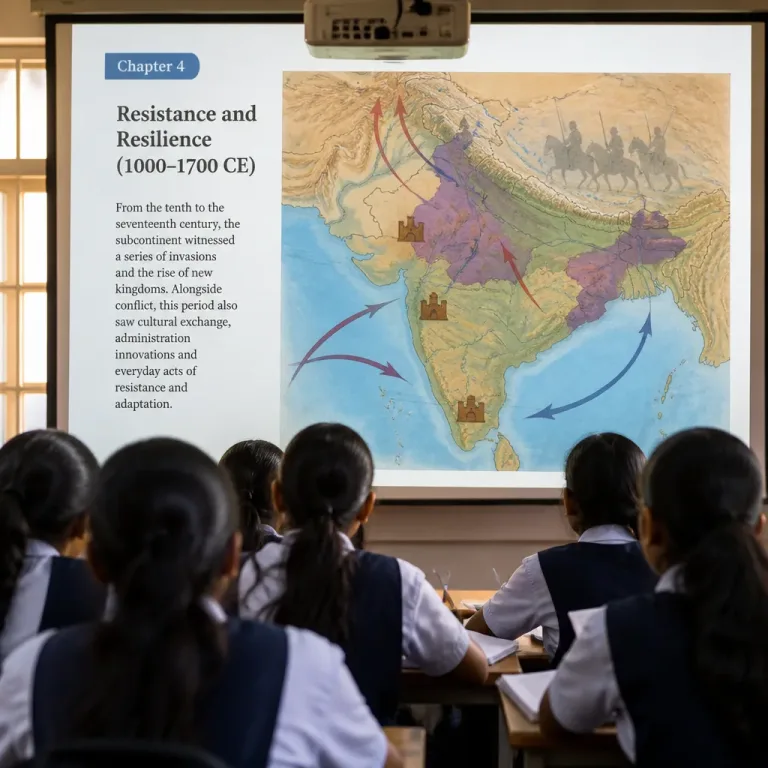

The National Council of Educational Research and Training (NCERT) has issued a revised Class 9 Social Science textbook that removes several chapters on European revolutions and instead foregrounds India’s medieval history, regional resistance movements and the impact of successive invasions, reported the original coverage on September 29, 2026.
Curriculum shift: what changes in focus
The new title, Understanding Society: India and Beyond — Part Two, replaces earlier chapters on the French and Russian revolutions with material that examines political sovereignty, resilience and regional dynamics in the subcontinent between c. 1,000 and 1,700 CE. NCERT’s revised text places particular emphasis on how external expansionist powers and religious motives shaped the region’s history across successive periods of contact and conflict.
The textbook frames one key driver of these incursions as the subcontinent’s economic attraction. It highlights that the surplus agrarian produce generated by fertile river plains contributed to sustained prosperity, which in turn made parts of India a target for foreign powers.
New emphasis on Mughal–Sikh relations and resistance
A chapter titled ‘Resistance and Resilience’ examines the dynamics between the Mughal state and the Sikh Gurus, characterising certain Mughal actions as particularly severe. The text cites specific incidents — the execution of Guru Arjan Dev, the detention of Guru Hargobind under Jahangir, and the execution of Guru Tegh Bahadur under Aurangzeb — and traces how these events contributed to the Sikh community’s movement towards organised armed resistance. It records institutional developments such as the establishment of the Akal Takht by Guru Hargobind and the later emergence of Sikh military confederacies.
“the brutality of the Mughal state” against the Gurus as having “few comparisons in history”
Alongside Sikh resistance, the revised textbook allocates space to regional kingdoms and localised struggles, signalling a move away from a Europe-centred narrative toward a more India-focused account of change, conflict and continuity through the medieval period.
Pedagogical and national implications
By substituting chapters on the French and Russian revolutions with expanded treatment of India’s medieval past and regional resistances, the NCERT edition recalibrates the balance of comparative history in Class 9. The change affects what students encounter in an early secondary-year Social Science course and will shape classroom discussions on state formation, religious dynamics, economic drivers and popular resistance.
Practical implications include revision of lesson plans, teacher preparation and assessment frameworks where textbooks are prescribed. Schools following NCERT textbooks will now have a different set of primary narratives and source materials for classroom work on socio-political transformations.
- Removed focus: Chapters on European revolutions (French and Russian).
- Added focus: India’s medieval political history (c. 1,000–1,700 CE), regional resistance movements, and the subcontinent’s encounters with expansionist powers.
- Case study emphasis: Mughal actions towards Sikh Gurus and the resulting militarisation and institutions such as the Akal Takht.
| Previous edition | Revised edition |
|---|---|
| European revolutions (French, Russian) | Medieval India, regional resistance, invasions (c. 1000–1700 CE) |
NCERT’s authoring and revision processes typically draw on curriculum frameworks and expert groups; the new text forms part of an ongoing series of releases and revisions across classes. The council’s announcement and the reporting did not include full chapter lists, pedagogical notes or the complete set of primary sources used in the new chapters, so teachers and schools will await the published book and any supplementary guidance to align classroom instruction.
The shift also has broader curricular resonance. How national textbooks select and frame historical episodes influences public understanding of the past, civic education and comparative perspectives offered to young learners. Altering emphasis from European revolutions to local and regional histories is a substantive editorial decision that will shape how a generation of students reads connections between economy, power and resistance in South Asian history.
The revised Class 9 Social Science title will now be available to schools and students adopting NCERT-prescribed materials; further details on chapter structure and classroom resources were not provided in the reporting.