A compact, low-cost particle detector that began as a student project has matured into a practical instrument for particle-physics research, education and high-altitude experiments, according to recent reporting from the University of Delaware and earlier accounts in Physics Today and Fermilab/SLAC’s Symmetry.
From a classroom build to field-ready detector
The detector, called CosmicWatch, was developed by physicist Spencer Axani and evolved from work he began while at MIT. The design has been refined through several iterations and is now used in high-altitude balloon missions and by groups involved in larger physics experiments, as reported by the University of Delaware.
CosmicWatch registers muons, short-lived subatomic particles produced when high-energy cosmic rays strike atoms in Earth’s atmosphere. Those collisions spawn cascades of secondary particles; some reach the ground and can pass through dense materials including rock and human bodies. Because muons travel near the speed of light they act as useful probes of atmospheric interactions, but they are invisible to the eye. The detector converts the tiny flashes of light created when a muon deposits energy into electronic signals that can be recorded and analysed.
Design, cost and capabilities
The device is notable for its simplicity and affordability. Key elements of the CosmicWatch design include a plastic scintillator coupled to a silicon photomultiplier, together with compact electronics that condition and record signals. The material cost of a unit is about $100, making it accessible to students and hobbyist groups outside large, well-funded laboratories.
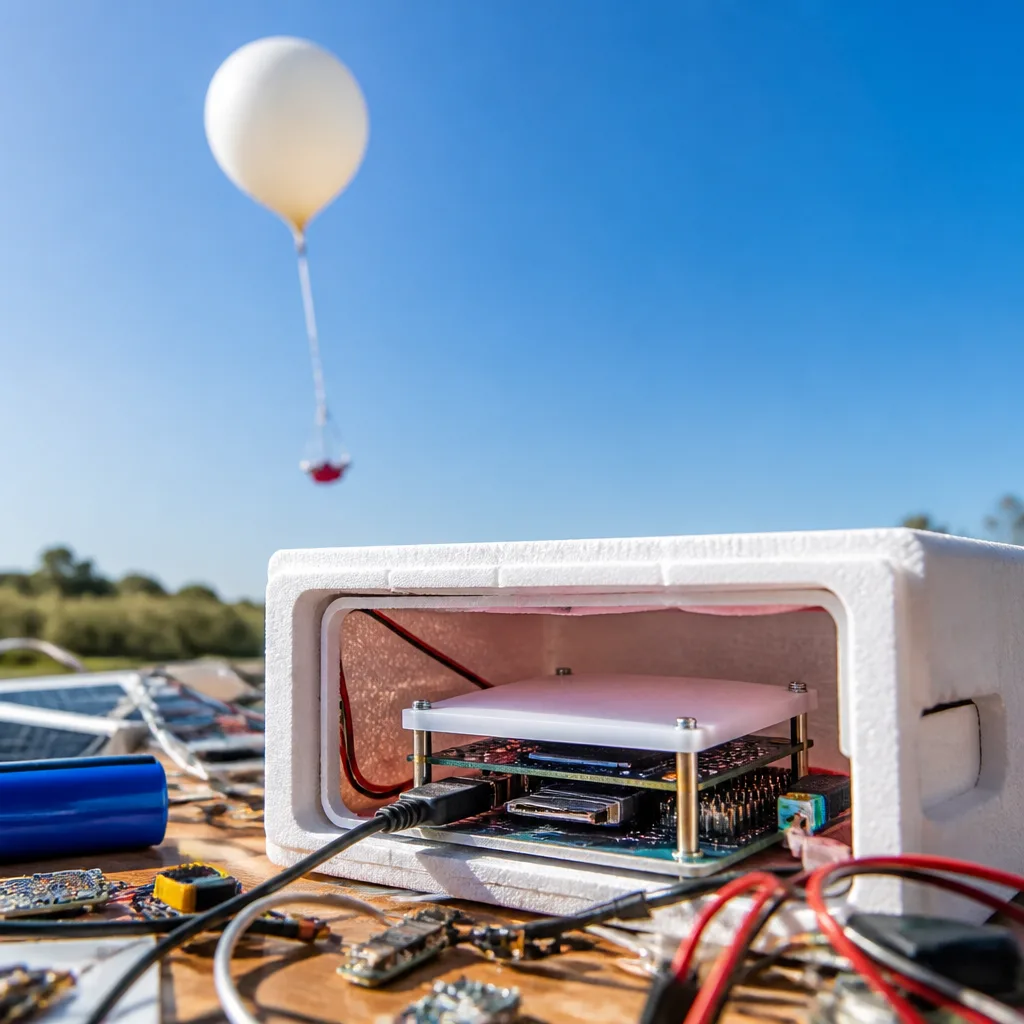
The latest public design, the v3X, can either store events on a microSD card or stream measurements via USB. In addition to particle counts, the device logs environmental variables such as temperature, pressure and acceleration, which aids experiments that relate muon flux to altitude or shielding.
| Feature | Detail |
|---|---|
| Typical cost | $100 in components |
| Primary detection | Muons from cosmic-ray air showers |
| Key hardware | Plastic scintillator + silicon photomultiplier |
| Data output | microSD card or USB; logs temperature, pressure, acceleration |
| Assembly time | First build for a novice: about four hours |
Why affordability matters
The affordability and portability of CosmicWatch contrast sharply with traditional particle detectors, which can be large and expensive. The original research paper describing the project presented the detector as a self-contained instrument that students could build and use themselves, enabling hands-on education in particle physics outside the confines of a major laboratory.
Because the system is small and low-cost, it is well suited for field experiments that probe how muon rates vary with altitude or are affected by material shielding. These capabilities have made it attractive for high-altitude balloon payloads and groups collaborating with larger experiments, expanding the range of institutions that can contribute particle data or run outreach projects.
- Accessible build process: a novice can assemble a first unit in about four hours.
- Data-rich output: event timestamps plus environmental telemetry allow correlated studies.
- Field-ready: small size and low cost make high-altitude and distributed deployments feasible.
Earlier coverage in Physics Today and Symmetry documented the project's evolution from Axani’s initial designs into the wider CosmicWatch programme. The University of Delaware's recent detailing of developments in September highlights continued refinement and adoption.
For Indian universities and colleges, the CosmicWatch approach presents an opportunity to broaden experimental training in particle physics at modest cost, while enabling student-led research that can contribute local measurements to larger efforts. As instrumentation becomes more affordable, the line between demonstration devices and capable research tools continues to blur — provided users attend to calibration, data quality and proper experimental controls when planning studies.
The CosmicWatch story underlines that useful scientific instruments need not always be large or costly to produce meaningful data, especially when designs are open, replicable and paired with clear documentation for education and research use.