New reptile record expands Rajasthan’s documented biodiversity
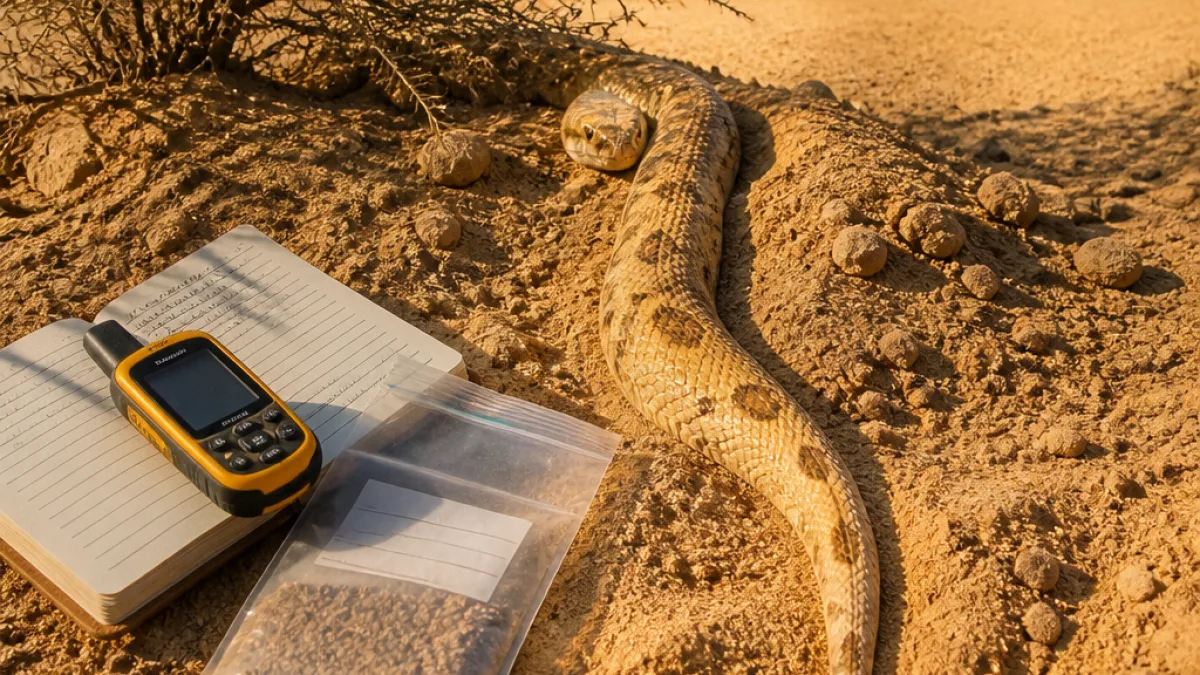
Jaipur — A snake species known as the Sistan sand boa (Eryx sistanensis) has been scientifically recorded from India for the first time after researchers located three individuals in Sikar district, Rajasthan. The record, based on field specimens collected during surveys in 2025, was reported in the Journal of Threatened Taxa on 26 May this year.
The Sistan sand boa is a non-venomous, stout-bodied snake associated with arid and semi-arid landscapes. Until recently it was known from neighbouring countries — primarily Iran and Pakistan — and its recognition in India extends the confirmed geographical range of the species westwards into the country’s arid north-west.
Where the snakes were found
Fieldwork in the Ramgarh–Shekhawati area of Sikar yielded three specimens during 2025. The individual records are dated as follows:
- 19 August 2025 — specimen located inside a gaushala (cow shelter)
- 12 September 2025 — specimen found in the courtyard of a house at Sunda Ki Dhani
- 21 September 2025 — specimen recorded near an under-construction house at Rukansar
Researchers Vivek Sharma (Jabalpur) and wildlife biologist Dharmendra Khandal (Tiger Watch, Ranthambhore) examined body shape, colouration and scale patterns before identifying the snakes as E. sistanensis. The paper emphasises careful morphological comparison rather than relying on photographs alone to confirm species identity.
“We knew that this snake was different, but we did not rush to publish a research paper. We first decided to understand and study it properly,”
Khandal said similar snakes had been noted in Rajasthan for years but photographic records from multiple localities were insufficient for formal confirmation. The team noted that comparable snakes had been reported from locations such as Churu in earlier years, and there are unconfirmed accounts from Bikaner, Hanumangarh and Jaisalmer.
How to distinguish Sistan sand boa from red sand boa
Field identification of sand boas in the region can be challenging because the Sistan sand boa resembles the familiar red sand boa. The study highlights a practical difference in tail morphology:
| Feature | Sistan sand boa (E. sistanensis) | Red sand boa |
|---|---|---|
| Tail profile | Gradually tapers to a pointed tip | Remains relatively thick for much of its length, narrowing only near the end |
Researchers caution that identification should be based on close morphological examination and, where possible, genetic analysis; photographs alone may not provide conclusive evidence.
Scientific and conservation implications
The published finding follows a taxonomic study from Iran in 2020 that separated the Sistan sand boa as a distinct species using morphological and genetic data. The Rajasthan records suggest that the species’ distribution crosses political boundaries and occupies arid landscapes on both sides of the India–Pakistan border.
For Rajasthan — a state with extensive semi-arid tracts and a long history of human–wildlife interactions — the record underscores the need for careful documentation of herpetofauna and for raising awareness among rural communities who frequently encounter snakes in villages, agricultural fields and construction sites.
- Research follow-up: The authors recommend targeted surveys in suspected localities and genetic sampling to map the species’ true range within India.
- Community guidance: Because the Sistan sand boa is non-venomous, avoid handling wild snakes; local forest departments should be informed for safe rescue or relocation.
While photographs of similar snakes have been circulating from at least 40 locations in Rajasthan, the authors emphasised that rigorous field study is necessary to establish distributional limits and conservation status within the state. The new record therefore opens avenues for further herpetological work across the Thar and adjoining sandy plains.
The identification of Eryx sistanensis in Sikar adds a fresh layer to Rajasthan’s natural history, joining its long catalogue of desert-adapted flora and fauna that continue to draw scientific attention to the region’s unique ecosystems.