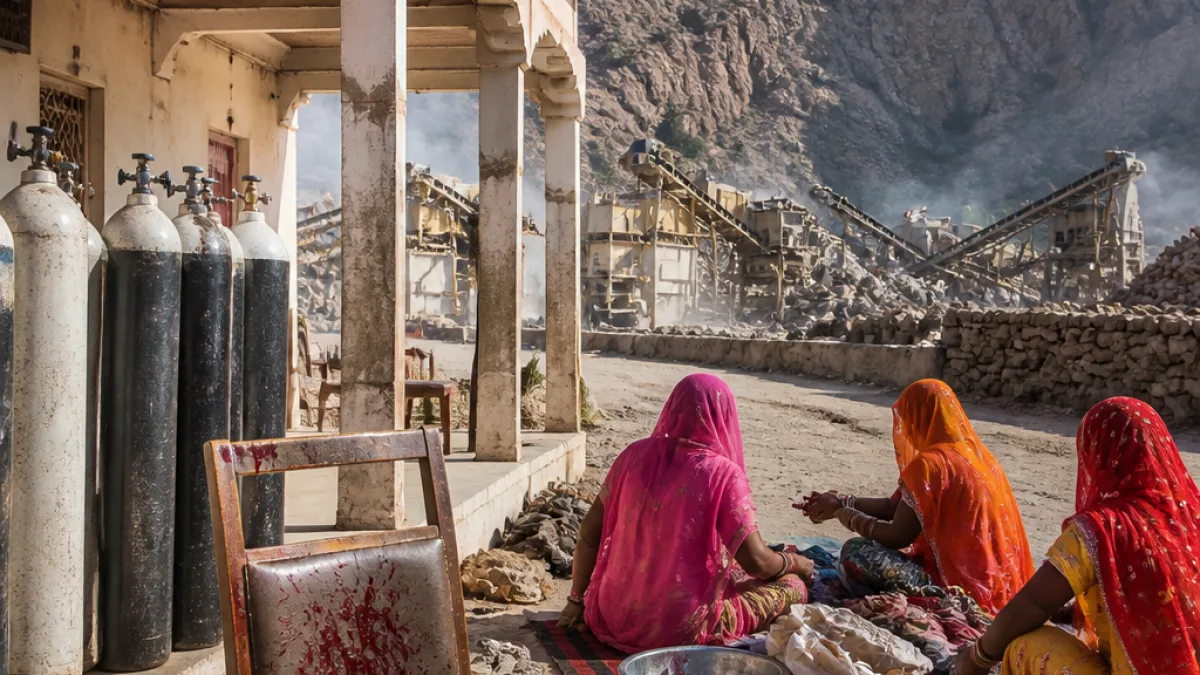
SYALODRA, SIKAR: In a small courtyard in Syalodra village, near the Aravalli foothills, oxygen cylinders line a veranda where grief and unfinished treatment plans linger. Manisha, 27, sits with women neighbours beside the cylinders that used to keep her 32-year-old husband, Manjeet, alive. He worked at a stone crushing unit and succumbed to silicosis, a crippling, incurable lung disease caused by inhaling silica dust.
Residents accuse panel of ignoring worst-hit pockets
Villagers and activists say silicosis has claimed more than 50 lives over the years in Syalodra, part of the Aravalli belt that stretches across Rajasthan. The deaths, they add, are directly linked to decades of unregulated mining activity — drilling, blasting and crushing stone — which disperses respirable silica particles into the air.
The issue has drawn judicial attention: a Supreme Court-appointed panel has been conducting an independent review of the Centre’s report on the definition and delineation of the Aravallis. The panel concluded field visits on 11 August, according to local accounts, and is required to submit a final report by 30 November. Activists say the team did not visit Syalodra or several other mining-affected pockets in Kotputli-Behror and Sikar districts during those inspections.
"We have spent most of our savings on my husband's treatment. Yet, no one from the administration has talked to us or come to help,"
The Supreme Court has refused petitioners' requests for a six-month extension to the panel's deadline, leaving communities with little hope that the final report will expand its mandate to address on-ground health crises, residents said.
Health impact and local economy
Silicosis is incurable and progressively debilitating. For families dependent on daily-wage employment at mining and allied units, the disease not only destroys the breadwinner’s health but also pushes households into debt. Manisha told visiting reporters that the family exhausted savings on treatment before Manjeet’s death.
Local activists stress that the problem is not limited to Syalodra. Kotputli-Behror and parts of Sikar have numerous small stone crushing units and open quarries operating close to habitations, where long-term exposure to high levels of silica-laden dust is common.
Medical diagnosis and compensation mechanisms remain limited in such areas. While some workers may receive sporadic treatment, comprehensive surveillance, workplace dust control and social protection for affected families are reportedly lacking.
What the panel can address
The Supreme Court-appointed committee is examining the Centre's delineation of the Aravallis — a technical exercise with broad ecological and regulatory consequences. Locals and activists hope the panel’s final recommendations, due at the end of November, will consider:
- Ecological boundaries that restrict mining close to habitations and ecologically sensitive hillsides.
- Stricter controls on stone crushing and quarrying operations, including dust mitigation measures and worker protection.
- Health surveillance and compensation frameworks for victims of occupational and environmental respiratory illnesses.
However, there is scepticism on the ground that the panel will take a sufficiently victim-centred approach, particularly after the refusal to extend the deadline, which activists say constrains field verification and stakeholder consultations.
Key dates and figures
| Item | Detail |
|---|---|
| Field visits by panel | Concluded on 11 August (local accounts) |
| Panel's final report due | 30 November |
| Reported silicosis deaths in Syalodra | More than 50 |
Voices from the field
Families in Syalodra describe repeated trips to urban hospitals, mounting medical bills and an absence of sustained engagement by local administration. Activists say many affected workers had been employed informally at crushing units without protective equipment or regular health check-ups.
Given the panel's narrow timeline and the scale of alleged health damage, campaigners want a follow-up mechanism to ensure implementation of any recommendations. Without robust mitigation and rehabilitation measures, villagers fear further loss of life and livelihood across the Aravalli fringe.
The pattern in Syalodra highlights a wider conundrum in Rajasthan's mineral belt: balancing economic activity with ecological limits and human health. For families such as Manisha’s, the cost has already been irretrievable.