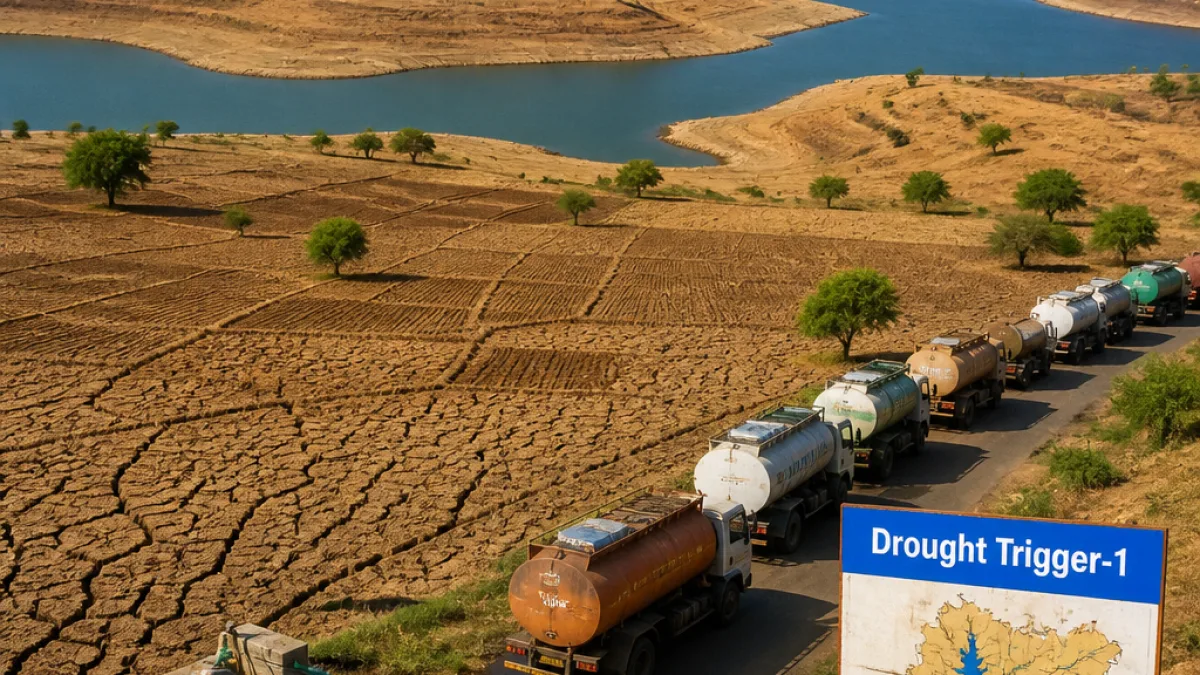
Nagpur, Maharashtra — The Water Resources Department (WRD) has reported a steep fall in water storage across five principal reservoirs serving Nagpur district, prompting the state to declare drought under Trigger-1 of the Drought Management Code for all 14 talukas in the district.
Reservoirs below last year’s levels
As of 28 September, combined storage in the five major dams — Totladoh, Navegaon Khairi, Khindsi, Wadgaon and Nand — stands at 884.97 million cubic metres (MCM), or 61.03% of their combined capacity of 1,449.99 MCM, WRD figures show. The same date last year saw near-full reservoirs.
- Totladoh — 562.81 MCM of 1,016.93 MCM capacity (55.34%), down from 99.92% a year earlier.
- Navegaon Khairi — 81.22%, down from 97.50% last year.
- Khindsi — 76.67%, down from 100% last year.
- Wadgaon — 60.76%, down from 100%.
- Nand — 86.33%, also below last year’s full storage.
The WRD attributed the drought declaration to a significant rainfall deficiency and extended dry spells that have reduced inflows into the reservoirs. The state government has declared 265 of its 358 talukas drought-affected, and Nagpur’s 14 talukas declared this week include Nagpur rural, Kamptee, Saoner, Parsheoni, Mouda, Bhiwapur, Kalmeshwar, Katol, Ramtek, Hingna, Umred, Kuhi, Narkhed and Nagpur city.
Implications for drinking water, industry and agriculture
WRD data on the three reservoirs central to Nagpur-city supply — Totladoh, Navegaon Khairi and Khindsi — indicated earlier assessed storage of 763.57 MCM. From this, the department estimated around 121 MCM would be lost to evaporation and 217 MCM would need to be reserved for drinking water for Nagpur and Bhandara districts and for industrial requirements.
That leaves approximately 436 MCM available for irrigation, compared with an estimated requirement of 550 MCM for the kharif season alone. Nearly 65,000 hectares of farmland in the district rely on irrigation, the WRD figures show.
"With storage in reservoirs depleting, balancing irrigation needs with drinking-water and industrial requirements will be a challenge for the administration," WRD figures indicate.
Local officials face the immediate task of prioritising allocations. If evaporation and drinking-water reservations are maintained, irrigation shortfall for the kharif season is likely. The shortfall could affect crop choices, sowing decisions and short-term income for farmers across talukas such as Kamptee and Katol, which have extensive irrigated acreage.
Operational pressures and next steps
Totladoh, a key component of the Pench system and the largest reservoir in the district, is the principal concern because of its size and the role it plays in supplying both urban consumers and irrigated agriculture. Lower levels at Totladoh reduce the margin to meet peak summer demand and irrigation lifts.
Officials from the WRD and district administration will need to coordinate water releases, rationing and alternative supply arrangements for urban centres, including Nagpur city. The drought declaration under Trigger-1 is expected to unlock state-level mitigation measures and relief planning, though the department’s release did not list specific relief steps for farmers or urban consumers.
Historically, drought declarations lead to measures such as restricted irrigation schedules, tanker deployments for critical drinking-water needs and support for affected farmers through crop insurance or relief packages. How these measures will be applied in Nagpur district will depend on evolving reservoir inflows and the monsoon’s remaining performance.
As Nagpur heads into the critical post-monsoon months, administrators in Hingna, Ramtek and other talukas will be watching reservoir telemetry closely to decide allocations that balance civic needs, industrial consumption and agricultural livelihood across the region.