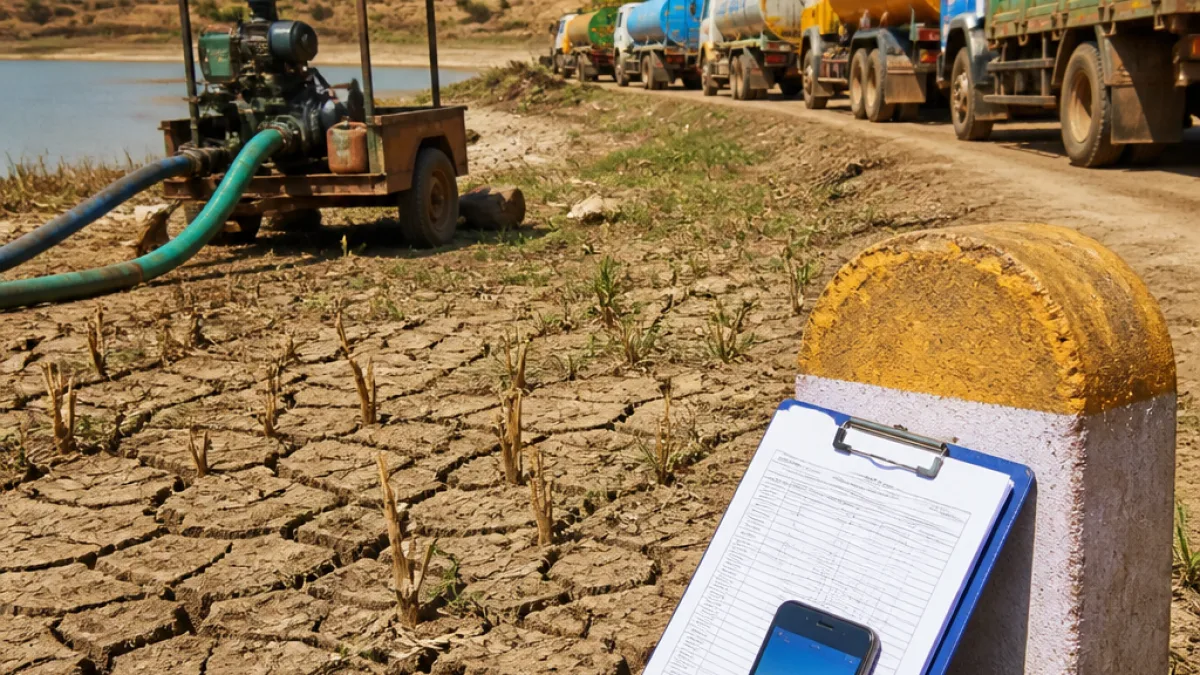
Mumbai, Maharashtra — The Maharashtra government on Saturday declared 265 of the state’s 358 talukas drought-affected, covering around 74% of the state, as a prolonged dry spell and deficient monsoon left large tracts short of rainfall, official orders showed.
Scale and geography of the declaration
The decision followed reports of below-normal rainfall across 32 districts. Most of the talukas listed as drought-affected are in Solapur, Ahilyanagar, Nashik, Latur, Beed, Buldhana, Amravati, Yavatmal, Nagpur and Chandrapur, the government communication said.
State officials noted the cumulative shortfall in the monsoon between June and September 18 at 18.8%, prompting the administration to trigger a set of relief and mitigation measures to protect farmers, livestock and drinking-water supplies.
Relief measures and administrative directions
The resolution issued by the state identifies immediate concessions and administrative steps in the drought-affected talukas. Key measures include:
- Restructuring of crop loans and deferment of recovery for agriculture-related loans;
- Concessions in land revenue for affected farmers;
- Subsidies/relief in electricity bills for agricultural pump sets and a directive to ensure uninterrupted power supply to pumps in water-scarce villages;
- Deployment of water tankers and arrangements for drinking water, foodgrains and fodder;
- Relaxation of norms under the Mahatma Gandhi National Rural Employment Guarantee Scheme (MNREGA) to facilitate supplemental livelihoods where agrarian incomes are hit;
- Waiver of examination fees for school and college students from drought-affected areas.
District collectors have been directed to complete a prescribed assessment of crop loss and submit detailed reports, including photographs and GPS coordinates, the order stated. A separate government resolution will be issued to finalise financial assistance for crop losses once these assessments are complete.
Administrative and on-ground implications
The directives place a clear burden on district administrations to carry out rapid, verifiable crop-loss assessments. The requirement for photographic evidence and GPS tagging indicates an emphasis on transparency and auditability when compensatory disbursals are formulated.
Ensuring uninterrupted power for pumps in water-scarce villages aims to protect sowing and irrigation for standing crops where groundwater or local water resources remain usable. At the same time, the deployment of water tankers and provision of fodder underline a twin focus on ensuring drinking water for communities and sustenance for livestock.
Timeline and next steps
The government resolution did not specify a timeline for completion of the district assessments or the disbursal of compensation. Officials will issue a separate order on financial assistance after the prescribed assessment procedure is completed, the communication said.
| Issue | Action ordered |
|---|---|
| Crop loans | Restructuring; deferment of recovery |
| Land revenue | Concessions in affected talukas |
| Power for irrigation | Concessions in bills; uninterrupted supply to pumps |
| Immediate relief | Water tankers; foodgrains; fodder |
| Assessment | District collectors to submit crop-loss reports with photos and GPS |
Local context and broader implications
Maharashtra has frequently faced agrarian distress in years of deficient rainfall, and the new declaration covers a large part of the state’s rural hinterland. Officials said measures such as loan relief and land-revenue concessions are designed to provide immediate breathing space for farmers; longer-term compensation hinges on the completion of loss verification.
The relief package also includes social measures aimed at reducing the burden on students in affected talukas and enabling rural employment through relaxed MNREGA norms. The state’s ability to rapidly implement tanker supply, fodder distribution and uninterrupted agricultural power will determine how effectively immediate distress is contained.
District administrations have been asked to begin assessments immediately and forward consolidated reports to the state revenue department so that the process for financial assistance can be initiated without delay, the government order said.
As Maharashtra moves into the post-monsoon period, the scale of the drought declaration underlines the need for sustained relief operations, better groundwater management and drought-resilient agricultural planning at the taluka level, officials and agricultural observers say.