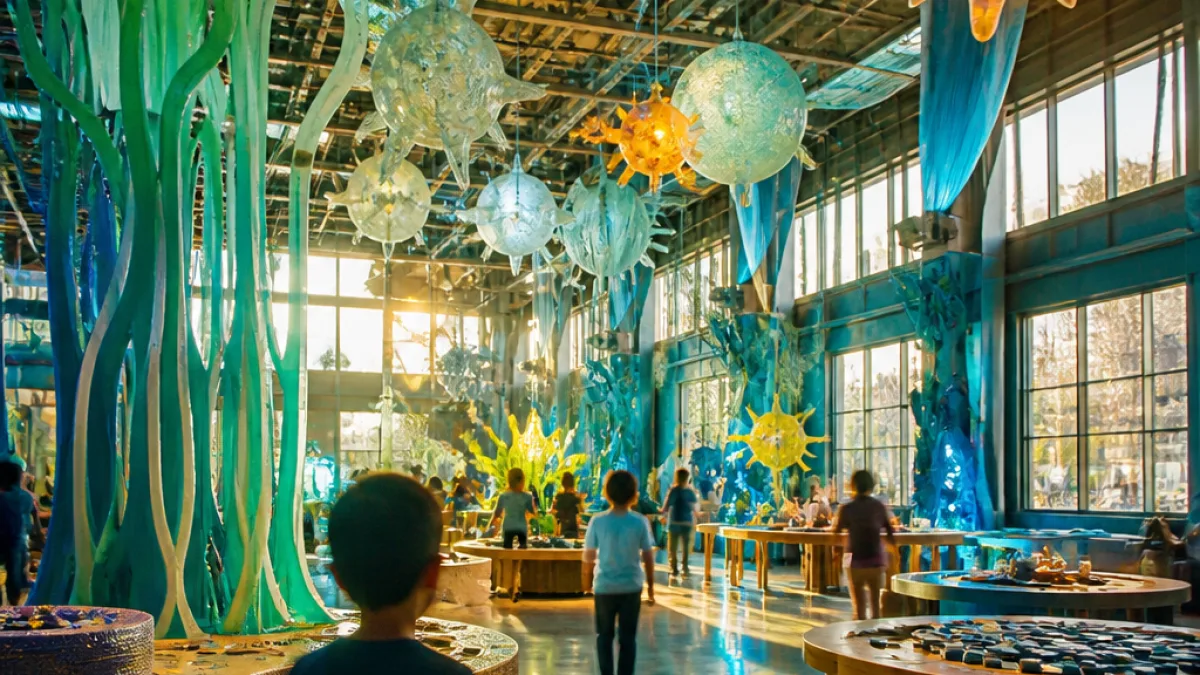
Urban space in Panaji adapted to host marine-ecology learning for children
The former GMC complex in Panaji has been converted into an immersive educational installation titled “Phytoplankton World: The Unseen Heroes of Marine Life”, organisers said on Monday. The project, created by Children’s Art Studio at the Museum of Goa with support from the Corporation of the City of Panaji (CCP) and the Entertainment Society of Goa (ESG), aims to introduce children to the ecological importance of microscopic marine organisms through art, storytelling and hands-on activities.
The installation transforms the existing urban complex into an imagined underwater environment featuring seaweed-like forms, tactile elements and enlarged luminous representations modelled on phytoplankton observed under a microscope. The design uses glow-in-the-dark artworks and sensory spaces to make otherwise invisible organisms visually and physically accessible to young visitors.
“Through an installation like Phytoplankton World, we want people to look closely at these tiny organisms and understand how fundamental they are to the food systems and ecological systems that sustain us,” said CCP mayor Rohit Monserrate.
Museum of Goa director Sharada Kerkar described the project as an attempt to build empathy for distant or microscopic ecosystems by rooting educational experiences in wonder. The production team’s approach, she said, is to enable children to connect with marine systems beyond their immediate surroundings through spatial design and storytelling.
What the installation offers and civic context
The exhibition presents a mix of visual, tactile and narrative elements intended for child audiences. According to the supplied report, visitors move through enlarged, luminous representations inspired by phytoplankton, accompanied by sensory setups and participatory activities. The space signals an alternative to conventional classroom or gallery settings by situating environmental learning within an adapted civic complex.
- Creators: Children’s Art Studio at the Museum of Goa.
- Support: Corporation of the City of Panaji (CCP) and Entertainment Society of Goa (ESG).
- Focus: Phytoplankton and their role in marine food webs and ecological systems.
The report supplied for this story does not specify key operational details such as the installation’s duration, visiting hours, visitor capacity or whether the complex will host additional programmes after this exhibition. Those details remain to be confirmed by the organisers.
Adaptive reuse and public programming
Local authorities and cultural organisers framed the project as an example of how existing urban assets can host public-facing cultural and educational programmes. By using the old GMC complex, the installation demonstrates one approach to activating civic infrastructure for community education and arts-based engagement.
Environmental education initiatives that foreground microscopic or lesser-known organisms are increasingly used to broaden public understanding of ecosystem interconnections. Phytoplankton, though not visible to the naked eye, are central to marine food chains and global biogeochemical cycles; the installation’s stated objective is to make that link more tangible for children.
| Stakeholder | Role |
|---|---|
| Children’s Art Studio (Museum of Goa) | Creator and producer of the installation |
| Corporation of the City of Panaji (CCP) | Support and site facilitation |
| Entertainment Society of Goa (ESG) | Support partner |
Organisers said the project uses art and sensory experience to foster curiosity and ecological awareness among children, but they have not released formal evaluation metrics or attendance targets. Civic planners and educators who follow such programmes typically assess outcomes over time through visitor feedback and partnering with schools, though no such plan was detailed in the supplied material.
Residents and families in Panaji seeking more information on visiting hours, ticketing (if any) or associated educational sessions should await an official schedule from the Museum of Goa, CCP or ESG. The installation highlights both an environmental-education aim and a practical instance of repurposing urban space for community-focused cultural programming.